Dwarf Grapevine VDG004
US20140366232P1
2014-12-11
13/999,595
2014-03-12
Abstract:
The invention is a new and distinct ornamental dwarf grapevine variety denominated ‘VDG004’. The new grapevine carries the REN1 gene for resistance to powdery mildew and is characterized by light green leaves, no visible hair on the young leaves, not having prominent lobes on mature leaf, having smooth leaf surface, having greenish internodes with distinctive anthocyanin accumulation on the nodes, and having small light purple berries.
Interested in similar patents?
Get notified when new applications in this technology area are published.
Classification:
A01H5/00 IPC
Products
A01H5/00 IPC
Angiosperms, i.e. flowering plants, characterised by their plant parts; Angiosperms characterised otherwise than by their botanic taxonomy
Description
LATIN NAME OF THE GENUS AND SPECIES OF THE PLANT CLAIMED
Vitis vinifera
VAREITY DENOMINATION
‘VDG004’
BACKGROUND OF THE INVENTION
The new and distinct dwarf ornamental grapevine described and claimed herein originated from a cross between ‘Pixie’™ and unknown Vitis vinifera male parent, the male parent having introgressed therein a REN1 gene for powdery mildew resistance originating from ‘Kishmish vatkana’.
The female parent ‘Pixie’™ is a natural dwarf ornamental grapevine (Vitis vinifera) derived from periclinal L1/L2 chimera ‘Pinot Meunier’ with dark purple berry skin. ‘Pixie’™ is the only known naturally dwarf grapevine in the public domain.
The pollen parent is an unknown Vitis vinifera line having a REN1 gene for powdery mildew resistance introgressed therein. The REN1 gene originates from ‘Kishmish vatkana’, an old Vitis vinifera variety from Uzbekistan with light purple berry skin. ‘Kishmish vatkana’ carries the REN1 gene for powdery mildew resistance.
The present variety of dwarf grapevine was first produced by controlled hybridization. The original cross was done at Vineland Research and Innovations Centre, Vineland Station, Ontario, Canada on Nov. 22, 2010.
‘VDG004’ was first successfully asexually propagated by single node softwood cuttings at the Vineland Research and Innovations Centre, Vineland Station, Ontario, Canada on Jun. 8, 2012. It is being maintained on its own roots in a container in a Canadian Food Inspection Agency certified greenhouse facility at Vineland Research and Innovation Centre, Vineland Station, Ontario, Canada.
SUMMARY OF THE INVENTION
The new grapevine ‘VDG004’ has the following major distinguishing characteristics. ‘VDG004’ carries the REN1 gene for resistance to powdery mildew and has light green leaves, has no visible hair on the young leaves, does not have prominent lobes on mature leaf, has smooth leaf surface, has greenish internodes with distinctive anthocyanin accumulation on the nodes, and has small light purple berries.
In contrast, the parent plant ‘Pixie’™ does not carry the REN1 gene for resistance to powdery mildew and has very dark green leaves, has dense prominent white hairy upper surface on the young leaves, has a 3 to 5 lobe leaf structure, has a prominent blistery texture of mature leaf, has green internodes and nodes, and has dark purple medium size berries.
The characteristics most useful in distinguishing ‘VDG004’ from ‘Pixie’™ are prostrate hairs on tip; young leaf: prostrate hairs between main veins on lower side of blade; mature leaf: blistering of upper side of blade; mature leaf: number of lobes; mature leaf: depth of upper lateral sinuses; bunch: density; berry size; berry: color of skin (without bloom); and berry: formation of seeds.
BRIEF DESCRIPTION OF THE DRAWING
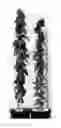
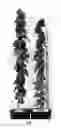
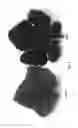
The accompanying photographic illustration illustrates in full color ‘VDG004’. The colors are as nearly true as reasonably possible in color representation of this type. Colors in the photographs may differ from the color values cited in the detailed botanical description below, which accurately describes the colors of the new dwarf grapevine.
FIG. 1 shows vigor and foliage color of ‘VDG004’, in comparison to the female parent ‘Pixie’™.
FIG. 2 shows upper side of mature leaf blades of ‘VDG004’, in comparison to the female parent ‘Pixie’™.
FIG. 3 shows a magnified view of upper side of mature leaf blade of ‘VDG004’, in comparison to the female parent ‘Pixie’™.
FIG. 4 shows lower side of mature leaf blade of ‘VDG004’, in comparison to the female parent ‘Pixie’™.
FIG. 5 shows upper side of young shoot of ‘VDG004’, in comparison to the female parent ‘Pixie’™.
FIG. 6 shows fruiting habit of ‘VDG004’.
FIG. 7 shows grape bunch size and density and berry color, size and shape of ‘VDG004’, in comparison to the female parent ‘Pixie’™.
DETAILED BOTANICAL DESCRIPTION OF THE INVENTION
‘VDG004’ is a dwarf ornamental grapevine with edible fruit. ‘VDG004’ has inherited the undetermined growth pattern and the dwarf growth habit from the mother variety (‘Pixie’™). The internodes are 10-15 mm in length (approximately 10-20 times shorter compared to standard Vitis vinifera cultivars).
The variety is uniform and stable. No off-types, variants or mutations have been found to date.
The R.H.S. Colour Chart of The Royal Horticultural Society has been used for colour identification of foliage, berry skin and shoot. The description is based on the observation of 10 plants growing in containers on their own roots in a greenhouse facility at Vineland Research and Innovation Centre, Vineland Station, Ontario, Canada during the year 2013.
- Time of bud burst: Not available as the plants were grown in a greenhouse.
- Young shoot:
-
- Openness of tip.—closed.
- Prostrate hairs on tip.—medium.
- Anthocyanin coloration on prostrate hairs on tip.—absent or very weak.
-
- Young leaf:
-
- Color of upper side of blade.—green (137-B).
- Prostrate hairs between main veins on lower side of blade.—absent or very sparse.
-
- Shoot:
-
- Color of dorsal side of internodes.—green.
- Color of ventral side of internodes.—green.
- Color of dorsal side of nodes.—green.
- Color of ventral side of nodes.—green and red (very little blush).
- Length of tendril.—very short (very scarce, very short, decline fast).
-
- Flower:
-
- Sexual organs.—fully developed stamens and fully developed gynoecium.
-
- Mature leaf:
-
- Size of blade.—small to very small.
- Shape of blade.—circular.
- Blistering of upper side of blade.—medium to weak.
- Number of lobes.—three.
- Depth of upper lateral sinuses.—absent or very shallow.
- Arrangement of lobes of upper lateral sinuses.—open.
- Arrangement of lobes of petiole sinus.—strongly overlapped.
- Length of teeth.—short.
- Ratio length/width of teeth.—small.
- Shape of teeth.—both sides convex.
- Proportion of main veins on upper side with anthocyanin coloration.—low to very low.
- Prostrate hairs between main veins on lower side of blade.—absent or very sparse.
- Erect hairs on main veins on lower side of blade.—absent or very sparse.
- Length of petiole compared to length of middle vein.—much shorter.
-
- Time of beginning of berry ripening: Not available as the plants were grown in a greenhouse.
- Bunch:
-
- Size (peduncle excluded).—very small.
- Density.—medium to lax.
- Length of peduncle of primary bunch.—medium to short.
-
- Berry:
-
- Size.—very small.
- Shape.—globose.
- Color of skin (without bloom).—dark red violet (N92-B).
- Ease of detachment from pedicel.—difficult.
- Thickness of skin.—thin.
- Anthocyanin coloration of flesh.—absent or very weak.
- Firmness of flesh.—soft or slightly firm.
- Particular flavor.—none.
- Formation of seeds.—none.
-
- Woody shoot:
-
- Main color.—orange brown (174-B).
-
- Genotypic analysis: Genotypic lab analysis confirmed the hybrid status of ‘VDG004’. It was confirmed that it carries the REN1 gene for resistance to powdery mildew, inherited from the male parent. Polymerase chain reaction (PCR) was performed on template DNA extracted from ‘VDG004’ using microsatellite marker primers that were polymorphic between ‘Pixie’™ and the male parent. The microsatellite markers confirmed that the new variety ‘VDG004’ is a hybrid of the parents. The REN1 gene was detected by PCR on template DNA extracted from VDG004 based on PCR primers described in Coleman C, et al. BMC Genetics. 2009, 10: 89.
Biometric data of ‘VDG004’ is compared to that of the mother variety (‘Pixie’™) in Table 1.
| TABLE 1 | ||
| Biometric data | ‘VDG004’ | ‘Pixie’ ™ |
| Average size of mature leaf blade, L × W, mm | 93 × 99 | 106 × 107 |
| Length of petiole/length of main vein, mm | 31/66 | 42/77 |
| Height of central stem, cm | 122 | 98 |
| Total linear growth per plant, cm | 122 | 150 |
| Total number of nodes per plant | 93 | 117 |
| Average internode size, mm | 13 | 13 |
| First bunch set at node number | 43 | 25 |
| Average peduncle length, mm | 31.4 | 40.5 |
| Average number of berries per bunch | 8.6 | 21.6 |
| Average bunch weight, g | 3.8 | 18.9 |
| Average berry weight, g | 0.4 | 0.9 |
| Average berry size, mm | 9.1 | 12.7 |
| Average number of seeds/berry | 0.0 | 2.7 |
| Sugar content, °Bx | 19.2 | 21.3 |
The ‘VDG004’ variety has not been observed under all possible environmental conditions to date. Accordingly, it is possible that the phenotypic expression may vary somewhat with changes in light intensity and duration, cultural practices, and other environmental conditions.
Claims
What is claimed:1. A new and distinct variety of dwarf ornamental grapevine substantially as herein illustrated and described.
Images & Drawings included:



Sources:
- United States Patent and Trademark Office - verify current appl. status at the USPTO↗
Recent applications in this class:
- » 20240292771 2024-08-29
Campanula plant named 'Twilight' - » 20240251691 2024-07-25
HYDRANGEA PLANT NAMED 'HYLV17520' - » 20240251690 2024-07-25
Vaccinium Plant Named 'BWPBLUE02' - » 20240251689 2024-07-25
BLUEBERRY PLANT NAMED 'FC13-113' - » 20240251688 2024-07-25
BLUEBERRY PLANT NAMED 'FCM14-057' - » 20240237567 2024-07-11
PONGAMIA VARIETIES - » 20240224827 2024-07-04
PELARGONIUM PLANT NAMED 'PEQZ0103' - » 20240215470 2024-06-27
Agapanthus plant named 'Monsapho' - » 20240215469 2024-06-27
plant named ‘LOCORA3519’ - » 20240206359 2024-06-20
CORYLUS PLANT NAMED 'BWM01'