Allergen Resistant Plush Toy
US20150290546A1
2015-10-15
14/248,805
2014-04-09
Abstract:
An allergen resistant plush toy including an allergen barrier fabric substrate covering, hypoallergenic stuffing and a plurality of seams that shape the covering into a figure. The plurality of seams is constructed using microneedles and synthetic thread and alternately the plurality of seams is bonded. The materials and the construction are configured to prevent or impede passage of an object having a diameter greater than 10 microns such as dust, dust mites, pet dander or other allergens through the fabric thereby reducing the risk of immune response to allergens normally found on plush toys
Interested in similar patents?
Get notified when new applications in this technology area are published.
Classification:
A63H3/02 » CPC main
Dolls made of fabrics or stuffed
A63H3/36 » CPC further
Dolls Details; Accessories
Description
CROSS-REFERENCE TO RELATED APPLICATIONS
Not Applicable
FEDERALLY SPONSORED RESEARCH OR DEVELOPMENT
Not Applicable
INCORPORATION BY REFERENCE OF MATERIAL SUBMITTED ON A COMPACT DISK
Not Applicable
BACKGROUND OF THE INVENTION
Various types of plush toys are known in the prior art. However, what is needed is an allergen resistant plush toy comprising an allergen barrier fabric covering wherein the allergen barrier fabric includes a tightly constructed fabric substrate. The fabric substrate is finished to a mean pore size of less than 10 microns, is air, heat and vapor permeable, is durable and soft in texture. This fabric substrate provides a barrier to prevent or impede passage of an object having a diameter greater than 10 microns, such as dust, dust mites, pet dander or other allergens through the fabric while being durable enough to withstand many washings. The allergen resistant plush toy is stuffed with a hypoallergenic stuffing and is sewn with a synthetic thread using a microneedle to minimize openings in the fabric. Alternately the seams are bonded to prevent dust mite and allergen penetration through the seams and to enhance durability. The materials and construction of the allergenic resistant plush toy are configured to reduce the risk of immune response to allergens normally found on plush toys.
FIELD OF THE INVENTION
The present invention relates to plush toys, and more particularly, to an allergen resistant plush toy comprising an allergen barrier fabric substrate covering, hypoallergenic stuffing and a plurality of seams. The plurality of seams is constructed using microneedles and synthetic thread and alternately the plurality of seams is bonded. The materials and the construction are configured to prevent or impede passage of dust, dust mites, pet dander or other allergens through the fabric thereby reducing the risk of immune response to allergens normally found on plush toys.
SUMMARY OF THE INVENTION
The general purpose of the present allergen resistant plush toy, described subsequently in greater detail, is to provide an allergen resistant plush toy which has many novel features that result in an allergen resistant plush toy which is not anticipated, rendered obvious, suggested, or even implied by prior art, either alone or in combination thereof.
To accomplish this, the present allergen resistant plush toy includes an allergenic barrier fabric covering formed in the shape of a figure, wherein the allergenic barrier fabric includes a tightly constructed allergen barrier fabric substrate finished to a mean pore size of less than 10 microns. The fabric substrate is also air, heat and vapor permeable, while also being durable and having a soft texture. The fabric substrate configured to provide a barrier to prevent or impede passage of an object having a diameter greater than 10 microns such as dust, dust mites, pet dander or other allergens therethrough. The allergen resistant plush toy also includes an interior cavity filled with a hypoallergenic stuffing, wherein the hypoallergenic stuffing comprises synthetic fibers, natural fibers or memory foam. The allergen resistant plush toy comprises a plurality of seams wherein the plurality of seams is constructed using synthetic thread and microneedles to minimize holes in the allergenic barrier substrate. Alternately, the plurality of seams is bonded to prevent passage of dust mites and allergens through the seams.
Thus has been broadly outlined the more important features of the present allergen resistant plush toy so that the detailed description thereof that follows may be better understood and in order that the present contribution to the art may be better appreciated.
BRIEF DESCRIPTION OF THE DRAWINGS
Figures
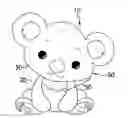
FIG. 1 is a front elevation view.
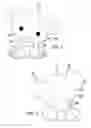
FIG. 2 is a rear elevation view.
FIG. 3 is a cross-sectional view taken along line 3-3 of FIG. 2.
FIG. 4 is an in-use view.
DETAILED DESCRIPTION OF THE DRAWINGS
With reference now to the drawings, and in particular FIGS. 1 through 4 thereof, an example of the instant allergen resistant plush toy employing the principles and concepts of the present allergen resistant plush toy and generally designated by the reference number 10 will be described.
Referring to FIGS. 1 through 4, the present allergen resistant plush toy 10 is illustrated. The allergen resistant plush toy 10 includes an allergenic barrier fabric covering 20 forming the shape of a FIG. 90, but not limited said shape. The allergenic barrier fabric covering 20 comprises a tightly constructed fabric substrate 30, which can be formed of a synthetic or a natural substance. The fabric substrate 30 has a mean pore size of less than 10 microns. The fabric substrate 30 is further air, heat, and vapor permeable, is durable, and has a soft texture. The fabric substrate 30 is configured to provide a barrier to prevent or impede passage of an object having a diameter greater than 10 microns, such as dust mites 45 and allergens 47 through the fabric substrate 30.
A continuous interior cavity 48 is disposed within the covering 20. A hypoallergenic stuffing 49 is contained within the interior cavity 48. The hypoallergenic stuffing comprises synthetic and, alternately natural, fibers, but can also be formed of viscoelastic foam.
A plurality of seams 50 are used to construct the shape of a FIG. 90, wherein the plurality of seams 50 are sewn using synthetic thread and microneedles and alternately are bonded to further prevent passage of dust mites and allergens through the allergenic barrier fabric covering 20.
Claims
What is claimed is:1. An allergen resistant plush toy comprising:
an allergenic barrier fabric covering forming the shape of a figure;
a continuous interior cavity disposed within the allergenic fabric covering;
a hypoallergenic stuffing disposed within the continuous interior cavity; and
a plurality of seams, wherein the seams are configured to collectively form the figure shape.
2. The allergen resistant plush toy of claim 1 wherein the allergenic barrier fabric covering comprises a tightly constructed synthetic fabric substrate and alternately a tightly constructed natural fabric substrate.
3. The allergen resistant plush toy of claim 2, wherein the fabric substrate is finished to a mean pore size of less than 10 microns;
wherein the fabric substrate is configured to provide a barrier to prevent the passage of an object having a diameter greater than 10 microns through the allergenic barrier fabric covering.
4. The allergen resistant plush toy of claim 3 wherein the fabric substrate is permeable to air, heat, and vapor.
5. The allergen resistant plush toy of claim 4 wherein the fabric substrate is durable and has a soft texture.
6. The allergen resistant plush toy of claim 1 wherein the hypoallergenic stuffing is comprised of synthetic fibers.
7. The allergen resistant plush toy of claim 1 wherein the hypoallergenic stuffing is comprised of natural fibers.
8. The allergen resistant plush toy of claim 1 wherein the hypoallergenic stuffing is comprised of viscoelastic foam.
9. The allergen resistant plush toy of claim 1 wherein the plurality of seams is comprised of synthetic thread stitching.
10. The allergen resistant plush toy of claim 1 wherein the plurality of seams is sewn using microneedles, wherein the microneedle sewn seams are configured to minimize holes within the fabric substrate.
11. The allergen resistant plus toy of claim 1 wherein the plurality of seams is bonded, wherein the bonded seams are configured to prevent penetration of allergens through the seams.
12. An allergen resistant plush toy comprising:
an allergenic barrier fabric covering forming the shape of a figure; wherein the hypoallergenic barrier fabric covering comprises a tightly constructed synthetic fabric substrate and alternately a tightly constructed hypoallergenic natural fabric substrate finished to a mean pore size of less than 10 microns;
wherein the fabric substrate is permeable to air, heat, and vapor;
wherein the fabric substrate is durable and has a soft texture;
wherein the allergenic barrier fabric covering is configured to provide a barrier to prevent passage of an object having a diameter greater than 10 microns through the allergenic barrier fabric covering;
a continuous interior cavity disposed within the allergenic fabric covering;
a hypoallergenic stuffing disposed within the interior cavity, wherein the hypoallergenic stuffing comprises one of synthetic fibers, natural fibers, and viscoelastic foam; and
a plurality of seams, wherein the seams are configured to collectively form the figure shape.
13. The allergen resistant plush toy of claim 12 wherein the plurality of seams comprise synthetic thread stitching formed by microneedles, wherein the microneedles minimize the number and size of holes in the hypoallergenic fabric substrate.
14. The allergen resistant plush toy of claim 12 wherein the plurality of seams is bonded, wherein the bonding of the seams is configured to prevent penetration of dust mites and a plurality of allergens through the seams.
Images & Drawings included:

Sources:
- United States Patent and Trademark Office - verify current appl. status at the USPTO↗
Recent applications in this class:
- » 20250114715 2025-04-10
Pixie Doll With Independent Posable Appendages And Embroidered Wings - » 20250058237 2025-02-20
Plush Toy - » 20250032944 2025-01-30
Plush Toy with removable and interchangeable covers - » 20240367064 2024-11-07
PLUSH TOY WITH LAYER OF MANUALLY REMOVABLE PLUSH - » 20240252938 2024-08-01
Plush Toy Device - » 20240238683 2024-07-18
REVERSIBLE TOY WITH COUPLING APPENDAGES - » 20240189726 2024-06-13
Stuffed Animal Assembly - » 20240033651 2024-02-01
PLUSH TOY WITH ATTACHED LENTICULAR PRINTED FILM - » 20240024790 2024-01-25
Plush Toy with Two Non-adjustable Accessory Bands Method of Use and Purpose - » 20230390655 2023-12-07
Plush toy with removable wig