Horizontal agitator for robotic vacuum
US20150320279A1
2015-11-12
14/698,695
2015-04-28
✅ Patent granted
US 9,877,626 B2
2018-01-30
-
-
Nina Bhat
2036-03-30
Abstract:
A horizontally vibrating brush for an automated robotic vacuum to agitate carpet fibers and like materials in a horizontal rather than vertical plane to loosen debris during vacuuming without causing debris to become more deeply embedded.
Assignee:
- BOBSWEEP INC. 10 🇨🇦 Toronto, Canada
- AI Incorporated 204 🇨🇦 Toronto, Canada
Applicant:
Interested in similar patents?
Get notified when new applications in this technology area are published.
Classification:
A47L9/0483 » CPC main
Details or accessories of suction cleaners, e.g. mechanical means for controlling the suction or for effecting pulsating action; Storing devices specially adapted to suction cleaners or parts thereof; Carrying-vehicles specially adapted for suction cleaners; Nozzles with driven brushes or agitators; Dust-loosening tools, e.g. agitators, brushes Reciprocating or oscillating tools, e.g. vibrators, agitators, beaters
A47L9/0411 » CPC further
Details or accessories of suction cleaners, e.g. mechanical means for controlling the suction or for effecting pulsating action; Storing devices specially adapted to suction cleaners or parts thereof; Carrying-vehicles specially adapted for suction cleaners; Nozzles with driven brushes or agitators; Driving means for the brushes or agitators driven by electric motor
A47L2201/00 » CPC further
Robotic cleaning machines, i.e. with automatic control of the travelling movement or the cleaning operation
A47L9/04 IPC
Details or accessories of suction cleaners, e.g. mechanical means for controlling the suction or for effecting pulsating action; Storing devices specially adapted to suction cleaners or parts thereof; Carrying-vehicles specially adapted for suction cleaners; Nozzles with driven brushes or agitators
B08B5/04 IPC
Cleaning by methods involving the use of air flow or gas flow Cleaning by suction, with or without auxiliary action
A47L9/0477 » CPC further
Details or accessories of suction cleaners, e.g. mechanical means for controlling the suction or for effecting pulsating action; Storing devices specially adapted to suction cleaners or parts thereof; Carrying-vehicles specially adapted for suction cleaners; Nozzles with driven brushes or agitators; Dust-loosening tools, e.g. agitators, brushes; Rotating tools Rolls
A47L11/00 IPC
Cleaning floors, carpets, furniture, walls, or wall coverings
A47L11/00 IPC
Machines for cleaning floors, carpets, furniture, walls, or wall coverings
A47L11/19 » CPC further
Machines for cleaning floors, carpets, furniture, walls, or wall coverings; Floor surfacing or polishing machines motor-driven with rotating tools the tools being roll brushes Parts or details of the brushing tools
Description
CROSS-REFERENCE TO RELATED APPLICATIONS
This application claims the benefit of provisional patent application Ser. No. 61/990,051, filed May 7, 2014 by the present inventor.
FIELD OF INVENTION
The present invention relates to automated robotic vacuums. More particularly, the present invention relates to the movement of a brush of an automated robotic vacuum.
BACKGROUND OF INVENTION
The following is a tabulation of some prior art that presently appears relevant:
| U.S. Patent Documents |
| Patent Number | Kind Code | Issue Date | Patentee |
| 2,558,496 | A | Jun. 26, 1951 | Gen Motors Corp |
| 3,813,726 | A | Jun. 4, 1974 | Cons Foods Corp |
| 7,657,967 | B2 | Feb. 9, 2010 | Lg Electronics Inc. |
| 6,148,475 | A | Nov. 21, 2000 | The Scott Fetzer Company |
Many efforts have been made to improve the effectiveness of robotic vacuum cleaners. Usually, automated robotic vacuum cleaners do not collect every debris particle in an area in a single pass. One method of dealing with this issue is having the robot cover all areas multiple times. This solution, however, requires expending more time and energy to get the job done. Additionally, this solution does not help retrieve stuck particles, but only cleans particles located freely on top of surfaces.
Other solutions involve using varied types of agitation systems to remove or loosen dirt particles from the flooring. Striking the work surface is one method of agitation, however this method can also cause some particles to become more deeply embedded in the material.
A need exists for a method for automated robotic vacuums to more thoroughly vacuum surfaces that does not lengthen the cleaning time or require significant extra energy.
SUMMARY OF THE INVENTION
It is a goal of the present invention to provide a method for an automated robotic vacuum to more thoroughly clean work surfaces without extending cleaning time or expending a significant amount of additional energy.
It is a goal of the present invention to provide a solution that does not cause debris particles to become further embedded in work surfaces.
The aforementioned goals are achieved through a horizontally vibrating brush in an automated robotic vacuum. Horizontal movements that agitate carpet or rug piles help loosen and free trapped debris without forcing the debris further downward. Horizontal movements could be added to the functionality of a robotic vacuum's main rotating brush, or could be added through a separate horizontally moving brush dedicated to that function. In systems with floor-sensing capabilities, the vibrating function can be automatically activated and deactivated as necessary based on the flooring type. The vibrating function could also be activated manually by a user. In one embodiment, a separate vibrating brush is retractable so that it can be applied when necessary and moved out of the way when not needed.
BRIEF DESCRIPTION OF THE DRAWINGS
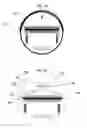
FIG. 1A shows an overhead view of the underside of an automated robotic vacuum provided with the provisioned system.
FIG. 1B shows the internal components of the provisioned vibrating brush.
FIG. 2 shows another embodiment of the invention.
DETAILED DESCRIPTION
The present invention provides a method for improving the cleaning efficiency of automated robotic vacuums on rugs and carpets.
FIG. 1A shows the underside of an automated robotic vacuum 100 equipped with the described system. The main brush 101 rotates to loosen and pick up debris from the floor. According to the present invention, a horizontal vibrating mechanism is added to the rotational movement of the main brush to improve the system's ability to loosen debris from fibers. FIG. 1B shows the vibrator assembly that is housed within the device 100. A vibrating electric motor 102 provides vibrations to an agitating spring 103, which connects to an agitating bar 104 through a mount 105. The agitating bar delivers the movements to the main brush 101 through rubber mounts 106. The main brush operates normally, rotating during operation, and the agitation assembly provides additional vibration functionality. Vibrations could be activated either manually when desired by the user or automatically as determined necessary by sensors. For example, a robot capable of sensing flooring types could activate the vibrations when working on carpet or rugs and deactivate the system when working on hard, non-fibrous surfaces to save energy.
In another embodiment depicted in FIG. 2, vibrations are delivered through a separate brush 207 alongside the main brush. The cleaning robot 200 has a rotating main brush 201 and an additional vibrating brush 207 that provides vibrations in a plane horizontal to the work surface. In some embodiments, the vibrating brush 207 is vertically fixed. In some embodiments, the vibrating brush is retractable so that it can be engaged when activated and retracted when deactivated. The vibrating brush uses the same mechanism as described previously to produce vibrations. A vibrating electric motor 202 provides vibrations to an agitating spring 203, which connects to an agitating bar 204 through a mount 205. The agitating bar delivers the movements to the vibrating brush 207 through rubber mounts 206.
Although specific features of the invention are shown in some drawings and not in others, this is for convenience only as each feature may be combined with any or all of the other features in accordance with the invention. The words “including”, “comprising”, “having”, and “with” as used herein are to be interpreted broadly and comprehensively and are not limited to any physical interconnection. Moreover, any embodiments disclosed in the subject application are not to be taken as the only possible embodiments.
Claims
We claim:1. A method for an automated robotic vacuum to agitate debris particles on surfaces under said automated robotic vacuum comprising a brush that vibrates in a plane horizontal to the plane of the surface on which said automated robotic vacuum is working, said vibrations powered by a vibrating electric motor that delivers vibrations to a spring connected to an agitating bar by a mount, said agitating bar delivering movements to said brush through rubber mounts.
2. The method of claim 1 in which said brush is a main brush of said automated robotic vacuum.
3. The method of claim 1 in which said brush is provided separately from a main brush of said automated robotic vacuum in a secondary brush.
4. The method of claim 1 in which the method further comprises a means to retract said brush such that, when retracted, said brush does not make contact with the surface on which said automated robotic vacuum is working.
5. The method of claim 4 in which the method further comprises a floor-detection system to detect the type of flooring on which said automated robotic vacuum is working, said brush being retracted when certain predetermined types of flooring are detected and engaged when certain other predetermined types of flooring are detected.
6. The method of claim 1 in which the bristles of said brush are arranged linearly.
7. A horizontally-vibrating agitator for an automated robotic vacuum comprising a member projecting from the bottom of the chassis of said automated robotic vacuum into the surface on which said automated robotic vacuum is working, said horizontal vibrations provided through a vibrating electric motor delivering vibrations to a spring connected to an agitating bar by a mount, said agitating bar delivering movements to said agitator through rubber mounts.
8. A horizontally-vibrating agitator for an automated robotic vacuum comprising a member projecting from the bottom of the chassis of said automated robotic vacuum into the surface on which said automated robotic vacuum is working and vibrating in a plane horizontal to the plane on which said automated robotic is working.
Images & Drawings included:


Sources:
- United States Patent and Trademark Office - verify current appl. status at the USPTO↗
Recent applications in this class:
- » 20220142428 2022-05-12
VACUUM CLEANER BRUSH HEAD AND DUST COLLECTION METHOD - » 20210212535 2021-07-15
FLOOR CLEANER - » 20210169288 2021-06-10
Dust collection guide structure, dust collection mechanism and sweeping robot - » 20210153705 2021-05-27
CLEANING DEVICE - » 20180192837 2018-07-12
Self-propelled cleaning device - » 20150135476 2015-05-21
Vacuum Cleaning Apparatus - » 20140373308 2014-12-25
Cleaning device with aerodynamic oscillator - » 20140250626 2014-09-11
VIBRATING MEMBER FOR A BRUSHLESS VACUUM CLEANER - » 20140182080 2014-07-03
Vacuum cleaner - » 20140123434 2014-05-08
Dual suction vacuum cleaner
Recent applications for this Assignee:
- » 20250278096 2025-09-04
STATIONARY SERVICE APPLIANCE FOR A POLY FUNCTIONAL ROAMING DEVICE - » 20250278088 2025-09-04
METHOD OF LIGHTWEIGHT SIMULTANEOUS LOCALIZATION AND MAPPING PERFORMED ON A REAL-TIME COMPUTING AND BATTERY OPERATED WHEELED DEVICE - » 20250271551 2025-08-28
Efficient Coverage Planning of Mobile Robotic Devices - » 20250264307 2025-08-21
A METHOD FOR A ROBOTIC DEVICE TO POLYMORPH, ADAPT, AND ACTUATE IN REAL TIME TO RESPOND TO A PERCEIVED STIMULI BASED ON A PROBABILISTIC PREDICTION OF AN OUTCOME GIVEN A CERTAIN RESPONSE - » 20250258596 2025-08-14
ROBOTIC FLOOR-CLEANING SYSTEM MANAGER - » 20250194873 2025-06-19
Mopping extension for a robotic vacuum - » 20250189972 2025-06-12
METHOD OF LIGHTWEIGHT SIMULTANEOUS LOCALIZATION AND MAPPING PERFORMED ON A REAL-TIME COMPUTING AND BATTERY OPERATED WHEELED DEVICE - » 20250172942 2025-05-29
OBSTACLE RECOGNITION METHOD FOR AUTONOMOUS ROBOTS - » 20250064287 2025-02-27
SIDE BRUSH WITH ELONGATED SOFT BRISTLES FOR ROBOTIC CLEANERS - » 20250036124 2025-01-30
System and Method for Establishing Virtual Boundaries for Robotic Devices