Aortic arch reconstruction device and method of using same
US20150351786A1
2015-12-10
14/731,360
2015-06-04
✅ Patent granted
US 9,707,006 B2
2017-07-18
-
-
Suzette J Gherbi
Bryan Cave LLP
2035-06-17
Abstract:
The present disclosure is directed to template devices and methods for using the same in aortic arch reconstruction.
Applicant:
Interested in similar patents?
Get notified when new applications in this technology area are published.
Classification:
A61B2017/320052 » CPC further
Surgical instruments, devices or methods, e.g. tourniquets; Surgical cutting instruments Guides for cutting instruments
A61B17/3205 » CPC main
Surgical instruments, devices or methods, e.g. tourniquets; Surgical cutting instruments Excision instruments
A61F2/24 IPC
Filters implantable into blood vessels; Prostheses, i.e. artificial substitutes or replacements for parts of the body; Appliances for connecting them with the body; Devices providing patency to, or preventing collapsing of, tubular structures of the body, e.g. stents; Prostheses implantable into the body Heart valves ; Vascular valves, e.g. venous valves; Heart implants, e.g. passive devices for improving the function of the native valve or the heart muscle; Transmyocardial revascularisation [TMR] devices; Valves implantable in the body
A61B2017/00778 » CPC further
Surgical instruments, devices or methods, e.g. tourniquets; Type of operation; Specification of treatment sites Operations on blood vessels
A61B2090/061 » CPC further
Instruments, implements or accessories specially adapted for surgery or diagnosis and not covered by any of the groups - , e.g. for luxation treatment or for protecting wound edges; Measuring instruments not otherwise provided for for measuring dimensions, e.g. length
A61B17/32 » CPC further
Surgical instruments, devices or methods, e.g. tourniquets Surgical cutting instruments
A61B17/00 IPC
Surgery
A61B17/00 IPC
Surgical instruments, devices or methods, e.g. tourniquets
A61B90/00 IPC
Instruments, implements or accessories specially adapted for surgery or diagnosis and not covered by any of the groups - , e.g. for luxation treatment or for protecting wound edges
A61B2090/0807 » CPC further
Instruments, implements or accessories specially adapted for surgery or diagnosis and not covered by any of the groups - , e.g. for luxation treatment or for protecting wound edges; Accessories or related features not otherwise provided for Indication means
Description
FIELD OF THE INVENTION
The present invention generally relates to template devices for aortic arch reconstruction and methods of using the same.
BACKGROUND OF THE INVENTION
In some neonates, infants, and children, surgical repair of the aortic arch is necessary to correct certain defects caused, for example, by hypoplastic left heart syndrome, interrupted aortic arch, hypoplastic aortic arch and complex aortic coarctation.
The congenital heart defect known as hypoplastic left heart syndrome, for example, leads to hypoplastic development of the aortic arch (that is, aortic arch hypoplasia). Neonates having this syndrome are palliated with an operation known as the Norwood procedure in which arch reconstruction is an essential component. (1,2). Among the limitations of arch reconstruction is that if the patch is not shaped appropriately, then there can be stenosis (narrowing) in the aortic arch which can lead to obstruction of the flow of blood to the body. (3-5). Furthermore, this narrowing can place a tremendous strain on the right ventricle which can lead to significant dysfunction and eventually heart failure and shock if left untreated. Treatment of recurrent narrowing of the reconstructed arch requires either a catheter based balloon dilatation or another open heart operation to repair the narrowed sight (6-12).
SUMMARY OF THE INVENTION
Among the various aspects of the present invention is the provision of template devices for aortic arch reconstruction and methods of using the same.
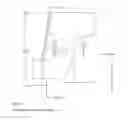
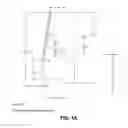
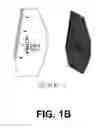
Briefly, therefore, the present invention is directed to a template device for use in aortic arch reconstruction, having the shape and dimensions as the template depicted in FIGS. 1A and 1B.
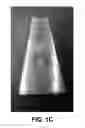
Another aspect of the invention is directed to a template device for use in aortic arch reconstruction, having the shape and dimensions as the template depicted in FIG. 1C.
Yet another aspect of the invention is directed to a method for the reconstruction of hypoplasia of the aortic arc, the method comprising shaping a patch using a template device described herein.
Other objects and features will be in part apparent and in part pointed out hereinafter.
BRIEF DESCRIPTION OF THE DRAWINGS
The above mentioned and other features of the present invention and the manner of obtaining them will become more apparent and the invention will be best understood by reference to the following description of embodiments of the invention taken in conjunction with the accompanying drawings, in which like numerals refer to like parts, and in which:
FIGS. 1A, 1B, and 1C depict template devices in accordance with embodiments of the present disclosure.
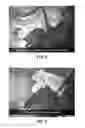
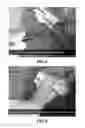
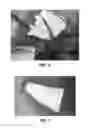
FIGS. 2-7 are photographs of steps performed in connection with a method for shaping patches for the reconstruction of hypoplasia of the aortic arch using an embodiment of the template device described herein.
DETAILED DESCRIPTION
The accompanying Figures and this description depict and describe embodiments of a template and method for using same in accordance with the present invention, and features and components thereof. It should also be noted that any references herein to front and back, right and left, top and bottom and upper and lower are intended for convenience of description, not to limit the present invention or its components to any one positional or spatial orientation.
Template Device
One aspect of the present invention is directed to a template device having a geometry as shown and described.
In accordance with one embodiment, the template device has the shape and dimensions as depicted in FIGS. 1A and 1B. In one particular embodiment, the generally heptagonal-shaped template device has the following dimensions: 15 mm (proximal end)×[20 mm×15 mm×15 mm (greater curvature)]×[35 mm×15 mm (lesser curvature)]×10 mm (distal end).
In accordance with another embodiment, the template device has the shape and dimensions as depicted in FIG. 1C. In one particular embodiment, the generally quadrilateral-shaped template device has the following dimensions: 30 mm (proximal end)×50 mm (greater curvature)×50 mm (lesser curvature)×10 mm (distal end).
In either of the preceding embodiments (i.e., FIGS. 1A/1B or 1C), the aforementioned dimensions of the template device may be increased, for instance, so that the device may be used in infants or older children. For example, in some embodiments, the aforementioned dimensions for the template device of FIGS. 1A/1B may be at least 1% greater, at least 2.5% greater, at least 5% greater, at least 10% greater, at least 15% greater, at least 20% greater, at least 25% greater, at least 30% greater, at least 35% greater, at least 40% greater, at least 45% greater, or at least 50% greater, in one or more directions. Similarly, for example, in some embodiments, the aforementioned dimensions for the template device of FIG. 1C may be at least 1% greater, at least 2.5% greater, at least 5% greater, at least 10% greater, at least 15% greater, at least 20% greater, at least 25% greater, at least 30% greater, at least 35% greater, at least 40% greater, at least 45% greater, or at least 50% greater, in one or more directions.
The template device is construction from any durable material capable of withstanding high temperatures during sterilization of the device prior to use. In this regard, plastics may be less preferred, while metals are more preferred. In one preferred embodiment, the template device is constructed from is stainless steel. In general, the template device is intended to be re-used multiple times for multiple procedures. It will be understood, however, that disposable embodiments of the template device are contemplated.
As depicted in FIGS. 1A, 1B, and 1C, the template device may in some embodiments include ruler markings and numbers. Other indicia may also optionally be provided.
Methods of Using the Template Device
In accordance with one aspect of the present disclosure, the device described herein may be employed in a method for shaping patches for the reconstruction of hypoplasia of the aortic arch, particularly (but not necessarily exclusively) for neonates and infants.
The method generally involves using the template device to shape the patch that will be used to reconstruct the aortic arch. Typically, pulmonary homograft tissue is used for the patch. First, the patch is thawed and the attached muscular tissue and leaflets are transected. See FIGS. 2 and 3. The pulmonary homograft tissue is then “filleted” opened, by incising along the right lateral wall of the main pulmonary artery and transecting the right branch pulmonary artery. An incision from the orifice of the right pulmonary artery proximally opens up the patch. See FIG. 4. The template device is used to mark the patch of pulmonary homograft (e.g., using a sterile pen). See FIG. 5. The patch of pulmonary homograft tissue is then cut along the boundaries outlined by the template. See FIGS. 6 and 7. This tailored patch is now ready for use to reconstruct the aortic arch in accordance with conventional techniques.
In accordance with another aspect of the present disclosure, the device described herein may be employed as a measuring tool in a method for performing congenital heart surgery. By way of example, in congenital heart surgery there is a need for measuring a variety of patches used, for instance, to repair defects such as atrial and ventricular septal defects, or to measure patches to reconstruct other vessels than the aortic arch, e.g., pulmonary arteries.
REFERENCES
- 1. Norwood, W I; Lang, P; Casteneda, A R; Campbell, D N. Experience with operations for hypoplastic left heart syndrome. J Thorac and Cardiovasc Surg. 1981; 82 (4): 511-9
- 2. Norwood, William I.; Lang, Peter; Hansen, Dolly D. (6 Jan. 1983). “Physiologic Repair of Aortic Atresia-Hypoplastic Left Heart Syndrome”. New England Journal of Medicine 308 (1): 23-26
- 3. Ashcraft T M, Jones K, Border W L, Eghtesady P, Pearl J, Khoury P R, Manning P B. Factors affecting long-term risk of aortic arch recoarctation after the Norwood procedure. Ann Thorac Surq 2008 April; 85(4):1397-401.
- 4. Zeltser I, Menteer J, Gaynor W, Spray T L, Clark B J, Kreutzer J, Rome J J. Impact of re-coarctation following the Norwood operation on survival in the balloon angioplasty era. J Am Coll Cardiol. 2005; 45(11):1844-1848.
- 5. Cleuziou J, Kasnar-Samprec J, Hörer J, Eicken A, Lange R, Schreiber C. Recoarctation after the Norwood I Procedure for Hypoplastic Left Heart Syndrome: Incidence, Risk Factors, and Treatment Options. Ann Thorac Surg 2013; 95:935-940
- 6. Hornik C P, He X, Jacobs J P, et al. Complications after the Norwood Operation: an analysis of the Society of Thoracic Surgeons Congenital Heart Surgery database. Ann Thorac Surg 2011; 92:1734-41.
- 7. Burkhart H M, Ashburn D A, Konstantinov I E, et al. Interdigitating arch reconstruction eliminates recurrent coarctation after the Norwood procedure. J Thorac Cardiovasc Surg 2005; 130:61-5.
- 8. Ishino K, Stümper O, De Giovanni J J, et al. The modified Norwood procedure for hypoplastic left heart syndrome: early to intermediate results of 120 patients with particular reference to aortic arch repair. J Thorac Card iovasc Surg 1999; 117:1920-30.
- 9. Lamers L J, Frommelt P C, Mussatto K A, Jaquiss R D B, Mitchell M E, Tweddell J S. Coarctectomy combined with an interdigitating arch reconstruction results in a lower incidence of recurrent arch obstruction after the Norwood procedure than coarctectomy alone. J Thorac Cardiovasc Surg 2012; 143:1098-102.
- 10. Larrazabal L A, Selamet Tierney E S, Brown D W, et al. Ventricular function deteriorates with recurrent coarctation in hypoplastic left heart syndrome. Ann Thorac Surg 2008;86: 869-74.
- 11. Porras D, Brown D W, Marshall A C, Del Nido P, Bacha E A, McElhinney DB. Factors associated with subsequent arch reintervention after initial balloon aortoplasty in patients with Norwood procedure and arch obstruction. J Am Coll Cardiol 2011; 58:868-76.
- 12. Mahle W. T., Spray T. L., Wernovsky G., Gaynor J. W., Clark B. J. Survival after reconstructive surgery for hypoplastic left heart syndrome: a 15-year experience from a single institution. Circulation 2000; 102 (Suppl. 3):111136-141.
Having described the invention in detail, it will be apparent that modifications and variations are possible without departing the scope of the invention defined in the appended claims. Furthermore, it should be appreciated that all examples in the present disclosure are provided as non-limiting examples.
Claims
1. A template device for use in aortic arch reconstruction, wherein the template device is a generally heptagonal-shaped template having the following dimensions: 15 mm (proximal end)×[20 mm×15 mm×15 mm (greater curvature)]×[35 mm×15 mm (lesser curvature)]×10 mm (distal end).
2. A template device for use in aortic arch reconstruction, wherein the template device is a generally quadrilateral-shaped template having the following dimensions: 30 mm (proximal end)×50 mm (greater curvature)×50 mm (lesser curvature)×10 mm (distal end).
3-4. (canceled)
5. The template device of claim 1, wherein the dimensions of the template device are at least 1% greater, at least 2.5% greater, at least 5% greater, at least 10% greater, at least 15% greater, at least 20% greater, at least 25% greater, at least 30% greater, at least 35% greater, at least 40% greater, at least 45% greater, or at least 50% greater, in one or more directions.
6. The template device of claim 1 wherein the template device comprises stainless steel.
7. The template device of claim 1, wherein the template device includes ruler markings and numbers.
8. A method for the reconstruction of hypoplasia of the aortic arc, the method comprising shaping a patch using the template device of claim 1.
9. The template device of claim 2, wherein the dimensions of the template device are at least 1% greater, at least 2.5% greater, at least 5% greater, at least 10% greater, at least 15% greater, at least 20% greater, at least 25% greater, at least 30% greater, at least 35% greater, at least 40% greater, at least 45% greater, or at least 50% greater, in one or more directions.
10. The template device of claim 2, wherein the template device comprises stainless steel.
11. The template device of claim 2, wherein the template device includes ruler markings and numbers.
12. A method for the reconstruction of hypoplasia of the aortic arc, the method comprising shaping a patch using the template device of claim 2.
Images & Drawings included:
Sources:
- United States Patent and Trademark Office - verify current appl. status at the USPTO↗
Recent applications in this class:
- » 20250160876 2025-05-22
COLLAPSIBLE HANDLE DESIGN FOR DEBRIDERS - » 20250127537 2025-04-24
METHODS AND DEVICES FOR PUNCTURING TISSUE - » 20250049465 2025-02-13
SYSTEM AND METHOD FOR HARVESTING A TENDON - » 20240285304 2024-08-29
TISSUE EXTRACTION DEVICES AND RELATED METHODS - » 20240285303 2024-08-29
SURGICAL CUTTING DEVICE FOR OTOLOGY AND METHOD OF OPERATING THE SAME - » 20240252196 2024-08-01
Unitary Endoscopic Vessel Harvesting Devices - » 20240245424 2024-07-25
JOINT ASSEMBLY FOR VASCULATURE OBSTRUCTION CAPTURE DEVICE - » 20240180583 2024-06-06
EXCISION CATHETER SYSTEM FOR AN AORTIC VALVE - » 20240156487 2024-05-16
MEDICANT DELIVERY DEVICE - » 20240148403 2024-05-09
ELECTRIC SPIRAL KNIFE FOR ELIMINATING NECK HUMPS