Copolymer for a hydrophobic coating having an improved durability
US20160159952A1
2016-06-09
14/903,436
2014-07-03
✅ Patent granted
US 9,714,308 B2
2017-07-25
WO; PCT/FR2014/051702; 20140703
WO; WO2015/004368; 20150115
Ramsey Zacharia
Pillsbury Winthrop Shaw Pittman LLP
2034-07-03
Abstract:
A copolymer includes a first group that is hydrophobic and a second group that is crosslinkable. Moreover, a glass substrate includes a coating of the copolymer, with interposition of a layer of silane including a functional group capable of reacting with the crosslinkable group. The glass substrate may be used as hydrophobic glazing for a transport vehicle, shower cubicle wall or easy-to-clean interior glazing.
Assignee:
- SAINT-GOBAIN GLASS FRANCE 1,340 🇫🇷 Courbevoie, France
- SPECIFIC POLYMERS 2 🇫🇷 Castries, France
Applicant:
Interested in similar patents?
Get notified when new applications in this technology area are published.
Classification:
C09D133/12 » CPC further
Coating compositions based on homopolymers or copolymers of compounds having one or more unsaturated aliphatic radicals, each having only one carbon-to-carbon double bond, and at least one being terminated by only one carboxyl radical, or of salts, anhydrides, esters, amides, imides, or nitriles thereof; Coating compositions based on derivatives of such polymers; Homopolymers or copolymers of esters of esters containing only carbon, hydrogen and oxygen, the oxygen atom being present only as part of the carboxyl radical; Homopolymers or copolymers of methacrylic acid esters Homopolymers or copolymers of methyl methacrylate
C03C17/34 IPC
Surface treatment of glass, not in the form of fibres or filaments, by coating with at least two coatings having different compositions
C03C17/3405 » CPC further
Surface treatment of glass, not in the form of fibres or filaments, by coating with at least two coatings having different compositions with at least two coatings of organic materials
C08K9/06 » CPC further
Use of pretreated ingredients; Ingredients treated with organic substances with silicon-containing compounds
C09D5/00 » CPC further
Coating compositions, e.g. paints, varnishes or lacquers, characterised by their physical nature or the effects produced ; Filling pastes
C03C17/32 » CPC further
Surface treatment of glass, not in the form of fibres or filaments, by coating with organic material with synthetic or natural resins
C08F220/18 » CPC main
Copolymers of compounds having one or more unsaturated aliphatic radicals, each having only one carbon-to-carbon double bond, and only one being terminated by only one carboxyl radical or a salt, anhydride ester, amide, imide or nitrile thereof; Monocarboxylic acids having less than ten carbon atoms; Derivatives thereof; Esters of monohydric alcohols or phenols of phenols or of alcohols containing two or more carbon atoms with acrylic or methacrylic acids
C03C2217/76 » CPC further
Coatings on glass; Properties of coatings Hydrophobic and oleophobic coatings
C08F220/22 IPC
Copolymers of compounds having one or more unsaturated aliphatic radicals, each having only one carbon-to-carbon double bond, and only one being terminated by only one carboxyl radical or a salt, anhydride ester, amide, imide or nitrile thereof; Monocarboxylic acids having less than ten carbon atoms; Derivatives thereof; Esters Esters containing halogen
C03C17/30 » CPC further
Surface treatment of glass, not in the form of fibres or filaments, by coating with organic material with silicon-containing compounds
C08F220/38 » CPC further
Copolymers of compounds having one or more unsaturated aliphatic radicals, each having only one carbon-to-carbon double bond, and only one being terminated by only one carboxyl radical or a salt, anhydride ester, amide, imide or nitrile thereof; Monocarboxylic acids having less than ten carbon atoms; Derivatives thereof; Esters Esters containing sulfur
C08F220/14 » CPC further
Copolymers of compounds having one or more unsaturated aliphatic radicals, each having only one carbon-to-carbon double bond, and only one being terminated by only one carboxyl radical or a salt, anhydride ester, amide, imide or nitrile thereof; Monocarboxylic acids having less than ten carbon atoms; Derivatives thereof; Esters of monohydric alcohols or phenols Methyl esters, e.g. methyl (meth)acrylate
C08F220/24 » CPC further
Copolymers of compounds having one or more unsaturated aliphatic radicals, each having only one carbon-to-carbon double bond, and only one being terminated by only one carboxyl radical or a salt, anhydride ester, amide, imide or nitrile thereof; Monocarboxylic acids having less than ten carbon atoms; Derivatives thereof; Esters; Esters containing halogen containing perhaloalkyl radicals
Description
The present invention relates to the preparation of a hydrophobic coating on glass using a polymer layer, the composition of which is adjusted in order to obtain a good durability: hydrolytic, UV or mechanical. This coating can be applied to a motor vehicle glazing on the face exposed to the outside in order to improve the visibility during rain and to thus improve safety.
Saint-Gobain Sekurit currently produces motor vehicle side windows coated with a hydrophobic treatment under the Aquacontrol® registered brand. This coating is applied by the liquid route in the form of a two-layer system: a silica-based underlayer, in order to improve the durability, and a hydrophobic layer. The hydrophobic layer is a molecular monolayer of a fluorosilane, namely 1H, 1H,2H, 2H-perfluorodecylsilane.
A first route for improvement had the objective of developing a coating of the same type which can be applied on a windshield. The main problem in this case was to improve the mechanical and hydrolytic durability so as to be able to withstand the additional stresses on a windshield in comparison with the side windows.
A hydrophobic treatment based on a molecular layer of fluorosilane exhibits two major disadvantages which cause problems of durability:
-
- the molecules are bonded to the surface of the glass via an Si—O—Si bond. This type of bond exhibits the disadvantage of being hydrolyzable in a saline or basic medium. This frequently happens on a windshield on which water drops may stagnate;
- the treatment is based on just one layer of molecule (monomolecular layer); it is easily understood that, during aging, if a molecule were to become uncoupled from the surface, the site released is no longer functional; thus, any minor deterioration in the surface (scratch, hydrolysis, and the like) brings about a complete loss in functionality at the defect.
The invention intends to address in a different way the problem of the hydrophobic coating by developing a polymer material which contributes this hydrophobic functionality. Its molecular architecture is adjusted in order to obtain optimum properties in terms of hydrophobic functionality, of ease of processing, of hydrolytic durability, of stability under UV irradiation and finally of mechanical stability.
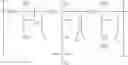
To this end, a subject matter of the invention is a copolymer of formula (I):
in which:
the R1 group is hydrophobic,
the R2 group is crosslinkable,
x, z and t>0 and y≧0 and x+y+z+t=1,
n is an integer.
The backbone of the polymer according to the invention is composed of four types of units resulting from four types of monomers:
-
- a polymethyl methacrylate (PMMA) base, the molar fraction of which is x;
- methacrylate components with a fluoromethyl group, contributing a portion of the hydrophobic functionality (molar fraction y);
- methacrylate links carrying the hydrophobic functionality, the molar fraction of which is z; this functional group can be of the —(CF2)mCF3 (m=5, 7, 9, 11) form or of the —OC(═O)CF(CF3)—(OCF2CF(CF3))p—F (p an integer between 2 and 10) form;
- methacrylate links carrying a crosslinkable group, the molar fraction of which is t; this group can carry an epoxide, mesyl, tosyl or isocyanate functional group.
According to the invention, the functionality is present at the surface of the coating but also in its body. Thus, it may be expected that, in the event of moderate deterioration, the coating will retain its hydrophobic functionality.
Another subject matter of the invention is a glass substrate comprising a coating of copolymer described above, with interposition of a layer of silane having a functional group capable of reacting with the crosslinkable R2 group. The silane functional group is, in a known way, capable of bonding to the glass.
Finally, the mechanical properties of the copolymer coating can be improved by incorporating inorganic fillers therein. These inorganic fillers are generally silica nanoparticles. Their size is less than 50 nm in order not to render the coating optically scattering. Furthermore, the surface of these inorganic fillers can be functionalized in order to be able to react with the crosslinkable R2 functional group of the copolymer.
Another subject matter of the invention is the application of the glass substrate described above as
-
- hydrophobic glazing for a transport vehicle (ground, aerial or water, in particular motor vehicle);
- shower cubicle wall; and
- easy-to-clean interior glazing.
The invention is now illustrated by the following implementational example.
EXAMPLE
a. Preparation of the Substrate
A glass substrate is activated beforehand by polishing with Cerox.
It is then functionalized with aminopropyltriethoxysilane. For this, use is made of an aqueous solution sold by Evonik, the concentration of which has been adjusted to 1% by weight. The solution is applied to the glass with a rag, the coating is dried at 110° C. for 15 min and any excess is removed by rubbing the glass with a rag impregnated with isopropanol.
b. Functional Layer
Use is made of the copolymer:
| Composition (mol %) | MMA: | 60% | |
| HEMA mesylate: | 20% | ||
| Zonyl: | 20% | ||
| Composition (% by weight) | MMA: | 29% | |
| HEMA mesylate; | 20% | ||
| Zonyl: | 51% | ||
| % by weight | Fluorine | 31% | |
| Molecular weight Mn | 16 500 g/mol | ||
| Molecular weight Mw | 60 100 g/mol | ||
| Polydispersity index | 3.7 | ||
| MMA: Methyl methacrylate | |||
| HEMA: Hydroxyethyl methacrylate | |||
| Mesylate: SO2CH3 | |||
| Zonyl: Fluorinated unit of the copolymer |
This copolymer is dissolved at 3% by weight in methyl ethyl ketone and deposited by spin coating (2000 revolutions per minute) on the functionalized substrate. The coating is crosslinked in an oven at 130° C. for 1 hour.
c. Properties
The contact angle with water measured on the functionalized substrate is measured at 114°.
After a neutral salt spray test for 72 hours, the contact angle measured is 103°.
After a test of exposure to UV radiation (WOM) for 400 hours, the contact angle measured is 105°.
It would have been possible to add, to the formulation, a dispersion of silica nanoparticles in methyl ethyl ketone in order to reinforce the so mechanical properties.
Claims
1. A copolymer of formula (I):
in which:
the R1 group is hydrophobic,
the R2 group is crosslinkable,
x, z and t>0 and y≧0 and x+y+z+t=1,
n is an integer.
2. The copolymer as claimed in claim 1, wherein the R1 group is a —(CF2)mCF3 group, with m=5, 7, 9 or 11, or a —OC(═O)CF(CF3)(OCF2CF(CF3))pF group, p being an integer between 2 and 10.
3. The copolymer as claimed in claim 1, wherein the R2 group carries an epoxide, mesyl, tosyl or isocyanate functional group.
4. A glass substrate comprising a coating of copolymer as claimed in claim 1, with interposition of a layer of silane having a functional group capable of reacting with the crosslinkable R2 group.
5. The glass substrate as claimed in claim 4, wherein the copolymer coating comprises inorganic fillers.
6. The glass substrate as claimed in claim 5, wherein said inorganic fillers are silica nanoparticles.
7. The glass substrate as claimed in claim 5, wherein the surface of said inorganic fillers exhibits a functional group capable of reacting with the crosslinkable R2 group.
8. A method comprising utilizing a glass substrate as claimed in claim 4 as hydrophobic glazing for a transport vehicle.
9. A method comprising utilizing a glass substrate as claimed in claim 4 as shower cubicle wall.
10. A method comprising utilizing a glass substrate as claimed in claim 4 as easy-to-clean interior glazing.
Images & Drawings included:

Sources:
- United States Patent and Trademark Office - verify current appl. status at the USPTO↗
Recent applications in this class:
- » 20240368319 2024-11-07
Curable Composition, and Cured Product - » 20240360259 2024-10-31
Binder composition and separator containing same - » 20240343848 2024-10-17
FREE-RADICALLY POLYMERIZABLE COMPOSITION, METHOD OF POLYMERIZING THE SAME, AND POLYMERIZED COMPOSITION - » 20240166785 2024-05-23
CATECHOL CONTAINING POLYMER EMULSIONS AND METHODS OF PREPARATION THEREOF - » 20230174695 2023-06-08
Process for the preparation of polyalkyl (meth)acrylate polymers - » 20230075291 2023-03-09
HIPE FOAM AND METHOD FOR PRODUCING SAME - » 20230074142 2023-03-09
POLYMER DISPERSION, ITS USE AND PROCESS FOR ITS PREPARATION - » 20230056141 2023-02-23
ACRYLIC RUBBER, RUBBER COMPOSITION, CROSSLINKED OBJECT CONTAINED THEREFROM, RUBBER HOSE, AND SEALING COMPONENT - » 20220267491 2022-08-25
ACRYLIC RUBBER BALE EXCELLENT IN STORAGE STABILITY AND PROCESSABILITY - » 20220259348 2022-08-18
ACRYLIC RUBBER BALE EXCELLENT IN STRENGTH PROPERTIES AND PROCESSABILITY
Recent applications for this Assignee:
- » 20250189716 2025-06-12
GLASS ASSEMBLY AND WINDOW ASSEMBLY - » 20250102722 2025-03-27
ILLUMINATED PANE-LIKE GLASS ELEMENT HAVING REDUCED EMITTANCE VIA THE LATERAL EDGE - » 20250091326 2025-03-20
Illuminable glazing - » 20250083418 2025-03-13
LAMINATED GLAZING HAVING A FUNCTIONAL FILM - » 20250050624 2025-02-13
Laminated pane with light source - » 20240329479 2024-10-03
LIQUID-CRYSTAL OPTICAL SYSTEM - » 20240278541 2024-08-22
Glazing comprising a functional coating and an absorbent element for colorimetric adjustment - » 20240270634 2024-08-15
GLAZING COMPRISING A FUNCTIONAL COATING AND AN ABSORBING ELEMENT - » 20240255689 2024-08-01
Glazing - » 20240228010 2024-07-11
GLAZING MOUNTED ON A STRUCTURE BY FIXING POINTS OF WHICH AT LEAST ONE IS FREE OF PLAY WITH RESPECT TO THE GLAZING OR TO A PINCHING FRAME THEREOF