Modified cellulose and composite material using the same
US20160185878A1
2016-06-30
14/965,264
2015-12-10
✅ Patent granted
US 9,556,282 B2
2017-01-31
-
-
Richard A Huhn
Birch, Stewart, Kolasch & Birch, LLP
2035-12-10
Abstract:
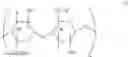
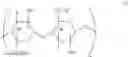
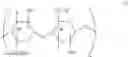
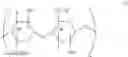
A modified cellulose is provided. The modified cellulose is represented by the chemical formula (1):
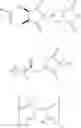
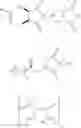
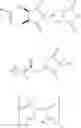
wherein n is between 60 and 2500, at least one R is selected from one of the group consisting of
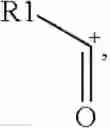
R1 is C11 to C32 alkyl group or C11 to C32 alkenyl group, R2 is hydrogen, C3 to C29 alkyl group or C3 to C29 alkenyl group, R3 is C3 to C29 alkyl group or C3 to C29 alkenyl group, R4 is C4 to C8 cycloalkyl group or C4 to C8 cycloalkenyl group, n2 is between 15 and 33, n4 is between 20 and 40.
Inventors:
- Sheng-Ju Liao 6 🇹🇼 Hsinchu City, Taiwan
- Yu-Ying HSU 1 🇹🇼 Taichung City, Taiwan
- Te-Yi CHANG 9 🇹🇼 Taoyuan City, Taiwan
- Ju-Feng LIAO 1 🇹🇼 Zhubei City, Taiwan
- Yao-Jheng HUANG 8 🇹🇼 Taipei City, Taiwan
- Sheng-Ju Liao 4 🇹🇼 Hsinchu, Taiwan
- Yu-Ying Hsu 1 🇹🇼 Taichung, Taiwan
- Te-Yi Chang 6 🇹🇼 Taoyuan, Taiwan
- Ju-Feng Liao 1 🇹🇼 Zhubei, Taiwan
- Yao-Jheng Huang 6 🇹🇼 Taipei, Taiwan
Assignee:
- INDUSTRIAL TECHNOLOGY RESEARCH INSTITUTE 7,890 🇹🇼 HSINCHU, Taiwan
Applicant:
Interested in similar patents?
Get notified when new applications in this technology area are published.
Classification:
C08G81/02 » CPC further
Macromolecular compounds obtained by interreacting polymers in the absence of monomers, e.g. block polymers at least one of the polymers being obtained by reactions involving only carbon-to-carbon unsaturated bonds
C08B3/10 » CPC main
Preparation of cellulose esters of organic acids of monobasic organic acids with three or more carbon atoms, e.g. propionate or butyrate with five or more carbon-atoms, e.g. valerate
C08B3/12 » CPC further
Preparation of cellulose esters of organic acids of polybasic organic acids
C07H15/20 » CPC further
Compounds containing hydrocarbon or substituted hydrocarbon radicals directly attached to hetero atoms of saccharide radicals Carbocyclic rings
C08G81/024 » CPC further
Macromolecular compounds obtained by interreacting polymers in the absence of monomers, e.g. block polymers at least one of the polymers being obtained by reactions involving only carbon-to-carbon unsaturated bonds Block or graft polymers containing sequences of polymers of or and of polymers of
C08L23/12 » CPC further
Compositions of homopolymers or copolymers of unsaturated aliphatic hydrocarbons having only one carbon-to-carbon double bond; Compositions of derivatives of such polymers not modified by chemical after-treatment; Homopolymers or copolymers of propene Polypropene
C07H15/04 » CPC further
Compounds containing hydrocarbon or substituted hydrocarbon radicals directly attached to hetero atoms of saccharide radicals; Acyclic radicals, not substituted by cyclic structures attached to an oxygen atom of the saccharide radical
C08L23/10 » CPC further
Compositions of homopolymers or copolymers of unsaturated aliphatic hydrocarbons having only one carbon-to-carbon double bond; Compositions of derivatives of such polymers not modified by chemical after-treatment Homopolymers or copolymers of propene
C07H15/10 » CPC further
Compounds containing hydrocarbon or substituted hydrocarbon radicals directly attached to hetero atoms of saccharide radicals; Acyclic radicals, not substituted by cyclic structures attached to an oxygen atom of the saccharide radical containing unsaturated carbon-to-carbon bonds
C08L1/10 » CPC further
Compositions of cellulose, modified cellulose or cellulose derivatives; Cellulose derivatives Esters of organic acids, i.e. acylates
Description
This application claims the benefit of Taiwan application Serial No. 103146047, filed Dec. 29, 2014, the disclosure of which is incorporated by reference herein in its entirety.
TECHNICAL FIELD
The disclosure relates in general to a cellulose and a composite material using the same, and more particularly to a modified cellulose and a composite material using the same.
BACKGROUND
Cellulose is the most abundant polymer in nature. In cellulose, each glucose unit includes three OH groups. Since most of OH groups may generate hydrogen bonds, cellulose forms stable crystal structure, and high bonding force may be formed between celluloses. Further, cellulose is a natural biomass material, and has a heat-resistant, high toughness and other advantages, so that it is widely used in composites.
However, general polyolefin polymers are oleophilic materials having low surface energy. The polyolefin polymers have low polarity, and the interface force between the polyolefin polymers and the hydrophilic plant fiber material are not easy to be formed. Therefore, it is not conducive to manufacturing the composite having cellulose for mechanical reinforcement.
SUMMARY
The disclosure is directed to a modified cellulose and a composite material using the same, which separates the cellulose crystal structure by cellulose activation technology, and then implements the surface modification to proceed a grafting reaction with the OH groups on the surface of the cellulose, such that the compatibility of the hydrophobic polymer may be increased and the cellulose material compatible with the petrochemical plastics such as polypropylene may be obtained. The disclosure may effectively solve the problems of the compatibility, processability and mechanical properties of the composite material formed with the biomass cellulose.
According to one embodiment, a modified cellulose is provided. The modified cellulose is represented by the chemical formula (1):
wherein n is between 60 and 2500, at least one R is selected from one of the group consisting of
R1 is C11 to C32 alkyl group or C11 to C32 alkenyl group, R2 is hydrogen, C3 to C29 alkyl group or C3 to C29 alkenyl group, R3 is C3 to C29 alkyl group or C3 to C29 alkenyl group, R4 is C4 to C8 cycloalkyl group or C4 to C9 cycloalkenyl group, n2 is between 15 and 33, n4 is between 20 and 40.
According to another embodiment, a composite material including polypropene and a modified cellulose is provided. The modified cellulose is represented by the chemical formula (1):
wherein n is between 60 and 2500, at least one R is selected from one of the group consisting of
R1 is C11 to C32 alkyl group or C11 to C32 alkenyl group, R2 is hydrogen, C3 to C29 alkyl group or C3 to C29 alkenyl group, R3 is C3 to C29 alkyl group or C3 to C29 alkenyl group, R4 is C4 to C8 cycloalkyl group or C4 to C8 cycloalkenyl group, n2 is between 15 and 33, n4 is between 20 and 40.
BRIEF DESCRIPTION OF THE DRAWINGS
(None)
In the following detailed description, for purposes of explanation, numerous specific details are set forth in order to provide a thorough understanding of the disclosed embodiments. It will be apparent, however, that one or more embodiments may be practiced without these specific details.
DETAILED DESCRIPTION
The embodiments are described in details. It is important to point out that some steps of the process in the embodiment according to the disclosure may be simplified or omitted for introducing the technical features more clearly, and there may be other embodiments of the present disclosure which are not specifically described. Thus, the specification is regarded as an illustrative sense rather than a restrictive sense.
The modified cellulose in the embodiment according to the disclosure may be represented by the chemical formula (1):
wherein n is between 60 and 2500, R may be hydrogen,
At least one R is selected from one of the group consisting of
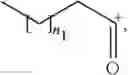
R1 is C11 to C32 alkyl group or C11 to C32 alkenyl group, R2 is hydrogen, C3 to C29 alkyl group or C3 to C29 alkenyl group, R3 is C3 to C29 alkyl group or C3 to C29 alkenyl group, R4 is C4 to C8 cycloalkyl group or C4 to C8 cycloalkenyl group, n2 is between 15 and 33, n4 is between 20 and 40.
In one embodiment, the
may include
the
may include
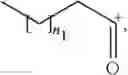
n1 is between 9 and 15, and n3 is 4 or 8.
The modified cellulose mentioned above may be formed by reacting a modification agent and a catalyst with a cellulose to carry out an esterification reaction. For example, the esterification reaction may be represented by the chemical equation (2):
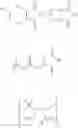
In one embodiment, the modification agent may include a material selected from the group consisting of
wherein n1 is between 9 and 15, n1′ is between 9 and 15, n2 is between 15 and 33, n3 is 4 or 8, and n4 is between 20 and 40. In other embodiments, the modification agent may include
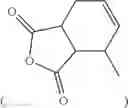
wherein R4 is C4 to C8 cycloalkyl group or C4 to C8 cycloalkenyl group, such as methylcyclohexene-1,2-dicarboxylic anhydride
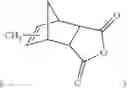
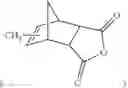
or methyl-5-norbornene-2,3-dicarboxylic anhydride
Further, the catalyst may include a material selected from the group consisting of sulfuric acid, triethylamine and 4-dimethylaminopyridine.
In the embodiment according to the disclosure, the degree of substitution of the modified cellulose may be, for example, between 0.2 and 2.8. Here, the degree of substitution is defined as the average number of hydroxyl groups substituted by the reagents on each dehydration glucose unit in the cellulose molecule chain. Besides, the weight-average molecular weight of the modified cellulose synthesized by the reaction represented by the chemical equation (2) above may be such as between 10,000 and 400,000.
The following are the first example to the sixth example for describing synthesizing methods of the modified cellulose. The first to the sixth examples use different modification agents according to the disclosure to modify the cellulose. It should be noted that the synthesizing methods of the disclosure are not limited to any of the following embodiments. Any structure complying with the structures of the modification agents mentioned above may be used as the modification agent of the disclosure.
FIRST EXAMPLE
First, cellulose was soaked in pure water and stirred to a swelling state, and filtered and dried to obtain activated cellulose. 36 g of activated cellulose, 14.4 g of palmitic anhydride, 0.86 g of sulfuric acid and 395 g of acetic acid were taken into the reaction flask and heated to 85° C. for 5 hours. The product was poured into 480 mL of pure water, and stirred to be precipitated. Then, filtration, washing and drying were implemented to obtain the modified cellulose 1.
SECOND EXAMPLE
First, cellulose was soaked in pure water and stirred to a swelling state, and filtered and dried to obtain activated cellulose. 20 g of activated cellulose, 15.12 g of polyisobutylene succinic anhydride (PIBSA), 9.92 g of triethylamine and 560 g of tetrahydrofuran (THF) were taken into the reaction flask and heated to 60° C. for 6 hours. The product was poured into hexane, and stirred to be precipitated. Then, filtration, washing and drying were implemented to obtain the modified cellulose 2.
THIRD EXAMPLE
First, cellulose was soaked in pure water and stirred to a swelling state, and filtered and dried to obtain activated cellulose. 20 g of activated cellulose, 15.2 g of polyisobutylene maleic anhydride (PIBMA), 6.4 g of 4-dimethylaminopyridine (DMAP) and 560 g of dimethyl sulfoxide (DMSO) were taken into the reaction flask and heated to 80° C. for 6 hours. The product was poured into ethanol, and stirred to be precipitated. Then, filtration, washing and drying were implemented to obtain the modified cellulose 3.
FOURTH EXAMPLE
First, cellulose was soaked in pure water and stirred to a swelling state, and filtered and dried to obtain activated cellulose. 20 g of activated cellulose, 52.24 g of tetrapropenyl succinic anhydride, 19.8 g of triethylamine and 400 g of tetrahydrofuran (THF) were taken into the reaction flask and heated to 60° C. for 6 hours. The product was poured into hexane, and stirred to be precipitated. Then, filtration, washing and drying were implemented to obtain the modified cellulose 4.
FIFTH EXAMPLE
First, cellulose was soaked in pure water and stirred to a swelling state, and filtered and dried to obtain activated cellulose. 20 g of activated cellulose, 22.48 g of lauric anhydride, 11.96 g of 4-dimethylaminopyridine (DMAP) and 440 g of dimethyl sulfoxide (DMSO) were taken into the reaction flask and heated to 80° C. for 6 hours. The product was poured into ethanol, and stirred to be precipitated. Then, filtration, washing and drying were implemented to obtain the modified cellulose 5.
SIXTH EXAMPLE
First, cellulose was soaked in pure water and stirred to a swelling state, and filtered and dried to obtain activated cellulose. 20 g of activated cellulose, 16 g of methylcyclohexene-1,2-dicarboxylic anhydride, 11.96 g of 4-dimethylaminopyridine (DMAP) and 440 g of dimethyl sulfoxide (DMSO) were taken into the reaction flask and heated to 80° C. for 6 hours. The product was poured into pure water, and stirred to be precipitated. Then, filtration, washing and drying were implemented to obtain the modified cellulose 6.
TABLE 1 summarizes portion of the material characteristics of the modified celluloses in the first example to the sixth example.
| TABLE 1 | |||
| degree of | weight-average | pyrolysis | |
| substitution | molecular weight | temperature (° C.) | |
| modified | 0.94 | 100,000 | 305 |
| cellulose 1 | |||
| modified | 2.01 | 136,000 | 333 |
| cellulose 2 | |||
| modified | 2.20 | 145,000 | 344 |
| cellulose 3 | |||
| modified | 2.20 | 172,000 | 256 |
| cellulose 4 | |||
| modified | 1.50 | 98,000 | 342 |
| cellulose 5 | |||
| modified | 2.20 | 145,000 | 340 |
| cellulose 6 | |||
TABLE 1 shows that the pyrolysis temperature of the modified cellulose obtained by the modification using the modification agents of the embodiments according to the disclosure may be higher than 300° C., which is suitable for mixing with polypropene (PP).
The composite material of the embodiment according to the disclosure may include polypropene and a modified cellulose represented by the chemical formula (1) above. In one embodiment, the content of the modified cellulose may be such as between 5 wt % and 50 wt %, and the weight-average molecular weight of the polypropene may be such as between 30,000 and 200,000.
Similarly, the modified cellulose may be formed by reacting a modification agent and a catalyst with a cellulose to carry out an esterification reaction. The modification agent may include a material selected from the group consisting of
wherein n1 is between 9 and 15, n1′ is between 9 and 15, n2 is between 15 and 33, n3 is 4 or 8, and n4 is between 20 and 40. In other embodiments, the modification agent may include
wherein R4 is C4 to C8 cycloalkyl group or C4 to C8 cycloalkenyl group, such as methylcyclohexene-1,2-dicarboxylic anhydride
or methyl-5-norbornene-2,3-dicarboxylic anhydride
Further, the catalyst may include a material selected from the group consisting of sulfuric acid, triethylamine and 4-dimethylaminopyridine.
Then, the modified celluloses 1 to 6 synthesized in the first to the sixth examples were mixed with polypropene by the plastic spectrometer to form the composite material. The mixing temperature was 180° C., and the mixing time was set to be 5 minutes. The composite material which was completely mixed was cut to form ASTM specimen by vacuum thermal pressing for the flexural modulus test. Here, the flexural modulus was measured in accordance with ASTM D790 standard method.
Meanwhile, the first comparative example and the second comparative example were compared with composite material synthesized by the modified celluloses 1 to 6 in the first to the sixth examples.
The cellulose in the first comparative example was non-modified cellulose. The non-modified cellulose in the first comparative example was mixed with polypropene by the mass spectrometer. The mixing temperature was 180° C., and the mixing time was set to be 5 minutes. The specimen which was completely mixed was cut to form ASTM specimen by vacuum thermal pressing for the mechanical property test.
In the second comparative example, 20 g of oleic acid was dissolved in 110 g of toluene solvent to form modified solution. 5 g of plant fiber was immersed in the modified solution and heated to 130° C. for 5 hours. Then, the plant fiber was cleaned repeatedly by hexane to remove the unreacted oleic acid. The plant fiber was finally placed in an oven at 80° C. and dried to obtain surface-modified plant fiber. Since the surface-modified plant fiber had poor compatibility with polypropylene, the mixing process was not implemented.
TABLE 2 summarizes the results of the mechanical property test for the composite material formed by mixing different proportions of the modified celluloses in the first example to the sixth example with polypropene, the composite material formed by mixing the cellulose in the first comparative example with polypropene, and pure polypropene.
| TABLE 2 | |||
| content of | |||
| polypropene | content of | flexural modulus | |
| material | (wt %) | cellulose (wt %) | (kg/cm2) |
| pure polypropene | 100 | 0 | 8291 |
| modified | 90 | 10 | 11707 |
| cellulose 1 + | 80 | 20 | 12547 |
| polypropene | |||
| modified | 90 | 10 | 14925 |
| cellulose 2 + | 80 | 20 | 15329 |
| polypropene | 70 | 30 | 17076 |
| modified | 90 | 10 | 26032 |
| cellulose 3 + | 80 | 20 | 24884 |
| polypropene | 70 | 30 | 25201 |
| modified | 90 | 10 | 16324 |
| cellulose 4 + | 80 | 20 | 17144 |
| polypropene | 70 | 30 | 18076 |
| modified | 90 | 10 | 17828 |
| cellulose 5 + | 80 | 20 | 18741 |
| polypropene | 70 | 30 | 17230 |
| modified | 90 | 10 | 16870 |
| cellulose 6 + | 80 | 20 | 16751 |
| polypropene | 70 | 30 | 18200 |
| cellulose of first | 90 | 10 | 9957 |
| comparative | 80 | 20 | 11817 |
| example + | |||
| polypropene | |||
TABLE 2 shows that the composite materials formed by mixing the modified celluloses 1 to 6, which are modified by the modification agents according to the disclosure, with polypropene have better the mechanical properties than pure polypropene or the composite material formed by mixing the non-modified cellulose with polypropene.
According to the examples and the results of the experiments, the modified celluloses modified by the modification agents according to the disclosure have higher pyrolysis temperature. Further, the composite materials formed by mixing the modified celluloses modified by the modification agents according to the disclosure with polypropene have better the mechanical properties than pure polypropene or the composite material formed by mixing the non-modified cellulose with polypropene. The modified cellulose according to the disclosure may make the polypropylene have the properties of high heat resistance and high toughness, while keep the features of lightweight, environment protection and energy saving.
It will be apparent to those skilled in the art that various modifications and variations can be made to the disclosed embodiments. It is intended that the specification and examples be considered as exemplary only, with a true scope of the disclosure being indicated by the following claims and their equivalents.
Claims
What is claimed is:1. A modified cellulose, represented by the chemical formula (1):
wherein n is between 60 and 2500, R is hydrogen,
and at least one R is selected from one of the group consisting of
R1 is C11 to C32 alkyl group or C11 to C32 alkenyl group, R4 is C4 to C8 cycloalkyl group or C4 to C8 cycloalkenyl group, n2 is between 15 and 33, n4 is between 20 and 40.
3. The modified cellulose according to claim 1, wherein a degree of substitution of the modified cellulose is between 0.2 and 2.8.
4. The modified cellulose according to claim 1, wherein the modified cellulose is formed by reacting a modification agent and a catalyst with a cellulose.
5. The modified cellulose according to claim 4, wherein the catalyst comprises a material selected from the group consisting of sulfuric acid, triethylamine and 4-dimethylaminopyridine.
6. The modified cellulose according to claim 4, wherein the modification agent comprises a material selected from the group consisting of palmitic anhydride, polyisobutylene succinic anhydride, polyisobutylene maleic anhydride, methylcyclohexene-1,2-dicarboxylic anhydride, methyl-5-norbornene-2,3-dicarboxylic anhydride and lauric anhydride.
7. The modified cellulose according to claim 1, wherein a weight-average molecular weight of the modified cellulose is between 10,000 and 400,000.
8. A composite material, comprising polypropene and a modified cellulose, the modified cellulose represented by the chemical formula (1):
wherein n is between 60 and 2500, R is hydrogen,
and at least one R is selected from one of the group consisting of
R1 is C11 to C32 alkyl group or C11 to C32 alkenyl group, R4 is C4 to C8 cycloalkyl group or C4 to C8 cycloalkenyl group, n2 is between 15 and 33, n4 is between 20 and 40.
10. The composite material according to claim 8, wherein a content of the modified cellulose is between 5 wt % and 50 wt %.
11. The composite material according to claim 8, wherein a degree of substitution of the modified cellulose is between 0.2 and 2.8.
12. The composite material according to claim 8, wherein the modified cellulose is formed by reacting a modification agent and a catalyst with a cellulose.
13. The composite material according to claim 12, wherein the catalyst comprises a material selected from the group consisting of sulfuric acid, triethylamine and 4-dimethylaminopyridine.
14. The composite material according to claim 12, wherein the modification agent comprises a material selected from the group consisting of palmitic anhydride, polyisobutylene succinic anhydride, polyisobutylene maleic anhydride, methylcyclohexene-1,2-dicarboxylic anhydride, methyl-5-norbornene-2,3-dicarboxylic anhydride and lauric anhydride.
15. The composite material according to claim 8, wherein a weight-average molecular weight of the modified cellulose is between 10,000 and 400,000.
16. The composite material according to claim 8, wherein a weight-average molecular weight of the polypropene is between 30,000 and 200,000.
Images & Drawings included:












Sources:
- United States Patent and Trademark Office - verify current appl. status at the USPTO↗
Recent applications in this class:
- » 20240417487 2024-12-19
JANUS-TYPE SPHERICAL CELLULOSE NANOPARTICLES - » 20240158539 2024-05-16
FUNCTIONALIZED CELLULOSE, METHOD OF ENZYMATIC FUNCTIONALIZATION OF CELLULOSE, PROCESS OF ENZYMATIC FUNCTIONALIZATION OF CELLULOSE USING AN ORGANIC ACID AND PROCESS FOR THE PRODUCTION OF A CELLULOSE WITH INCREASED HYDROPHOBICITY AND ARTICLE - » 20220325005 2022-10-13
Use of molar mass controlled cellulose - » 20220153877 2022-05-19
Polysaccharide derivative production method and lignin derivative production method - » 20210147578 2021-05-20
Functionalised compounds - » 20200031953 2020-01-30
Method for producing hypromellose phthalate - » 20190359733 2019-11-28
Use of molar mass controlled cellulose - » 20190002591 2019-01-03
ACYLATION OF BIOPOLYMER COMPRISING ANHYDROGLUCOSE UNITS - » 20160355609 2016-12-08
Methods for Biocompatible Derivatization of Cellulosic Surfaces - » 20150368364 2015-12-24
Methods for Biodegradable Derivatization of Cellulosic Surfaces
Recent applications for this Assignee:
- » 20250289330 2025-09-18
MOBILE VEHICLE CHARGING PROTECTION DEVICE FOR ELECTRICAL SAFETY IN LIVESTOCK HOUSES - » 20250287224 2025-09-11
COMMUNICATION DEVICE AND COMMUNICATION METHOD - » 20250286593 2025-09-11
COMMUNICATION DEVICE AND METHOD OF BEAM MANAGEMENT - » 20250284336 2025-09-11
SYSTEM AND METHOD FOR ADJUSTING IMAGE BASED ON PHYSIOLOGICAL INFORMATION AND POSTURE - » 20250281908 2025-09-11
ELECTROCATALYST COMPOSITION AND PREPARATION METHOD THEREOF - » 20250273403 2025-08-28
CAPACITOR AND ELECTRONIC DEVICE - » 20250271759 2025-08-28
POLYMER, POSITIVE PHOTORESIST COMPOSITION, AND METHOD FOR FORMING PATTERNED PHOTORESIST LAYER - » 20250265803 2025-08-21
MULTI-SENSOR COORDINATION METHOD, PROCESSING DEVICE, AND INFORMATION DISPLAY SYSTEM - » 20250263659 2025-08-21
METHOD AND KIT FOR PREPARING AN IMMUNE CELL DIFFERENTIATED FROM A STEM CELL - » 20250252547 2025-08-07
CORROSION POSITIONING SYSTEM, CORROSION INSPECTION VEHICLE AND CORROSION POSITIONING METHOD USING THE SAME