Pre-stressed curved ceramic plates/tiles and method of producing same
US20160356576A1
2016-12-08
15/112,884
2015-01-29
✅ Patent granted
US 10,139,201 B2
2018-11-27
WO; PCT/IL2015/050107; 20150129
WO; WO2015/114632; 20150806
Jeffry H Aftergut
Harness, Dickey & Pierce, P.L.C.
2035-07-25
Abstract:
A pre-stressed curved plate comprising a curved plate having at least one concave surface, the curved plate being enveloped and adhesively bonded with tensioned reinforcing fibers, whereby the reinforcing fibers are first wound around the plate under tension being spaced apart from the concave surface and subsequently subjected to pressure to stretch and bond the reinforcing fibers to the surfaces of the plate, where upon bonding, the tensile strain of the fiber introduces stress in the plate.
Assignee:
- IMI SYSTEMS LTD. 8 🇮🇱 Ramat Hasharon, Israel
Applicant:
Interested in similar patents?
Get notified when new applications in this technology area are published.
Classification:
F41H5/0435 » CPC main
Armour; Armour plates; Plate construction composed of more than one layer; Layered armour containing ceramic material; Ceramic layers in combination with additional layers made of fibres, fabrics or plastics the additional layers being only fibre- or fabric-reinforced layers
B29C65/4815 » CPC further
Joining of preformed parts ; Apparatus therefor using adhesives, i.e. using supplementary joining material; solvent bonding characterised by the type of adhesives; Non-reactive adhesives, e.g. physically hardening adhesives Hot melt adhesives, e.g. thermoplastic adhesives
F41H5/04 IPC
Armour; Armour plates; Plate construction composed of more than one layer
B29K2709/02 » CPC further
Use of inorganic materials not provided for in groups -, for preformed parts, e.g. for inserts Ceramics
B29K2995/0089 » CPC further
Properties of moulding materials, reinforcements, fillers, preformed parts or moulds; Other properties Impact strength or toughness
B29C70/56 » CPC further
Shaping composites, i.e. plastics material comprising reinforcements, fillers or preformed parts, e.g. inserts comprising reinforcements only, e.g. self-reinforcing plastics; Shaping operations therefor; Component parts, details or accessories; Auxiliary operations, e.g. feeding or storage of prepregs or SMC after impregnation or during ageing Tensioning reinforcements before or during shaping
B29C70/34 » CPC further
Shaping composites, i.e. plastics material comprising reinforcements, fillers or preformed parts, e.g. inserts comprising reinforcements only, e.g. self-reinforcing plastics; Shaping operations therefor; Shaping by lay-up, i.e. applying fibres, tape or broadsheet on a mould, former or core; Shaping by spray-up, i.e. spraying of fibres on a mould, former or core and shaping or impregnating by compression, i.e. combined with compressing after the lay-up operation
B29C65/48 IPC
Joining of preformed parts ; Apparatus therefor using adhesives, i.e. using supplementary joining material; solvent bonding
B29C53/56 » CPC further
Shaping by bending, folding, twisting, straightening or flattening; Apparatus therefor Winding and joining, e.g. winding spirally
B29C65/44 » CPC further
Joining of preformed parts ; Apparatus therefor by heating, with or without pressure Joining a heated non plastics element to a plastics element
B32B9/005 » CPC further
Layered products comprising a layer of a particular substance not covered by groups - comprising one layer of ceramic material, e.g. porcelain, ceramic tile
C04B35/117 » CPC further
Shaped ceramic products characterised by their composition ; Ceramics compositions ; Processing powders of inorganic compounds preparatory to the manufacturing of ceramic products based on oxide ceramics based on aluminium oxide; Fine ceramics Composites
B32B9/00 IPC
Layered products characterised by particular substances used
B32B9/00 IPC
Layered products comprising a layer of a particular substance not covered by groups -
C04B35/565 » CPC further
Shaped ceramic products characterised by their composition ; Ceramics compositions ; Processing powders of inorganic compounds preparatory to the manufacturing of ceramic products based on non-oxide ceramics based on carbides or oxycarbides based on silicon carbide
C04B35/58 IPC
Shaped ceramic products characterised by their composition ; Ceramics compositions ; Processing powders of inorganic compounds preparatory to the manufacturing of ceramic products based on non-oxide ceramics based on borides, nitrides, or silicides
C04B35/584 » CPC further
Shaped ceramic products characterised by their composition ; Ceramics compositions ; Processing powders of inorganic compounds preparatory to the manufacturing of ceramic products based on non-oxide ceramics based on borides, nitrides, or silicides based on silicon nitride
C04B35/80 IPC
Shaped ceramic products characterised by their composition ; Ceramics compositions ; Processing powders of inorganic compounds preparatory to the manufacturing of ceramic products; Ceramic products containing macroscopic reinforcing agents containing non-metallic materials Fibres, filaments, whiskers, platelets, or the like
C04B35/58071 » CPC further
Shaped ceramic products characterised by their composition ; Ceramics compositions ; Processing powders of inorganic compounds preparatory to the manufacturing of ceramic products based on non-oxide ceramics based on borides, nitrides, or silicides based on borides based on refractory borides based on titanium borides
B32B3/04 » CPC further
Layered products comprising a layer with external or internal discontinuities or unevennesses, or a layer of non-planar form ; Layered products having particular features of form characterised by features of form at particular places, e.g. in edge regions characterised by layer folded at the edge, e.g. over another layer
B32B9/047 » CPC further
Layered products comprising a layer of a particular substance not covered by groups - comprising such substance as the main or only constituent of a layer, next to another layer of a made of fibres or filaments
C04B35/563 » CPC further
Shaped ceramic products characterised by their composition ; Ceramics compositions ; Processing powders of inorganic compounds preparatory to the manufacturing of ceramic products based on non-oxide ceramics based on carbides or oxycarbides based on boron carbide
C04B37/008 » CPC further
Joining burned ceramic articles with other burned ceramic articles or other articles by heating by means of an interlayer consisting of an organic adhesive, e.g. phenol resin or pitch
B32B2260/021 » CPC further
Layered product comprising an impregnated, embedded, or bonded layer wherein the layer comprises an impregnation, embedding, or binder material; Composition of the impregnated, bonded or embedded layer Fibrous or filamentary layer
C04B2237/343 » CPC further
Aspects relating to ceramic laminates or to joining of ceramic articles with other articles by heating; Composition of layers of ceramic laminates or of ceramic or metallic articles to be joined by heating, e.g. Si substrates; Ceramic; Oxidic Alumina or aluminates
C04B2237/36 » CPC further
Aspects relating to ceramic laminates or to joining of ceramic articles with other articles by heating; Composition of layers of ceramic laminates or of ceramic or metallic articles to be joined by heating, e.g. Si substrates; Ceramic Non-oxidic
C04B2237/365 » CPC further
Aspects relating to ceramic laminates or to joining of ceramic articles with other articles by heating; Composition of layers of ceramic laminates or of ceramic or metallic articles to be joined by heating, e.g. Si substrates; Ceramic; Non-oxidic Silicon carbide
C04B2237/366 » CPC further
Aspects relating to ceramic laminates or to joining of ceramic articles with other articles by heating; Composition of layers of ceramic laminates or of ceramic or metallic articles to be joined by heating, e.g. Si substrates; Ceramic; Non-oxidic Aluminium nitride
C04B2237/368 » CPC further
Aspects relating to ceramic laminates or to joining of ceramic articles with other articles by heating; Composition of layers of ceramic laminates or of ceramic or metallic articles to be joined by heating, e.g. Si substrates; Ceramic; Non-oxidic Silicon nitride
C04B2237/76 » CPC further
Aspects relating to ceramic laminates or to joining of ceramic articles with other articles by heating; Processing aspects relating to ceramic laminates or to the joining of ceramic articles with other articles by heating Forming laminates or joined articles comprising at least one member in the form other than a sheet or disc, e.g. two tubes or a tube and a sheet or disc
B32B9/04 IPC
Layered products comprising a layer of a particular substance not covered by groups - comprising such substance as the main or only constituent of a layer, next to another layer of a
C04B35/581 » CPC further
Shaped ceramic products characterised by their composition ; Ceramics compositions ; Processing powders of inorganic compounds preparatory to the manufacturing of ceramic products based on non-oxide ceramics based on borides, nitrides, or silicides based on aluminium nitride
C04B37/00 IPC
Joining burned ceramic articles with other burned ceramic articles or other articles by heating
B32B5/04 » CPC further
Layered products characterised by the non- homogeneity or physical structure, i.e. comprising a fibrous, filamentary, particulate or foam layer; Layered products characterised by having a layer differing constitutionally or physically in different parts characterised by structural features of a layer characterised by a layer being specifically extensible by reason of its structure or arrangement, e.g. by reason of the chemical nature of the fibres or filaments
B32B1/00 » CPC further
Layered products having a general shape other than plane
Description
CROSS-REFERENCE TO RELATED APPLICATIONS
This application is a U.S. National Phase Application under 35 U.S.C. 371 of International Application No. PCT/IL2015/050107 filed on Jan. 29, 2015 and published as WO 2015/114632 A1 on Aug. 6, 2015, which claims priority to Isreal Patent Application No. 230775 filed on Feb. 2, 2014. The entire disclosures of all of the above applications are incorporated herein by reference.
FIELD OF THE INVENTION
The present invention relates to pre-stressed curved ceramic plates that have improved ballistic protection characteristics and improved survivability under static and dynamic loading. The invention describes the structure of the plate, pre-stressed by an external envelope of stretched fibers bonded to the plate, and method of producing them.
BACKGROUND OF THE INVENTION
Ceramic materials are widely used for ballistic protection with the purpose of overcoming the high power penetration of projectiles, such as armor piercing (AP) projectiles, due to their relatively low density, high rigidity and high compression strength. See C. Barry Carter, M. Grant Norton, Ceramic Materials Science and Engineering, Spinger Science, 2007. Usually, ceramics are used in structures for ballistic protection in the form of plates, tiles, pellets or specially shape ceramic elements.
The significant disadvantage of these ceramic components is their low fracture toughness and the formation of a wide net of relatively long cracks during fracture. Such behavior of ceramic components reduces their ability to protect against not only around the local impact zone, but also around the wide area, which is affected by propagated cracks.
The impact on the ceramic component by a projectile generates the propagation of compression stress waves, which are reflected back from the free surfaces of the protection plate as tensile waves.
The ceramic materials have low tensile strength and usually these tensile stresses lead to the fracture of the ceramic component. It is therefore reasonable to assume that pre-stressing (initial compression) the ceramic component in a ballistic protection structure, should decrease the level of reflected tensile stresses after impact, and improve the protective ability of the ceramics component in a protection structure.
D. Sherman, J. PHYS IV FRANCE 7 1997, showed that inducing the compression stresses in the ceramics by confined frame reduces significantly their damage from impact.
T. J. Holmquist, International Journal of Impact Engineering, November 2003, evaluated the response of ceramic targets with and without pre-stress subjected to projectile impact. The results demonstrate that ballistic performance of confined ceramic targets can be improved by pre-stressing the ceramic.
U.S. Pat. No. 6,389,594 describes that an applying of the high isostatic pressure on a monolith ceramics wrapped by a composite materials impregnated with adhesives to cure it, induces the internal stresses into the ceramics and improves the multi hit capabilities of the armor.
U.S. Pa. No. 6,601,497 discloses an armor component that includes a tile having a perimeter, with optional recess to encase a wrapping material wrapped around the perimeter of the tile. The purpose of wrapping the tile is to prevent lateral expansion of the tile if it is hit. The wrapping material pre-stresses the tile, however the technique used here limits the degree of tensioning of the wrapping material by relatively low ability of tensioners and delivery system for the wrapping materials, and does not take an advantage of the tensile ability of them. The level of pre-stressing of the tile depends on the perimeter geometry of the tile, where the circular perimeter provides a uniform pressure on the tile recess. The straight sections of the tile perimeter will not supply any pressure on the tile, so this technology shouldn't be effective for monolithic ceramic plates that usually have straight perimeter lines, like personal protection ceramic plates.
U.S. Pat. No. 7,300,893 describes an armor including a strain rate hardening elastomers. An option to wrap the ballistic clothes or fibers around the ceramic tiles is suggested in this invention as a way to encapsulate the elastomer, and not for pre-stressing of the ceramic plate.
U.S. Pat. No. 7,827,899 describes an armor panel to protect a body from an incoming projectile, comprising the ceramic or glass-ceramic plate and backing polyethylene clothes, encapsulated within by a wrapping layer and bonded together by applying an external pressure on this wrapping layer. An armor panel, produced by this way, contains the externally wrapped layer, but this layer doesn't induce any significant pre-stressing of the internal ceramic plate.
The above prior art relates to pre-stressing anti-ballistic flat ceramic articles.
It is an object of the present invention is to provide anti-ballistic pre-stressed curved monolithic plates/tiles and a method of producing same.
It is a further object of this invention to provide a method of preparing pre-stressed anti-ballistic curved plates/tiles.
Anti-ballistic articles containing pre-stressed curved plates/tiles according to the present invention have superior ballistic characteristics including significant reduction of damages to the plate when hit, thus, providing armor plate with an enhanced multi-hit capabilities. In addition, anti-ballistic articles containing pre-stressed curved plates of the present invention are of relatively lower weight and decreased thickness than conventional ballistic articles for achieving the same affect.
Further objectives, features and advantages of the invention will become apparent from the following detailed description taken in conjunction with the following figures.
SUMMARY OF THE INVENTION
In accordance with the present invention, there is provided a pre-stressed curved plate comprising a curved plate having at least one concave surface, said curved plate being enveloped and adhesively bonded with tensioned reinforcing fibers, whereby the reinforcing fibers that were wound around the concave side of the plate and spaced apart from the concave surface were subjected to pressure at elevated temperature to stretch and bond the reinforcing fibers to the surfaces of the plates and maintain the tension after cooling, thereby stressing the plate, said bonding being effected by either applying an adhesive to the surfaces of the curved plate prior to winding the reinforcing fibers or coating the reinforcing fibers prior to or during winding.
The bonded fibers maintain the internal tension due to their stretched status and induce compression stress in the plate.
It is to be understood that the term plate used herein includes single curve or multi-curve plates or tiles and shells containing at least one concave zone.
The invention also provides methods for preparing stressed curved ceramic plates, as follows.
a. a curved plate is coated with adhesive.
pre-tensioned reinforcing fibers are wound around the ceramic plate, contacting the convex surface of the plate, and spanning across the concave surface of the plate, leaving a distance between the fibers and the convex surface.
external pressure, such as by autoclave or press is then applied, optionally at elevated temperature, to the wound fiber on the concave side of the plate, to stretch it until it comes in contact with the concave surface of the plate and is bonded thereto by curing the adhesive.
cooling the plate and releasing the external pressure, whereby the bonded tensioned fibers induce compression stress on the plate.
b. the same procedure as a., with the exception that the reinforcing fibers are pre-impregnated with adhesive prior to winding or are impregnated during winding.
c. Where the tensile strength of reinforcing fibers is limited and will not allow the fibers to stretch sufficiently under applied pressure and elevated temperature, to contact the concave surface, one can place a removable spacer on the concave surface so that the reinforcing fibers will be wound around the spanner, increasing the length of the fiber loop, so that when the spacer is removed the reinforcing fibers will have enough length and tenacity be pressed against the concave surface and adhere thereto.
DETAILED DESCRIPTION OF THE INVENTION
In accordance with the present invention, the curved plate is preferably a ceramic plate and can be made of aluminum oxide (Al2O3), boron carbide (B4C), silicon carbide (SiC), boron silicon carbide (BSC), titanium diboride (Ti B2), aluminum nitride, silicon nitride, sintered silicon carbide, sintered silicon nitride, and glass-ceramic or combinations thereof. It is preferred that the plate have a thickness of between 2-30 mm. Furthermore, the plate, tile or shell may also be multi-curved containing at least one concave zone.
The reinforcing fibers are selected from aramid, poly(p-phenylene-2,6-benzobisozazole), glass, carbon, thermoplastics (polyamide, polyethylene, polypropylene) or metal (boron, steel, aluminum) fibers.
Suitable adhesives for bonding the fibers to the curved ceramic plate are preferably hot melt thermoplastic adhesives like polyethylene and polypropylene films or thermosetting adhesives like epoxy with optionally high or low curing temperatures, rubber or elastomer based adhesives, ceramic adhesives.
The fibers are preferably impregnated with an adhesive material either before or during the winding, but before subjecting them to expansion by external pressure. Alternatively, the plate can be coated with an adhesive prior to winding the reinforcing fiber.
The pre-stressed curved plate can form an insert for either personal body armor, or antiballistic panels for vehicles, ships, aircrafts and helicopters, or for a helmet.
One advantage of the pre-stressed curved plate of the present invention is that it has increased multi-hit capability.
A second advantage of the pre-stressed curved plate anti-ballistic articles containing according to the present invention is that they achieves the same ballistic characteristics with reduced weight.
During the winding procedure the fibers should have some initial tension and not be slack to assure tight winding. This can be achieved by tensioners, see S. T. Peters, W. D. Humphrey, R. F. Foral, Filament Winding, Composite Structure, Fabrication, SAMPE, ISBN 0-938994-81-6.
To maintain the tension in the wound reinforcing fibers and to induce the compression in the plate, the wound plate should be cured under applied external pressure and optionally at an elevated temperature. The external pressure should be sufficiently high to maintain full contact between the fibers and the concave surface of the plate during the curing of adhesive and final bonding of the stretched fibers to the plate. The degree of compression of the plate will depend on the curvature of the plate, the direction of winding trajectory of the fibers, and elastic modulus of the fibers. Thus, the same fibers will induce different compressions in plates with different curvatures.
In cases where the ultimate tensile strain of a fiber is so low that even under pressure and elevated temperature it would not stretch sufficiently to reach and bond to the concave surface of a ceramic plate, then it is possible to interpose a removable spacer between the concave surface of the plate and the wound fiber. The removable spacer should have an appropriate geometry to increase the length of the fibers spanning the concave surface of the curved plate, in effect transforming the concave side to convex with respect of the winding. Thus, when pressure is applied to the wound plate and the spacer is removed the fibers will be sufficiently stretched to be pressed against the concave surface of the plate and be bonded thereto. After bonding the tensile strain of the fibers will induce stress to the plate, which is maintained upon cooling.
BRIEF DESCRIPTION OF THE DRAWINGS
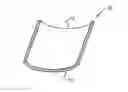
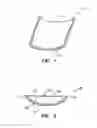
FIG. 1 illustrates a curved ceramic plate before winding with reinforcing fibers.
FIG. 2 is a cross-sectional view of a curved ceramic plate wound initially with reinforcing fibers in accordance with the present invention.
FIG. 3 is a cross-sectional view of a curved ceramic plate with wound fibers stretched and bonded to the surfaces of the plate.
FIG. 4 is a cross-sectional view of a curved ceramic plate with spacer wound initially with reinforcing fibers prior to applying pressure at elevated temperature.
DETAILED DESCRIPTION OF THE DRAWINGS
FIG. 1 is a perspective view of a curved ceramic plate 10 having a concave surface 12 and a convex surface 14. In FIG. 2 the curved plate 20 is wound with adhesive coated reinforcing fibers 16 under tension. Fibers 16 thus come in direct contact with the convex surface 14 and loops around the concave surface 12 forming a taught straight line between the edges 17 and 19 of the plate, leaving a space 15 between the tautly wound fibers 16a and the concave surface 12 of the plate. FIG. 3 shows fibers 16,16a wound around a curved ceramic plate 30 after being subjected to elevated temperature of about 180° C., while applying pressure (see the arrows) against the tensioned wound fibers 16,16a, pressing the fibers against the surfaces 12, 14 and curing it. Curing can be done by means of a hydroclave, autoclave, isotactic press or other suitable apparatus as described in U.S. Pat. No. 6,389,594. The tensioned wound fibers 16,16a are thus bonded to the concave surface 12 and compress the curved plate.
FIG. 4 illustrates in cross-section a curved ceramic plate 40 having a concave surface 12 and a convex surface 14. A removable spacer 42 is placed on the concave surface 12. Reinforcing fibers 44, 44a having low tensile strain, which would prevent the fibers from being pressed against the concave surface 12 under pressure were they stretched taut across line x-x, are wrapped around a spacer 42 raising fibers 44a over the concave surface 12 above the line x-x. This increases the length of fibers 44a on the concave side sufficiently so that when the temperature is raised and pressure is applied, and the spacer 42 is removed, fibers 44a will stretch sufficiently to reach the concave surface 12 to be bonded to the plate and cured.
The type of fiber should be chosen according to its possible elongation and maximum elastic modulus to increase the compression stresses in the plate.
It should be noted that by using different fibers and/or different adhesives and/or other bonding conditions such as different processing temperature or pressure, one may vary the degree of impregnation and/or the degree of tensioning of the fibers and/or the degree of compression, which may affect the degree of stress in the ceramic plate/tile.
In practice, ceramic plates of this invention are generally backed with an anti-ballistic cloth in anti-ballistic body protecting articles.
EXAMPLE
A number of ceramic body armor articles were prepared as follows. Aluminum oxide double curved ceramic plates 7.1 mm thick and weighing an average of 2100 g were wound with 200 g of T700 carbon fibers under tension, treated under pressure and 180 degrees temperature to pre-stress the plates, and backed with 23 layers of polyethylene cloth, with average weight of 460 g including adhesive. These articles had a general weight of 2760 g.
These articles were tested against APM2 projectiles with velocity range 868-883 m/s and provided good protection (two bullets were stopped by these articles) whereas articles with the same ceramic plates without pre-stressing have to include at least 40 layers of polyethylene cloth with average weight of 2900 g to provide the same ballistic protection.
Claims
1. A pre-stressed curved plate comprising a curved ceramic plate having at least one concave surface, said curved ceramic plate being enveloped and adhesively bonded with tensioned reinforcing fibers, wherein the reinforcing fibers are first wound around the ceramic plate under tension and being spaced apart from the concave surface and subsequently subjected to pressure to stretch and bond the reinforcing fibers to the surfaces of the ceramic plate, where upon bonding, the tensile strain of the fibers introduces stress in the ceramic plate.
2. The curved plate in accordance with claim 1, wherein the ceramic plate is subjected to pressure at elevated temperature.
3. The curved plate in accordance with claim 1, wherein said bonding is effected by either applying adhesive to the surfaces of the curved ceramic plate prior to winding the reinforcing fibers and/-or coating the reinforcing fibers prior to winding.
4. The curved plate in accordance with claim 1, wherein the ceramic plate is a ceramic plate tile.
5. The curved plate in accordance with claim 4, wherein the ceramic plate is made of aluminum oxide (Al2O3), hot pressed, sintered or reaction bonded boron carbide (B4C), silicon carbide (SiC), boron silicon carbide (BSC), titanium diboride (Ti B2), aluminum nitride, silicon nitride, sintered silicon carbide, sintered silicon nitride, and glass-ceramic or combinations thereof.
6. The curved plate in accordance with claim 1, wherein the ceramic plate has a thickness of between 3-30 mm.
7. The curved plate in accordance with claim 1, wherein the reinforcing fibers are selected from aramid, poly(p-phenylene-2,6-benzobisoxazole), S or E glass, carbon, thermoplastics (polyamide, HMWPE, polyethylene, polypropylene) or metal (boron, steel, aluminum) fibers or their combination.
8. The curved plate in accordance with claim 1, wherein the adhesive is selected from epoxy, phenolic, thermoplastic, thermosetting adhesives, rubber or elastomer based adhesives and ceramic adhesives.
9. (canceled)
10. The curved plate in accordance with claim 1, further comprising a removable spacer interposed between the concave surface of the ceramic plate and the reinforcing fibers.
11. The curved plate in accordance with claim 10, wherein the spacer is at least partially melted during the application of pressure at elevated temperature.
12. (canceled)
13. A method of preparing a pre-stressed curved plate having at least one concave surface, comprising:
winding tensioned reinforcing fibers around a curved ceramic plate whereby a space is left between the concave surface of the ceramic plate and the wound reinforcing fibers;
applying external pressure to the tensioned fibers to stretch the fibers until they contact and bond to the concave surface, and
cooling the plate and removing the external pressure after bonding.
14. The method of claim 13, further comprising heating the tensioned fibers to an elevated temperature during the step of applying external pressure to the tensioned fibers, in order to stretch the fibers until they contact and bond to the concave surface.
15. The method of claim 13, further comprising interposing a removable spacer between the concave surface and the reinforcing fibers in order to distance the fibers from the concave surface and to increase their length prior to subjecting the fiber wound ceramic plate to pressure and temperature.
16. The method of claim 15, further comprising ensuring that the removable spacer at least partially melts during the application of external pressure at elevated temperature.
Images & Drawings included:

Sources:
- United States Patent and Trademark Office - verify current appl. status at the USPTO↗
Similar patent applications:
Recent applications in this class:
- » 20230146363 2023-05-11
Lightweight composite armor - » 20210180919 2021-06-17
Antiballistic panel arranged for optical inspection and method thereof - » 20200363163 2020-11-19
ARMOR SYSTEM WITH MULTI-AXIAL REINFORCEMENTS - » 20200033097 2020-01-30
Ballistic tile - » 20190063879 2019-02-28
Pre-stressed curved ceramic plates/tiles and method of producing same - » 20180080742 2018-03-22
Composite Materials and Applications Thereof - » 20170299345 2017-10-19
Multi-layer multi-impact ballistic body armor and method of manufacturing the same - » 20170234657 2017-08-17
BALLISTIC PLATE MATERIALS AND METHOD - » 20130263728 2013-10-10
SHOCK AND IMPACT RESISTANT MULTILAYERED COMPOSITE AND METHOD FOR ITS FABRICATION - » 20130263727 2013-10-10
Multi-Functional Hybrid Panel For Blast and Impact Mitigation and Method of Manufacture
Recent applications for this Assignee:
- » 20250067544 2025-02-27
INTEGRATED AMMUNITION CARTRIDGE - » 20220097843 2022-03-31
INCOMING THREAT PROTECTION SYSTEM AND METHOD OF USING SAME - » 20210063126 2021-03-04
Cartridge for providing delayed chaff for use as a decoy for RF radars - » 20200225010 2020-07-16
Small caliber ammunition cartridge and armor piercing match bullet thereof - » 20190063879 2019-02-28
Pre-stressed curved ceramic plates/tiles and method of producing same - » 20160223683 2016-08-04
GPS-aided inertial navigation method and system - » 20150268007 2015-09-24
Antiballistic article and method of producing same