Conductive polymer of poly(thio- or seleno-)phene type
US20170107372A1
2017-04-20
15/127,185
2015-03-19
✅ Patent granted
US 10,377,895 B2
2019-08-13
WO; PCT/EP2015/055781; 20150319
WO; WO2015/140249; 20150924
Duc Truong
Oliff PLC
2035-10-16
Abstract:
The present invention relates to a conductive polymer material of poly(thio- or seleno-)phene type containing at least two distinct species of counteranion, including a first species which is an anionic form of sulphuric acid, and a second species of counteranion selected from triflate, triflimidate, tosylate, mesylate, perchlorate and hexafluorophosphate. The invention also relates to a process for preparing such a material and the use thereof as conductive film. The invention also targets a substrate coated at least partly by a film of a material as defined above, a device comprising a material as defined above as conductive material, and also the use thereof in the organic electronics, organic thermoelectricity, organic photovoltaic and organic photodetector fields.
Inventors:
- Alexandre Carella 13 🇫🇷 Mazeres Lezons, France
- Jean-Pierre Simonato 27 🇫🇷 Sassenage, France
- Nicolas MASSONNET 1 🇫🇷 Saint-Orens de Gameville, France
Assignee:
- Commissariat A L'Energie Atomique Et Aux Energies Alternatives 4,902 🇫🇷 Paris, France
Applicant:
Interested in similar patents?
Get notified when new applications in this technology area are published.
Classification:
C08G61/12 IPC
Macromolecular compounds obtained by reactions forming a carbon-to-carbon link in the main chain of the macromolecule Macromolecular compounds containing atoms other than carbon in the main chain of the macromolecule
C08G61/126 » CPC further
Macromolecular compounds obtained by reactions forming a carbon-to-carbon link in the main chain of the macromolecule; Macromolecular compounds containing atoms other than carbon in the main chain of the macromolecule derived from five- or six-membered heterocyclic compounds, other than imides derived from five-membered heterocyclic compounds with a five-membered ring containing one sulfur atom in the ring
C09D5/24 » CPC further
Coating compositions, e.g. paints, varnishes or lacquers, characterised by their physical nature or the effects produced ; Filling pastes Electrically-conducting paints
C09D165/00 » CPC further
Coating compositions based on macromolecular compounds obtained by reactions forming a carbon-to-carbon link in the main chain ; Coating compositions based on derivatives of such polymers
C08G2261/1424 » CPC further
Macromolecular compounds obtained by reactions forming a carbon-to-carbon link in the main chain of the macromolecule; Definition of the polymer structure; Side-groups; Side-chains containing oxygen containing ether groups, including alkoxy
C08G2261/3242 » CPC further
Macromolecular compounds obtained by reactions forming a carbon-to-carbon link in the main chain of the macromolecule; Monomer units or repeat units incorporating structural elements in the main chain incorporating heteroaromatic structural elements in the main chain condensed containing one or more oxygen atoms as the only heteroatom, e.g. benzofuran
C08G2261/3243 » CPC further
Macromolecular compounds obtained by reactions forming a carbon-to-carbon link in the main chain of the macromolecule; Monomer units or repeat units incorporating structural elements in the main chain incorporating heteroaromatic structural elements in the main chain condensed containing one or more sulfur atoms as the only heteroatom, e.g. benzothiophene
C08G2261/51 » CPC further
Macromolecular compounds obtained by reactions forming a carbon-to-carbon link in the main chain of the macromolecule; Physical properties Charge transport
C08G2261/792 » CPC further
Macromolecular compounds obtained by reactions forming a carbon-to-carbon link in the main chain of the macromolecule; Post-treatment doping with low-molecular weight dopants
C08L65/00 » CPC main
Compositions of macromolecular compounds obtained by reactions forming a carbon-to-carbon link in the main chain ; Compositions of derivatives of such polymers
C08L71/02 » CPC further
Compositions of polyethers obtained by reactions forming an ether link in the main chain ; Compositions of derivatives of such polymers Polyalkylene oxides
C08K3/30 IPC
Use of inorganic substances as compounding ingredients Sulfur-, selenium- or tellurium-containing compounds
H01B1/127 » CPC further
Conductors or conductive bodies characterised by the conductive materials; Selection of materials as conductors mainly consisting of other non-metallic substances organic substances; Intrinsically conductive polymers comprising five-membered aromatic rings in the main chain, e.g. polypyrroles, polythiophenes
C08K5/42 » CPC further
Use of organic ingredients; Sulfur-, selenium-, or tellurium-containing compounds; Compounds containing sulfur bound to oxygen Sulfonic acids; Derivatives thereof
H01L51/0036 » CPC further
Solid state devices using organic materials as the active part, or using a combination of organic materials with other materials as the active part; Processes or apparatus specially adapted for the manufacture or treatment of such devices, or of parts thereof; Selection of organic semiconducting materials, e.g. organic light sensitive or organic light emitting materials; Organic polymers or oligomers comprising aromatic, heteroaromatic, or arrylic chains, e.g. polyaniline , polyphenylene , polyphenylene vinylene Heteroaromatic compounds comprising sulfur or selene, e.g. polythiophene
H01L51/0037 » CPC further
Solid state devices using organic materials as the active part, or using a combination of organic materials with other materials as the active part; Processes or apparatus specially adapted for the manufacture or treatment of such devices, or of parts thereof; Selection of organic semiconducting materials, e.g. organic light sensitive or organic light emitting materials; Organic polymers or oligomers comprising aromatic, heteroaromatic, or arrylic chains, e.g. polyaniline , polyphenylene , polyphenylene vinylene; Heteroaromatic compounds comprising sulfur or selene, e.g. polythiophene Polyethylene dioxythiophene [PEDOT] and derivatives
C08K2003/309 » CPC further
Use of inorganic substances as compounding ingredients; Sulfur-, selenium- or tellurium-containing compounds Sulfur containing acids
Y02E10/549 » CPC further
Energy generation through renewable energy sources; Photovoltaic [PV] energy Organic PV cells
Y02E10/549 » CPC further
Energy generation through renewable energy sources; Photovoltaic [PV] energy Organic PV cells
H01B1/12 IPC
Conductors or conductive bodies characterised by the conductive materials; Selection of materials as conductors mainly consisting of other non-metallic substances organic substances
H01L51/00 IPC
Solid state devices using organic materials as the active part, or using a combination of organic materials with other materials as the active part; Processes or apparatus specially adapted for the manufacture or treatment of such devices, or of parts thereof
C08K3/24 » CPC further
Use of inorganic substances as compounding ingredients; Oxygen-containing compounds, e.g. metal carbonyls Acids; Salts thereof
C08G2261/3223 » CPC further
Macromolecular compounds obtained by reactions forming a carbon-to-carbon link in the main chain of the macromolecule; Monomer units or repeat units incorporating structural elements in the main chain incorporating heteroaromatic structural elements in the main chain non-condensed containing one or more sulfur atoms as the only heteroatom, e.g. thiophene
C08L2203/20 » CPC further
Applications use in electrical or conductive gadgets
Description
The present invention relates to a novel material based on poly(thio- or seleno)phenes and to a process for its preparation.
Devices such as organic electronic devices, organic photovoltaic devices, organic light-emitting diodes, organic thermoelectric devices or organic photodetectors are composed of electrodes employing conductive materials.
One generally popular material is indium tin oxide (ITO). It is advantageous, on the one hand, for its optical transparency and, on the other hand, for its high conductivity. Unfortunately, this material remains weak and it thus remains difficult to employ it in flexible devices. In addition, it is very expensive to supply with indium.
For these reasons, organic materials represent an advantageous alternative for replacing indium tin oxide in these devices.
In particular, poly(3,4-ethylenedioxythiophene) (PEDOT) and its derivatives are regarded as polymers exhibiting a high technological and commercial potential. This is because they are biocompatible and in addition have a good dynamic electrochromic activity and a good long-term stability in air.
However, these materials exhibit moderate conductivities.
Various routes have been explored in order to attempt to increase the conductivity of these materials.
A first option was proposed by Groenendaal et al., who developed the synthesis of conductive PEDOTs by electropolymerization of 3,4-ethylenedioxythiophene (EDOT). These materials are synthesized by liquid-phase electropolymerization of EDOT in a solution of salts in acetonitrile. PEDOT:triflate, PEDOT:triflimidate, PEDOT:perchlorate or PEDOT:hexafluorophosphate materials have thus been synthesized (Groenendaal et al., Advanced Material, 2003, 15(11), 855-879). However, the conductivity of these polymers remains too low. In addition, the process for the synthesis of these materials is not compatible with all the substrates on which the conductive material is deposited, which substrates have to be conductive in order to act as electrode during the polymerization.
Another possibility was described by Fabretto et al., synthesized PEDOT:OTs materials. The latter are prepared by oxidizing vapor-phase polymerization of EDOT by iron tristosylate Fe(OTs)3 in a PEG-PPG-PEG matrix (Fabretto et al., Chemistry of Materials, 2012, 24, 3998-4003). However, the synthesis of these materials is very restricting and is not compatible with the high-throughput preparation of large surface areas.
More recently still, Park et al. developed conductive PEDOT:OTs materials for thermoelectric applications by solution polymerization. These PEDOTs are also synthesized by oxidizing liquid-phase polymerization of EDOT by iron tristosylate Fe(OTs)3 in a PEG-PPG-PEG matrix. Pyridine is used as polymerization inhibitor (Park et al., Energy & Environmental Science, 2013, 6(3), 788). Nevertheless, the use of pyridine is restricting as it is very toxic and is thus not compatible with industrial production of this material.
Consequently, a need remains for novel highly conductive materials which can in addition be synthesized in a simple way suitable for industrial scale production.
Thus, according to one of its aspects, the invention relates to a conductive polymeric material of poly(thio- or seleno)phene type comprising at least two distinct kinds of counter anion with at least one of them being an anionic form of a sulfur-comprising acid.
Preferably, just one of the two kinds is an anionic form of a sulfur-comprising acid.
In particular, the invention relates to a conductive polymeric material of poly(thio- or seleno)phene type comprising at least two distinct kinds of counteranion, including a first kind which is an anionic form of sulfuric acid and a second kind of counteranion chosen from triflate, triflimidate, tosylate, mesylate, perchlorate and hexafluorophosphate.
Contrary to all expectation, the inventors have found that these polymeric materials exhibit a very high conductivity. Their use is thus particularly advantageous in organic electronic devices, organic photovoltaic devices, organic thermoelectric devices, organic light-emitting diodes or organic photodetectors.
In addition, their synthesis is easy and compatible with large scale production.
Thus, according to yet another of its aspects, the present invention relates to a process for the preparation of a material as defined above comprising at least the stages consisting in:
(a) having available a polymeric material of poly(thio- or seleno)phene type comprising at least one anionic entity chosen from triflate, triflimidate, tosylate, mesylate, perchlorate and hexafluorophosphate,
(b) bringing said material into contact with an aqueous solution of a sulfur-comprising acid under conditions favorable to the immobilization of an anionic form of said acid within the polymeric material, and
(c) having available said material comprising a first anionic entity chosen from triflate, triflimidate, tosylate, perchlorate and hexafluorophosphate and a second entity corresponding to an anionic form of said sulfur-comprising acid.
In particular, the material of stage (a) is obtained beforehand by polymerization in a solvent medium of thio- or selenophene monomer(s) in the presence of an oxidizing solution of iron(III) triflate, triflimidate, tosylate, mesylate, perchlorate or hexafluorophosphate and of an effective amount of block copolymer of polyethylene glycol-polypropylene glycol-polyethylene glycol (PEG-PPG-PEG) type and is purified by aqueous washing before it is employed in stage (b).
According to an advantageous alternative form, this material of stage (a) already appears on a support at the surface of which it has been formed beforehand by polymerization according to the process described in detail above.
The process according to the invention advantageously makes it possible to obtain highly conductive materials.
According to another of its aspects, the present invention relates to the use of a material according to the invention or obtained according to the process described above as conductive film.
According to yet another of its aspects, the present invention is targeted at a substrate coated at least in part with a film of a material according to the invention or obtained according to the process described above.
According to yet another of its aspects, the present invention relates to a device comprising, as conductor material, a material according to the invention or obtained according to the process described above.
According to another of its aspects, the present invention relates to the use of a material according to the invention or obtained according to the process described above or of a substrate according to the invention in the fields of organic electronics, organic thermoelectricity, organic photovoltaics and organic photodetectors.
Other advantages and characteristics will become apparent on reading the description and examples which follow.
Material
As mentioned above, a conductive polymeric material of poly(thio- or seleno)phene type according to the invention comprises at least two distinct kinds of counteranion with at least one of them being an anionic form of a sulfur-comprising acid.
According to a preferred embodiment, just one of the two kinds is an anionic form of a sulfur-comprising acid.
In a material according to the invention, the sulfur-comprising acid is chosen in particular from sulfuric acid, a sulfonic acid and a perfluorosulfonic acid.
Preferably, the sulfur-comprising acid is sulfuric acid.
According to another preferred embodiment, the second kind of counteranion is at least one anionic entity chosen from triflate, triflimidate, tosylate, mesylate, perchlorate and hexafluorophosphate and in particular triflate.
In particular, a conductive polymeric material of poly(thio- or seleno)phene type according to the invention comprises at least two distinct kinds of counteranion, including a first kind which is an anionic form of sulfuric acid and a second kind of counteranion chosen from triflate, triflimidate, tosylate, mesylate, perchlorate and hexafluorophosphate.
The use of triflate makes it possible to obtain films with very good conductive properties.
Thus, more preferably, a material according to the invention comprises at least hydrogensulfate and triflate counteranions.
According to a first alternative embodiment, the material according to the invention is based on a thiophene polymer deriving from the polymerization of monomer(s) chosen from thiophene, 3-alkylthiophenes, 3,4-dialkylthiophenes, 3,4-cycloalkylthiophenes, 3,4-dialkoxythiophenes and 3,4-alkylenedioxythiophenes, in which the alkyl groups, which are identical or different, are of formula CnH2n+1 with n between 1 and 12.
In particular, the material according to the invention is based on a thiophene polymer deriving from the polymerization of monomer(s) chosen from 3,4-dialkylthiophenes, 3,4-cycloalkylthiophenes, 3,4-dialkoxythiophenes and 3,4-alkylenedioxythiophenes, in which the alkyl groups, which are identical or different, are of formula CnH2n+1 with n between 1 and 12.
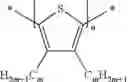
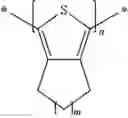
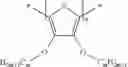
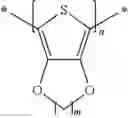
Thus, the thiophene polymer can, for example, be:
a poly(3,4-dialkylthiophene) of formula:
a poly(3,4-cycloalkylthiophene) of formula:
a poly(3,4-dialkoxythiophene) of formula:
a poly(3,4-alkylenedioxythiophene) of formula:
In particular, the monomers are chosen from thiophene, 3,4-ethylenedioxythiophene (EDOT), 3-hexylthiophene and 3,4-propylenedioxythiophene (PRODOT).
Preferably, the monomer is 3,4-ethylenedioxythiophene (EDOT).
Thus, the material according to the invention is preferably based on poly(3,4-ethylenedioxythiophene) (PEDOT).
According to a second alternative form of the invention, the material according to the invention is based on a selenophene polymer deriving from the polymerization of monomer(s) chosen from selenophene, 3-alkylselenophenes, 3,4-dialkylselenophenes, 3,4-cycloalkylselenophenes, 3,4-dialkoxyselenophenes and 3,4-alkylenedioxyselenophenes, in which the alkyl groups, which are identical or different, are of formula CnH2n+1 with n between 1 and 12.
In particular, the material according to the invention is based on selenophene polymer deriving from polymerization of monomer(s) chosen from 3,4-dialkylselenophenes, 3,4-cycloalkylselenophenes, 3,4-dialkoxyselenophenes and 3,4-alkylenedioxyselenophenes, in which the alkyl groups, which are identical or different, are of formula CnH2n+1 with n between 1 and 12.
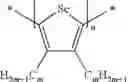
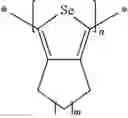
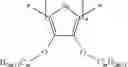
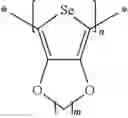
The selenophene polymer can, for example, be:
a poly(3,4-dialkylselenophene) of formula:
a poly(3,4-cycloalkylselenophene) of formula:
a poly(3,4-dialkoxyselenophene) of formula:
a poly(3,4-alkylenedioxyselenophene) of formula:
In particular, the monomers are chosen from selenophene, 3,4-ethylenedioxyselenophene (EDOS), 3-hexylselenophene and 3,4-propylenedioxyselenophene (PRODOS).
Preferably, a material according to the invention has a conductivity at least equal to 1000 S/cm and preferably varying from approximately 1500 S/cm to approximately 2500 S/cm, measured by the 4-point method, using a Loresta EP MCP-T360 conductivity meter.
Advantageously, a material according to the invention can be of use as conductive film.
Process
The present invention also relates to a process for the preparation of a material comprising at least the stages consisting in:
(a) having available a polymeric material of poly(thio- or seleno)phene type comprising at least one anionic entity chosen from triflate, triflimidate, tosylate, mesylate, perchlorate and hexafluorophosphate,
(b) bringing said material into contact with an aqueous solution of a sulfur-comprising acid under conditions favorable to the immobilization of an anionic form of said acid within the polymeric material, and
(c) having available said material comprising a first anionic entity chosen from triflate, triflimidate, tosylate, perchlorate and hexafluorophosphate and a second entity corresponding to an anionic form of said sulfur-comprising acid.
The operation in which the material is brought into contact with an aqueous solution of a sulfur-comprising acid can, for example, be carried out by immersing the material in a bath of the aqueous solution of sulfur-comprising acid.
Preferably, in a process according to the invention, the material of stage (a) is obtained beforehand by polymerization in a solvent medium of thio- or selenophene monomer(s) in the presence of an oxidizing solution of iron(III) triflate, triflimidate, tosylate, mesylate, perchlorate or hexafluorophosphate and of an effective amount of block copolymer of polyethylene glycol-polypropylene glycol-polyethylene glycol (PEG-PPG-PEG) type and is purified by aqueous washing before it is employed in stage (b).
More preferably, the material of stage (a) is obtained beforehand in the presence of an oxidizing triflate solution.
The block copolymer of polyethylene glycol-polypropylene glycol-polyethylene glycol (PEG-PPG-PEG) type advantageously makes it possible to inhibit the crystallization of the molecules of the oxidizing solution, to slow down the rate of polymerization and to increase the conductivity of the polymeric material.
Advantageously, the time during which the material is in contact with the aqueous solution of sulfur-comprising acid is greater than 10 minutes and preferably greater than 30 minutes.
According to an advantageous embodiment, the operation in which the material is brought into contact with the aqueous solution of sulfur-comprising acid is carried out at ambient temperature.
Preferably, the material is subsequently subjected to an annealing at a temperature of between 120° C. and 200° C., in particular of between 140° C. and 180° C. and preferably equal to 160° C.
According to an advantageous alternative embodiment, the polymeric material of stage (a) is provided in the form of a film appearing at the surface of a solid substrate.
Thus, according to another of its aspects, the present invention also relates to a process for increasing the conductivity of a polymeric material of poly(thio- or seleno)phene type comprising at least one anionic entity distinct from a sulfur-comprising acid, which is provided in the form of a film, appearing at the surface of a solid substrate, comprising the stage consisting in bringing said film into contact with an aqueous solution of a sulfur-comprising acid under conditions favorable to the immobilization of an anionic form of said acid within the polymeric material.
On conclusion of this stage, the film thus treated is dried.
According to a specific embodiment, the anionic entity distinct from a sulfur-comprising acid is chosen from triflate, triflimidate, tosylate, mesylate, perchlorate and hexafluorophosphate.
In particular, the present invention relates to a process for increasing the conductivity of a polymeric material of poly(thio- or seleno)phene type comprising at least one first kind of counteranion which is an anionic form of sulfuric acid and a second kind of counteranion chosen from triflate, triflimidate, tosylate, mesylate, perchlorate and hexafluorophosphate, which is provided in the form of a film, appearing at the surface of a solid substrate, comprising the stage consisting in bringing said film into contact with an aqueous solution of a sulfur-comprising acid under conditions favorable to the immobilization of an anionic form of said acid within the polymeric material.
Advantageously, the operation in which the film is brought into contact with the aqueous solution can be carried out by directly immersing the substrate in a bath of the aqueous solution of sulfur-comprising acid.
This substrate can in particular be as defined below.
Substrate
The present invention also relates to a substrate coated at least in part with a film of a material according to the invention or obtained according to the process according to the invention.
Preferably, the substrate is a substrate made of glass, of silicon, of woven material or of organic and/or polymeric nature, for example a substrate made of paper.
When it is of polymeric nature, the substrate can, for example, be made of polyethylene terephthalate (PEN), of polyethylene naphthalate (PET), of polyimide or of polytetrafluoroethylene (PTFE).
The examples which follow are presented by way of illustration and not of limitation of the field of the invention.
EXAMPLES
Example 1: Synthesis of PEDOT with Different Acid Treatments
2 ml of a 20% by weight solution of polyethylene glycol-polypropylene glycol-polyethylene glycol (PEG-PPG-PEG) (Mn=5800 g·mol−1) in ethanol are prepared with stirring in an ultrasonic bath for 4 hours.
240 mg of Fe(OTf)3 are added to the solution with stirring.
The solution is left stirring for an additional 30 minutes.
The solution is subsequently cooled to 5° C. and 20 μl of EDOT are added.
The solution is immediately placed in an ultrasonic bath at 5° C. for 1 minute.
The solution is spin coated onto a sheet of Corning Eagle XG glass (10×10 cm) and then annealed for 10 minutes on a heating plate at 70° C. in the open air.
The glass sheet is cut into 2.5×1.25 cm pieces and the conductivity of the films obtained is measured at 1200 S/cm (+/−20 S/cm) by 4-point measurement for a mean thickness of 70 nm (+/−5 nm).
These films are dipped in an acid bath at pH=1 for one hour and then dried on a heating plate at 160° C. for 30 minutes.
The conductivity of the films is measured by the Van der Pauw (4 point) method and compared with the value before acid treatment.
The values are collated in the table below.
| Conductivity | Conductivity after | ||
| Sample | (S/cm) | Acid treatment | treatment (S/cm) |
| 1 | 1207 | CF3SO3H (pH = 1) | 1376 |
| 2 | 1192 | HCl (pH = 1) | 341 |
| 3 | 1230 | HNO3 (pH = 1) | 671 |
| 4 | 1215 | CH3SO3H (pH = 1) | 1690 |
| for 1 h | |||
| 5 | 1220 | H2SO4 (pH = 1) | 2541 |
| for 1 h | |||
It is noticed that samples 1, 4 and 5, which have been subjected to a treatment with a sulfur-comprising or sulfonic acid, exhibit very high conductivities after treatment, in contrast to samples 2 and 3, which were treated with HCl or HNO3.
Example 2: Synthesis of Highly Conductive PEDOT:HSO4
2 ml of a 20% by weight solution of PEG-PPG-PEG (Mn=5800 g·mol−1) in ethanol are prepared with stirring in an ultrasonic bath for 4 hours.
240 mg of Fe(OTf)3 are added to the solution with stirring.
The solution is left stirring for an additional 30 minutes.
The solution is subsequently cooled to 5° C. and 20 μl of EDOT are added.
The solution is immediately placed in an ultrasonic bath at 5° C. for 1 minute.
The solution is spin coated onto a sheet of Corning Eagle XG glass (10×10 cm) and then annealed for 10 minutes on a heating plate at 70° C. in the open air.
The glass sheet is cut into 2.5×1.25 cm pieces and the conductivity of the films obtained is measured at 1200 S/cm (+/−20 S/cm) by 4-point measurement for a mean thickness of 70 nm (+/−5 nm).
These films are dipped in a bath of sulfuric acid at pH=1 for a predetermined period of time (1 min, 10 min, 30 min, 1 h, 2 h, 5 h or 24 h) and then dried on a heating plate at 160° C. for 30 minutes.
The conductivity of the films is measured by the Van der Pauw (4 point) method and compared with the value before acid treatment.
The values are collated in the table below.
| Conductivity | Conductivity after | ||
| Sample | (S/cm) | Acid treatment | treatment (S/cm) |
| 6 | 1262 | H2SO4 (pH = 1) | 1450 |
| for 1 min | |||
| 7 | 1189 | H2SO4 (pH = 1) | 1806 |
| for 10 min | |||
| 8 | 1189 | H2SO4 (pH = 1) | 2502 |
| for 30 min | |||
| 9 | 1301 | H2SO4 (pH = 1) | 2480 |
| for 1 h | |||
| 10 | 1338 | H2SO4 (pH = 1) | 2512 |
| for 2 h | |||
| 11 | 1186 | H2SO4 (pH = 1) | 2521 |
| for 24 h | |||
All of the samples treated with H2SO4 have very high conductivities after treatment. The conductivities after acid treatment are all the higher when the treatment time is greater than 30 minutes.
Example 3: Synthesis of Highly Conductive PEDOT:HSO4
2 ml of a 20% by weight solution of PEG-PPG-PEG (Mn=5800 g·mol−1) in ethanol are prepared with stirring in an ultrasonic bath for 4 hours.
240 mg of Fe(OTf)3 are added to the solution with stirring.
The solution is left stirring for an additional 30 minutes.
The solution is subsequently cooled to 5° C. and 20 μl of EDOT are added.
The solution is immediately placed in an ultrasonic bath at 5° C. for 1 minute.
The solution is spin coated onto a sheet of Corning Eagle XG glass (10×10 cm) and then annealed for 10 minutes on a heating plate at 70° C. in the open air.
The glass sheet is cut into 2.5×1.25 cm pieces and the conductivity of the films obtained is measured at 1200 S/cm (+/−20 S/cm) by 4-point measurement for a mean thickness of 70 nm (+/−5 nm).
These films are dipped in a bath of sulfuric acid at pH=1 for 30 minutes and then dried on a heating plate at different temperatures (140° C., 160° C. or 180° C.) for 30 minutes.
The conductivity of the films is measured by the Van der Pauw (4 point) method and compared with the value before acid treatment.
The values are collated in the table below.
| Conductivity | Conductivity after | ||
| Sample | (S/cm) | Acid treatment | treatment (S/cm) |
| 12 | 1238 | H2SO4 (pH = 1) at | 1920 |
| 140° C. | |||
| 13 | 1276 | H2SO4 (pH = 1) at | 2520 |
| 160° C. | |||
| 14 | 1286 | H2SO4 (pH = 1) at | 1723 |
| 180° C. | |||
| 15 | 1238 | H2SO4 (pH = 1) at | 1453 |
| 200° C. | |||
All of the samples treated with H2SO4 have very high conductivities after treatment. The conductivities after acid treatment are all the higher when the treatment temperature is 160° C.
Example 4: Synthesis of Highly Conductive PRODOT:HSO4
2 ml of a 20% by weight solution of PEG-PPG-PEG (Mn=5800 g·mol−1) in ethanol are prepared with stirring in an ultrasonic bath for 4 hours.
240 mg of Fe(OTf)3 are added to the solution with stirring.
The solution is left stirring for an additional 30 minutes.
The solution is subsequently cooled to 5° C. and 25 μl of 3,4-propylenedioxythiophene (PRODOT) are added.
The solution is immediately placed in an ultrasonic bath at 5° C. for 1 minute.
The solution is spin coated onto a sheet of Corning Eagle XG glass (2.5×2.5 cm) and then annealed for 10 minutes on a heating plate at 70° C. in the open air.
The film is dipped in a bath of sulfuric acid at pH=1 for 30 minutes and then dried on a heating plate at 160° C. for 30 minutes.
The conductivity of the film, measured by the Van der Pauw (4 point) method, is 1500 S·cm−1 and its thickness is 70 nm (+/−5 nm).
Example 5: Synthesis of Highly Conductive PEDOS:HSO4
2 ml of a 20% by weight solution of PEG-PPG-PEG (Mn=5800 g·mol−1) in ethanol are prepared with stirring in an ultrasonic bath for 4 hours.
240 mg of Fe(OTf)3 are added to the solution with stirring.
The solution is left stirring for an additional 30 minutes.
The solution is subsequently cooled to 5° C. and 25 μl of 3,4-ethylenedioxyselenophene (EDOS) are added.
The solution is immediately placed in an ultrasonic bath at 5° C. for 1 minute.
The solution is spin coated onto a sheet of Corning Eagle XG glass (2.5×2.5 cm) and then annealed for 10 minutes on a heating plate at 70° C. in the open air.
The film is dipped in a bath of sulfuric acid at pH=1 for 30 minutes and then dried on a heating plate at 160° C. for 30 minutes.
The conductivity of the film, measured by the Van der Pauw (4 point) method, is 1650 S·cm−1 and its thickness is 70 nm (+/−5 nm).
Example 6: Synthesis of Highly Conductive PEDOT:HSO4 from PEDOT:OTs
2 ml of a 20% by weight solution of PEG-PPG-PEG (Mn=5800 g·mol−1) in ethanol are prepared with stirring in an ultrasonic bath for 4 hours.
240 mg of Fe(OTf)3 are added to the solution with stirring.
The solution is left stirring for an additional 30 minutes.
The solution is subsequently cooled to 5° C. and 20 μl of 3,4-ethylenedioxythiophene (EDOT) are added.
The solution is immediately placed in an ultrasonic bath at 5° C. for 1 minute.
The solution is spin coated onto a sheet of Corning Eagle XG glass (2.5×2.5 cm) and then annealed for 10 minutes on a heating plate at 70° C. in the open air.
The film is dipped in a bath of sulfuric acid at pH=1 for 30 minutes and then dried on a heating plate at 160° C. for 30 minutes.
The conductivity of the film, measured by the Van der Pauw (4 point) method, is 1750 S·cm−1 and its thickness is 70 nm (+/−5 nm).
Claims
1. A conductive polymeric material of poly(thio or seleno)phene type comprising at least two distinct kinds of counteranion, including a first kind which is an anionic form of sulfuric acid and a second kind of counteranion chosen from triflate, triflimidate, tosylate, mesylate, perchlorate and hexafluorophosphate.
2. The material as claimed in claim 1, comprising at least hydrogensulfate and triflate counteranions.
3. The material as claimed in claim 1, based on a thiophene polymer deriving from the polymerization of monomer(s) chosen from thiophene, 3-alkylthiophenes, 3,4-dialkylthiophenes, 3,4-cycloalkylthiophenes, 3,4-dialkoxythiophenes and 3,4-alkylenedioxythiophenes, in which the alkyl groups, which are identical or different, are of formula CnH2n+1 with n between 1 and 12.
4. The material as claimed in claim 1, in which the monomers are chosen from thiophene, 3,4-ethylenedioxythiophene (EDOT), 3-hexylthiophene and 3,4-propylenedioxythiophene (PRODOT).
5. The material as claimed in claim 1, based on poly(3,4-ethylenedioxythiophene) (PEDOT).
6. The material as claimed in claim 1, based on a selenophene polymer deriving from the polymerization of monomer(s) chosen from selenophene, 3-alkylselenophenes, 3,4-dialkylselenophenes, 3,4-cycloalkylselenophenes, 3,4-dialkoxyselenophenes and 3,4-alkylenedioxyselenophenes, in which the alkyl groups, which are identical or different, are of formula CnH2n+1 with n between 1 and 12.
7. The material as claimed in claim 1, in which the monomers are chosen from selenophene, 3,4-ethylenedioxyselenophene (EDOS), 3-hexylselenophene and 3,4-propylenedioxyselenophene (PRODOS).
8. The material as claimed in claim 1, having a conductivity at least equal to 1000 S/cm, measured by the 4-point method, using a Loresta EP MCP-T360 conductivity meter.
9. A process for the preparation of a material as claimed in claim 1, comprising at least the stages consisting in:
(a) having available a polymeric material of poly(thio or seleno)phene type comprising at least one anionic entity chosen from triflate, triflimidate, tosylate, mesylate, perchlorate and hexafluorophosphate,
(b) bringing said material into contact with an aqueous solution of a sulfur-comprising acid under conditions favorable to the immobilization of an anionic form of said acid within the polymeric material, and
(c) having available said material comprising a first anionic entity chosen from triflate, triflimidate, tosylate, perchlorate and hexafluorophosphate and a second entity corresponding to an anionic form of said sulfur-comprising acid.
10. The process as claimed in claim 9, in which said material of stage (a) is obtained beforehand by polymerization in a solvent medium of thio or selenophene monomer(s) in the presence of an oxidizing solution of iron(III) triflate, triflimidate, tosylate, mesylate, perchlorate or hexafluorophosphate and of an effective amount of block copolymer of polyethylene glycol-polypropylene glycol-polyethylene glycol (PEG-PPG-PEG) type and is purified by aqueous washing before it is employed in stage (b).
11. The process as claimed in claim 9, in which the temperature during the operation in which the material is brought into contact with the aqueous solution of sulfur-comprising acid in stage b) is between 120° C. and 200° C.
12. A process for increasing the conductivity of a polymeric material of poly(thio or seleno)phene type comprising at least one first kind of counteranion which is an anionic form of sulfuric acid and a second kind of counteranion chosen from triflate, triflimidate, tosylate, mesylate, perchlorate and hexafluorophosphate, which is provided in the form of a film, appearing at the surface of a solid substrate, comprising the stage consisting in bringing said film into contact with an aqueous solution of a sulfur-comprising acid under conditions favorable to the immobilization of an anionic form of said acid within the polymeric material.
13. A method for obtaining a conductive film using a material as claimed in claim 1.
14. A substrate coated at least in part with a film of a material as claimed in claim 1.
15. The substrate as claimed in claim 14, made of glass, of silicon, of woven material or of organic and/or polymeric nature.
16. A device comprising, as conductor material, a material as claimed in claim 1.
17. (canceled)
18. The material as claimed in claim 1, having a conductivity varying from approximately 1500 S/cm to approximately 2500 S/cm, measured by the 4-point method, using a Loresta EP MCP-T360 conductivity meter.
19. The process as claimed in claim 9, in which the temperature during the operation in which the material is brought into contact with the aqueous solution of sulfur-comprising acid in stage b) is between 140° C. and 180° C.
20. A method for obtaining a conductive film using a material obtained according to claim 9.
21. A substrate coated at least in part with a film of a material obtained according to claim 9.
22. A device comprising, as conductor material, a material obtained according to claim 9.
Images & Drawings included:
Sources:
- United States Patent and Trademark Office - verify current appl. status at the USPTO↗
Recent applications in this class:
- » 20250075069 2025-03-06
RESIN COMPOSITION AND ARTICLE MADE THEREFROM - » 20240309201 2024-09-19
SUPRAMOLECULE-BASED TOPOLOGICAL NETWORK ENABLED HIGHLY STRETCHABLE, CONDUCTING, AND PHOTO-PATTERNABLE PEDOT:PSS - » 20240043682 2024-02-08
Alcohol dispersion of conductive polyethylenedioxythiophene, and method for preparing same and use of same - » 20230159744 2023-05-25
POLYMER BLEND CRADLE FOR CABLE-STAYED BRIDGE - » 20220289965 2022-09-15
Phenolic triazine silicon polymer resin blends - » 20220135789 2022-05-05
Rubber composition for lighter weight tires and improved wet traction - » 20220119636 2022-04-21
Semi-interpenetrating and crosslinked polymers and membranes thereof - » 20220002537 2022-01-06
CYCLIC OLEFIN POLYMER CONCENTRATE FOR POLYESTER-BASED MATERIALS - » 20200062951 2020-02-27
THERMALLY ACTIVE COMPOSITE POLYMERIC COMPOSITIONS - » 20190367726 2019-12-05
Rubber composition and crosslinked rubber
Recent applications for this Assignee:
- » 20250294920 2025-09-18
METHOD FOR FORMING A LAYER WITH THE BASIS OF A DIELECTRIC MATERIAL ON A LAYER WITH THE BASIS OF AN ETCHED III-V MATERIAL - » 20250294269 2025-09-18
DEPTH PIXEL WITH SWITCHABLE INTEGRATION CAPABILITY - » 20250289195 2025-09-18
PROCESS FOR PRODUCING, AT THE END OF A STRUCTURE, A MICRO-OR NANO-COMPONENT MADE OF VITREOUS MATERIAL PRODUCED BY MULTI-PHOTON PHOTOPOLYMERIZATION - » 20250287705 2025-09-11
LIGHTWEIGHT, IMPACT-RESISTANT PHOTOVOLTAIC MODULE - » 20250285310 2025-09-11
METHOD FOR MAPPING A SPATIAL DISTRIBUTION OF A CHARACTERISTIC - » 20250279402 2025-09-04
OPTOELECTRONIC DEVICE INCLUDING A LIGHT-EMITTING DIODE STACKED ON A PHOTODETECTOR - » 20250270669 2025-08-28
METHOD FOR IRRIGATING A POROUS SUBSTRATE USING A FOAM, AND THE USES THEREOF - » 20250270148 2025-08-28
METHOD AND SYSTEM FOR TREATING ANIMAL PRODUCTS - » 20250266322 2025-08-21
SUBSTRATE COMPRISING VIAS AND ASSOCIATED MANUFACTURING METHODS - » 20250263865 2025-08-21
PROCESS FOR PRODUCING A CRYSTALLINE LAYER