Valve for high temperature liquid
US20170130854A1
2017-05-11
15/317,589
2015-06-09
✅ Patent granted
US 10,167,972 B2
2019-01-01
WO; PCT/EP2015/025030; 20150609
WO; WO2015/188950; 20151217
Ian G Paquette
Vorys, Sater, Seymour and Pease LLP
2035-06-28
Abstract:
A valve for a high temperature liquid, more in particular for liquid ZnMg, wherein the valve parts are made of ceramic material and graphite to be heat-resistant against the temperature of these liquid metals.
Inventors:
- Theodorus Franciscus Jozef Maalman 8 🇳🇱 Uitgeest, Netherlands
- Edzo Zoestbergen 7 🇳🇱 ALKMAAR, Netherlands
- Colin COMMANDEUR 5 🇳🇱 BEVERWIJK, Netherlands
- Stephan DE BRUIJN 1 🇳🇱 BEVERWIJK, Netherlands
Assignee:
- TATA STEEL NEDERLAND TECHNOLOGY BV 44 🇳🇱 Velsen-Noord, Netherlands
Applicant:
Interested in similar patents?
Get notified when new applications in this technology area are published.
Classification:
F16K25/005 » CPC main
Details relating to contact between valve members and seat Particular materials for seats or closure elements
C23C14/246 » CPC further
Coating by vacuum evaporation, by sputtering or by ion implantation of the coating forming material characterised by the process of coating; Vacuum evaporation Replenishment of source material
F16K25/00 IPC
Details
F16K25/00 IPC
Details relating to contact between valve members and seat
C23C14/24 IPC
Coating by vacuum evaporation, by sputtering or by ion implantation of the coating forming material characterised by the process of coating Vacuum evaporation
F16K5/045 » CPC further
Taps or cocks comprising only cut-off apparatus having at least one of the sealing faces shaped as a more or less complete surface of a solid of revolution, the opening and closing movement being predominantly rotary Plug valves; with plugs having cylindrical surfaces; Packings therefor Particular coverings and materials
B22D11/005 » CPC further
Continuous casting of metals, i.e. casting in indefinite lengths of wire
B22D11/064 » CPC further
Continuous casting of metals, i.e. casting in indefinite lengths into moulds with travelling walls, e.g. with rolls, plates, belts, caterpillars; Accessories therefor for supplying molten metal
F16K5/025 » CPC further
Taps or cocks comprising only cut-off apparatus having at least one of the sealing faces shaped as a more or less complete surface of a solid of revolution, the opening and closing movement being predominantly rotary Plug valves; with plugs having conical surfaces; Packings therefor Particular coverings or materials
B22D1/005 » CPC further
Treatment of fused masses in the ladle or the supply runners before casting; Treatment with gases Injection assemblies therefor
B22D1/00 IPC
Treatment of fused masses in the ladle or the supply runners before casting
B22D11/00 IPC
Particular casting processes; Machines or apparatus therefor
B22D11/00 IPC
Continuous casting of metals, i.e. casting in indefinite lengths
B22D11/06 IPC
Continuous casting of metals, i.e. casting in indefinite lengths into moulds with travelling walls, e.g. with rolls, plates, belts, caterpillars
F16K5/04 » CPC further
Taps or cocks comprising only cut-off apparatus having at least one of the sealing faces shaped as a more or less complete surface of a solid of revolution, the opening and closing movement being predominantly rotary Plug valves; with plugs having cylindrical surfaces; Packings therefor
F16K5/02 IPC
Taps or cocks comprising only cut-off apparatus having at least one of the sealing faces shaped as a more or less complete surface of a solid of revolution, the opening and closing movement being predominantly rotary Plug valves; with plugs having conical surfaces; Packings therefor
Description
FIELD OF THE INVENTION
The invention relates to a valve for a high temperature liquid, more in particular liquid metal or a liquid of two or more metals.
BACKGROUND OF THE INVENTION
In physical vapour deposition (PVD) a metal is vaporized and deposited on a substrate, such as a steel strip. In this process a liquid metal or a liquid of two or more metals is supplied to an evaporator in a vacuum chamber where it is vaporized. In PVD processes and more in particular in continuous or semi-continuous PVD processes on an industrial scale it is necessary to regularly supply liquid metal to the evaporator device to make up for the liquid metal evaporated from the evaporator.
For the supply of liquid metal to the evaporator a supply system is used comprising a feeding vessel with liquid metal, heated pipes between the vessel and evaporator, one or more valves to shut off and open the flow in the pipes and depending on the system one or more pumps to pump the liquid metal. The vessel with liquid metal is located outside the vacuum chamber.
In order to safely start and shut down the PVD installation it is essential that a valve is present in the piping between feeding vessel and the evaporator melt. This will assure that when the piping is empty the vacuum chamber will not be vented. Furthermore, during the shut down procedure or during an emergency situation the valve will make it possible to shut off the supply of liquid metal in a controlled and safe manner.
Liquid metal is used to provide an anti-corrosive coating on a steel strip and usually contains Zn or Zn and Mg which metals are both very reactive in the liquid phase. The material of the valve that comes into contact with the liquid ZnMg should not only be capable to withstand the corrosive action of this liquid metal but it should also be dense enough to prevent penetration of the liquid metal into the material, since such penetration could sooner or later lead to failure of the material.
Furthermore, it is not enough that the material of the valve is resistant against ZnMg. Oxides present on the material, formed by the material and any excess oxygen must be stable enough to liquid ZnMg to assure that the valve will continue to work.
OBJECTIVES OF THE INVENTION
It is an objective of the present invention to provide a valve that can be operated under high temperature conditions.
It is an objective of the present invention to provide a valve wherein the material of the valve is resistant against the corrosive action of liquid metal, more in particular liquid ZnMg.
It is another objective of the present invention to provide a valve wherein the material of the valve is dense enough to prevent penetration of the liquid metal into the material.
It is another objective of the present invention to provide a valve wherein the material of the valve is such that an oxide formed on the material will be stable under these conditions.
DESCRIPTION OF THE INVENTION
According to a first aspect of the invention one or more of the objectives of the invention are realized by providing a valve for high temperature liquid comprising a valve body, a valve seat, input and output connections, a valve closure member provided with a passageway, a valve cover member and a valve spindle connected to the valve closure member, wherein the parts of the valve that come into contact with the liquid are provided with a coating of a material or are made of a material that is resistant against the high temperature liquid.
To make a proper valve it is not only required that the used materials are resistant against liquid and or gaseous ZnMg, these materials should preferably also have the following features:
-
- The material must be dense enough to assure that no penetration of the ZnMg is occurring.
- A possible oxide formed on the part must not be reduced by the ZnMg liquid. Otherwise, due to the sequential oxidation and reduction steps the material will wear.
- Thirdly, the different parts of the valve must not cause fretting when the valve is being operated.
- Preferably the material(s) is/are thermo shock resistant.
- Preferably the material(s) must be resistant to air in the temperature interval from 450 to 850° C.
- The expansion of the material in specified temperature range much be such that any anisotropic expansion will not hinder the valve from working.
- Finally, it must be possible to obtain the material in the required seizes and it must be machinable.
The results are summarised below.
| Penetration and/or | ||
| Material | Reaction ? | Thermal shock resistance |
| Fused SiO2 | R | Y |
| Al2O3 | No | N |
| ZrO2 (Yttria stabilized) | No | Y |
| Hex BN | P, R | Y |
| HP BN (AX05) | P | Y |
| HIP BN | No | Y |
| Layered BN | P | Y |
| ZrO2-BN | P, R | Y |
| SiC-ZrO2-BN | R | Y |
| CaO-BN | P, R | Y |
| Si3N4-BN | P, R | Y |
| Si3N4 | No | Y |
| Graphite (porosity 18%) | P | Y |
| Tungsten | No (oxide reduced) | Y |
| Cast Iron | R | Y |
| Steel | R | Y |
The list above has been used to select materials to produce valves from.
In a first embodiment according to the invention a valve is provided wherein the parts of the valve that come into contact with the liquid are provided with a coating selected from a group consisting of graphite, BN, ZrO, Al2O3 and Si3N4. The part to which the coating is applied is made from steel, stainless steel, bronze or any other metal or alloy that is strong enough at the specified temperature interval, does not react destructively with the coating and preferably can withstand atmospheric conditions.
In a second embodiment according the invention the valve closure member is made of graphite and the valve body is made of hot isostatic pressed boron nitride (HIP BN). The graphite is preferable a higher density grade of graphite, such as graphite with a porosity of 18% or less. Preferably graphite is used with a porosity lower than 18% in order to minimize penetration of ZnMg in the voids in the graphite as much as possible, for instance graphite with a porosity of 15% or 12% or even less. From the materials on the list these materials are the easiest to machine. It was found that a valve made of HIP BN parts that are to be moved with respect to each other will show fretting. Furthermore the thermal expansion of HIP BN is very anisotropic which will result in a valve that can not be operated at elevated temperatures. A valve made of a HIP BN and a high density graphite part has to proven to work but because of the use of graphite the working temperature of the valve is limited up to 500° C.
Furthermore by providing that the valve closure member of graphite is at least partially surrounded by HIP BN the oxidation of graphite, which will normally occur under atmospheric conditions, is suppressed. Because of this construction it is possible to use this valve under atmospheric conditions at temperatures up to 850° C.
For a valve with solid parts of a single material also Al2O3 could be used but this material has the disadvantage of a bad thermal shock resistance. Also Si3N4 could be used for the purpose but it is difficult to machine the material to the required dimensions for this kind of valve.
According to a further aspect of the invention it is provided that also the valve cover member is made of HIP BN. With a valve body and a valve cover member of HIP BN the graphite valve closure member is surrounded on all sides by HIP BN.
BRIEF DESCRIPTION OF THE DRAWINGS
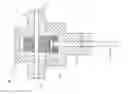
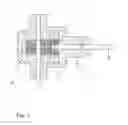
The invention will be further explained on hand of the example shown in the drawing, which shows a schematic drawing of the valve in cross-section.
DETAILED DESCRIPTION OF THE DRAWINGS
The valve comprises a valve body 1 provided with an inlet connection 2 and an outlet connection 3 and a valve seat 4 which accommodates valve closure member 5. Valve closure member 5 is provided with a passageway which connects to inlet and outlet channels respectively when turned in a position corresponding with these channels. The valve closure member is provided with a spindle 6 which extends through valve cover member 7 and is to be operated by mechanical or electro-mechanical means. The valve closure member 5 is made from HIP BN and the valve body 1 and the valve cover member 7 from a high density graphite.
This is a two way valve but it is also possible to make a three way valve using the materials as disclosed.
Claims
1. A valve for high temperature liquid comprising a valve body, a valve seat, input and output connections, a valve closure member provided with a passageway, a valve cover member and a valve spindle connected to the valve closure member, wherein the parts of the valve that come into contact with the liquid are provided with a coating of a material or are made of a material that is resistant against the high temperature liquid.
2. The valve according to claim 1, wherein the valve has the coating, and wherein the coating is selected from the group consisting of graphite, BN, ZrO, Al2O3 and Si3N4.
3. The valve according to claim 2, wherein the part to which the coating is applied is made from steel, stainless steel, titanium, nickel, copper, brass or bronze.
4. The valve according to claim 1, wherein the valve closure member is made of graphite and the valve body is made of HIP BN.
5. The valve according to claim 4, wherein the valve cover member is made of HIP BN.
6. The valve according to claim 1, wherein the valve closure member and the valve body are made of graphite or tungsten.
7. The valve according to claim 1, wherein the spindle is made from steel, stainless steel, titanium, nickel, copper, brass or bronze.
8. The valve according to claim 1, wherein the high temperature liquid is a liquid containing at least one metal.
9. The valve according to claim 7, wherein the liquid is liquid ZnMg.
10. A method to operate the valve according to claim 6, wherein the valve is operated in an inert gas atmosphere.
Images & Drawings included:
Sources:
- United States Patent and Trademark Office - verify current appl. status at the USPTO↗
Recent applications in this class:
- » 20250084929 2025-03-13
VALVE CORE WITH MICROPOROUS STRUCTURE AND SOLENOID VALVE USING VALVE CORE - » 20250075818 2025-03-06
GRADIENT MATERIAL STRUCTURES AND METHODS OF FORMING THE SAME - » 20240418282 2024-12-19
VALVE WITH REPLACEABLE HARD INSERTS - » 20240410486 2024-12-12
FLUID FLOW DEVICE, COMPRISING A FLOW CONTROL DEVICE WITH A SEALING PORTION PROVIDED WITH A NON-STICK LAYER HAVING ONE OR MORE DISCONTINUITIES - » 20240318738 2024-09-26
CONTROL VALVE - » 20240247729 2024-07-25
Hard and lubricious valve surfaces, material compositions and sequences of manufacturing - » 20240229956 2024-07-11
BLAST TUBE ASSEMBLIES - » 20240167577 2024-05-23
CONTROLLER AND VAPORIZATION SUPPLY DEVICE - » 20240133477 2024-04-25
BLAST TUBE ASSEMBLIES - » 20240125402 2024-04-18
Contamination-Resistant Throttle Valve
Recent applications for this Assignee:
- » 20240175818 2024-05-30
METHOD OF ADJUSTING THE ELEMENTAL INHOMOGENEITY OF A CONTINUOUS CAST METAL - » 20240088487 2024-03-14
METHOD FOR MANUFACTURING A STEEL STRIP OR SHEET FOR A BATTERY CASE AND BATTERY CASE MADE THEREFROM - » 20240052473 2024-02-15
MULTI-JET AIR KNIFE - » 20240018639 2024-01-18
HOT DIP COATING DEVICE AND METHOD - » 20230400130 2023-12-14
EXPANSION JOINT - » 20230243057 2023-08-03
METHOD FOR ELECTRODEPOSITING A FUNCTIONAL OR DECORATIVE CHROMIUM LAYER FROM A TRIVALENT CHROMIUM ELECTROLYTE - » 20220355830 2022-11-10
TUBE SECTION FOR EVACUATED TUBE TRANSPORT SYSTEM - » 20220332091 2022-10-20
Metal substrate with a surface texture - » 20220266323 2022-08-25
Double walled tube segment and method for producing said tube segment - » 20220205058 2022-06-30
High strength steel product and a process to produce a high strength steel product