System and method of playing word games
US20170157502A1
2017-06-08
14/960,445
2015-12-07
✅ Patent granted
US 9,687,728 B1
2017-06-27
-
-
James S McClellan | Kevin Carter
Pamela K. Riewerts, Esq. | Larry J. Guffey, Esq. | Oliver & Grimsley, LLC
2036-02-07
Abstract:
The present invention is a system and method of playing word games wherein any letter of the alphabet can be switched to another by simple 180-degrees rotation. This unique feature fundamentally changes the usual manner by which word games are played. The resultant increase in available choices enhances user experience by providing more chances for beginners and more challenges for advanced players. In the embodiment described herein, elements of word games and solitaire are combined to provide a product that has both entertainment and educational values.
Applicant:
Interested in similar patents?
Get notified when new applications in this technology area are published.
Classification:
A63F3/0423 » CPC main
Board games; Raffle games; Geographical or like games ; Educational games Word games, e.g. scrabble
A63F1/00 IPC
Card games
A63F3/04 IPC
Board games; Raffle games Geographical or like games ; Educational games
A63F13/20 » CPC further
Video games, i.e. games using an electronically generated display having two or more dimensions Input arrangements for video game devices
Description
CROSS-REFERENCE TO RELATED APPLICATIONS
This application claims the benefit of U.S. Design patent application Ser. No. 29/544,240 filed on Nov. 1, 2015, the contents of which are incorporated herein.
STATEMENT REGARDING FEDERALLY SPONSORED RESEARCH OR DEVELOPMENT
Not Applicable
REFERENCE TO SEQUENCE LISTING
Not Applicable
BACKGROUND OF THE INVENTION
The invention disclosed herein generally relates to a game. More particularly, the invention relates to a word card game.
A wide variety of games have been invented and introduced to the public over time, including those that involve forming or finding words. One challenge regarding word games is that while they can be too difficult and frustrating for children or beginners, the same can be too simple and boring for adults or advanced players. This suboptimal result is attributable, at least in part, to the inherent limitation of letter choices available to players at any given point during the game. Such word games typically have rules that disallow capitalized words but, ironically, use the majuscule or uppercase letters of the alphabet as their components.
Solitaire is a ubiquitous pastime played for centuries with actual cards as a tabletop game and, in recent decades, also with virtual cards as an electronic game. While games are expected to have entertainment value, they ideally can also have an educational impact.
BRIEF SUMMARY OF THE INVENTION
The system and method of playing word games described herein utilize specially designed characters, each of which represents not only one minuscule but also, when rotated 180-degrees, a second minuscule. Thus, only 13 characters are needed to represent all 26 minuscule or lowercase letters of the alphabet. This unique feature, whereby any letter can be instantly switched to another just by rotating the card, provides more choices for players. This invention enhances user experience by optimizing the chances for beginners and the challenges for advanced players.
In the embodiment described herein, elements of word games and solitaire are combined to provide a product that has both entertainment and educational values. The games can be played with actual or virtual cards in tabletop or electronic formats, respectively. The objective is to use up all the provided cards to form words. Challenge or achievement levels are determined by the number of words formed, with the highest score being attained by forming the lowest possible number of words with all of the given cards. In the current application, the ultimate goal is to use all of the 50 cards to form 10 words.
BRIEF DESCRIPTION OF DRAWINGS
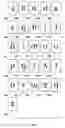
FIG. 1 shows the cards with the 13 specially designed characters that represent the complete set of 26 minuscule or lower case letters of the alphabet.
FIG. 2 shows the distribution of cards in the solitaire word game embodiment of the present invention.
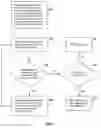
FIG. 3 shows the algorithm applied in the solitaire word game embodiment of the present invention.
FIG. 4 shows a typical initial setup of cards in the solitaire word game embodiment of the present invention.
FIG. 5 shows a typical play on a card in the initial setup of the solitaire word game embodiment shown in FIG. 4.
FIG. 6 shows a typical subsequent play on the cards in the solitaire word game embodiment shown in FIG. 5.
FIG. 7 shows a typical subsequent setup of cards in the solitaire word game embodiment following the play shown in FIG. 6.
FIG. 8 shows a typical subsequent play on the cards in the solitaire word game embodiment shown in FIG. 7.
DETAILED DESCRIPTION OF THE INVENTION
The system and method of playing word games described herein utilize 13 specially designed characters that collectively represent all the 26 minuscule or lowercase letters of the English alphabet as shown in FIG. 1.
The central unique feature of the present invention is illustrated in FIG. 1, wherein the letter “a” 101 can be instantly switched to the letter “e” 105, and vice versa, by a simple 180-degrees rotation of the card. In the same manner, the letter “b” 102 can be switched to the letter “q” 117, the letter “c” 103 can be switched to the letter “o” 115, the letter “d” 104 can be switched to the letter “p” 116, the letter “f” 106 can be switched to the letter “t” 120, the letter “g” 107 can be switched to the letter “k” 111, the letter “h” 108 can be switched to the letter “y” 125, the letter “i” 109 can be switched to the letter “l” 112, the letter “j” 110 can be switched to the letter “r” 118, the letter “m” 113 can be switched to the letter “w” 123, the letter “n” 114 can be switched to the letter “u” 121, the letter “s” 119 can be switched to the letter “v” 122, and the letter “x” 124 can be switched to the letter “z” 126.
Mathematically, the aforementioned versatility of each card provides the player more choices when attempting to find or form words by significantly magnifying the permutation involved in arranging such cards. In an ordinary word card game, for example, a hand of 5 cards, each of which represents only one letter, can maximally be arranged in 5×4×3×2×1=120 ways. In the novel system and method of playing word card games described herein, a hand of 5 cards, each of which represents either one of two letters, can maximally be arranged in 10×8×6×4×2=3,840 ways.
The distribution of 50 cards in the solitaire word game embodiment of the present invention is based in part on the relative frequency of the letters as they appear in databases of English words and is shown in FIG. 2 as follows: “a” or “e”—10 cards, “i” or “l”—6 cards, “o” or “c”—6 cards, “u” or “n”—5 cards, “t” or “f”—5 cards, “d” or “p”—4 cards, “h” or “y”—3 cards, “s” or “v”—3 cards, “m” or “w”—2 cards, “g” or “k”—2 cards, “j” or “r”—2 cards, “q” or “b”—1 card, “z” or “x”—1 card.
Among the 50 cards in the solitaire word game embodiment of the present invention, the vowel letters “a” 101, “e” 105, “i” 109, “o” 115, “u” 121, and “y” 125 are depicted in 30 cards. The consonant letters “b” 102, “c” 103, “d” 104, “f” 106, “g” 107, “h” 108, “j” 110, “k” 111, “l” 112, “m” 113, “n” 114, “p” 116, “q” 117, “r” 118, “s” 119, “t” 120, “v” 122, “w” 123, “x” 124, “y” 125, and “z” 126 are depicted in 40 cards. Of note, the letter “y” 125 can be used in a word as either a vowel or a consonant.
It is thus highly remarkable that while 30 out of 50 (60%) cards in the present invention can be used as vowels 134, 40 out of 50 (80%) of the same set of cards can be used as consonants 135. This distinctive effect on the probability of any card being available as a vowel and/or a consonant, in addition to the previously mentioned enhanced permutation involved in arranging cards, fundamentally changes the usual manner by which word games are played.
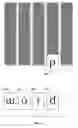
FIG. 3 shows the algorithm applied to the solitaire word game embodiment of the present invention. To start a new game 127, the 50 cards shown in FIG. 2 are randomly distributed into an array of 5 columns, each of which is comprised of 10 overlapping cards as shown in FIG. 4. As illustrated in this typical initial setup, all the cards are placed face down, except for the ones at the bottom of each column. Only the cards that face up, at the bottom of each column, are available for play.
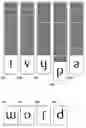
The player must form a valid word using at least two of the cards available for play 128. To accomplish this step, one or more letters may have to be switched to another. The player can make such a switch by manually rotating the actual card in the tabletop version, or by tapping or clicking the virtual card in the electronic version of the games. As an example, the letter “m” 113 in FIG. 4 is switched to the letter “w” 123 in FIG. 5.
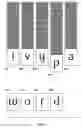
A word can be formed by manually assembling the actual cards in the tabletop version or by dragging and dropping the virtual cards into designated slots in the electronic version of the games. As an example, the letters “w” 123, “d” 104, “r” 118, and “o” 115 in FIG. 5 can be rearranged and assembled in the proper sequence to form “w-o-r-d” as shown in FIG. 6.
The word is determined to be valid if it is comprised of two or more letters, if it is listed in a dictionary or similar reference that exists in either printed or electronic form, and if it is not disqualified due to restrictions as follows. Abbreviations and words that require an apostrophe, hyphen or capitalization are not allowed 128.
All the cards used to form a valid word are removed from the array and set aside. The cards that are consequently uncovered by this step are then turned over to make them face up and, therefore, available for play 129 as shown in FIG. 7.
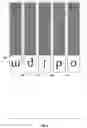
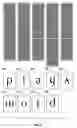
The player must form a valid word again using at least two of the cards available for play as shown in FIG. 8. In this example, the card with the letter “v” 122 in FIG. 7 is rotated to switch it to the letter “s” 119 in FIG. 8. The letters “l” 112, “s” 119, “y” 125, “p” 116, and “a” 101 are then rearranged and assembled in the proper sequence to form “p-l-a-y-s” as shown in FIG. 8.
The cycle as described and as illustrated in FIG. 3 continues until the player can no longer form a valid word, in which case the game ends 130.
If all the 50 cards are used up in forming words at the end of the game 131, the player wins 133. Otherwise, the player loses 132.
When the player wins, the challenge or achievement level 133 is determined based on its inverse relationship with the number of words formed. In the solitaire word game embodiment described herein, the ultimate goal is to use all the 50 cards to form 10 words.
In the tabletop version of the game, the player counts the total number of words formed with 50 cards to determine the attained challenge or achievement level. An example range of levels based on the total number of words formed with 50 cards are as follows: 10 words—Extreme Level, 11 to 12 words—Epic Level, 13 to 14 words—Elite Level, 15 or more words—Easy Level.
In the electronic version of the game, a scoring system can be employed such that longer words are assigned higher point values. An example range of point values based on the length of formed words are as follows: 5 letter word—25 points, 4 letter word—16 points, 3 letter word—9 points, 2 letter word—4 points. The final score is calculated as the sum of the point values of the words formed with 50 cards. Thus, the perfect or highest attainable score in such a scoring system is 250 points.
An alternative scoring system for more advanced players entails the assignment of a numerical point value for each letter, based in part on the relative frequency of their appearance in databases of English words, as in the following example: “a”—1 point, “b”—5 points, “c”—3 points, “d”—2 points, “e”—1 point, “f”—3 points, “g”—4 points, “h”—2 points, “i”—1 point, “j”—8 points, “k”—5 points, “l”—2 points, “m”—3 points, “n”—1 point, “o”—1 point, “p”—3 points, “q”—10 points, “r”—2 points, “s”—1 point, “t”—1 point, “u”—3 points, “v”—5 points, “w”—4 points, “x”—8 points, “y”—4 points, and “z”—10 points. Thus, “w-o-r-d” in FIGS. 6, 7, 8 is worth 9 points and “p-l-a-y-s” in FIG. 8 is worth 11 points. The final score is calculated as the sum of the point values of all the letters used in forming words with 50 cards.
Comparative analysis of the present vis-à-vis the past achievement scores of the same player and/or other players can enhance the heuristic experience and promote the educational and entertainment values of the solitaire word game embodiment of the present invention.
Claims
What is claimed is:1. The system and method of playing word games wherein 13 characters collectively represent all the 26 letters of the English alphabet.
2. The system and method of playing word games wherein any letter can be instantly switched to another by simple 180-degrees rotation of the component on which the character according to claim 1 is affixed.
3. The system and method of playing word games wherein the components according to claim 2 are comprised of cards or other comparable elements such as tiles.
4. The system and method of playing word games wherein the components according to claim 3 are either actual or virtual in nature and used in tabletop or electronic versions of the games, respectively.
5. The system and method of playing word games wherein each component according to claim 4 has a designated numerical point value based on the rotational position of the character thereon.
6. The system and method of playing word games wherein the rotational position according to claim 5 can be changed in the tabletop versions by physical manipulation and in the electronic versions by tapping or clicking of the components.
7. The solitaire word game embodiment of the present invention, comprising: 50 actual or virtual cards with characters thereon, each of which can be used as either one of two letters of the English alphabet.
8. The game according to claim 7 wherein 30 out of 50 cards represent vowel letters and 40 out of the same set of 50 cards represent consonant letters.
9. The game according to claim 7 wherein 50 cards are randomly distributed in an array of 5 columns, each comprised of 10 overlapping cards that are placed face down except for the ones at the bottom of each column.
10. The game according to claim 7 wherein only the cards that face up at the bottom of each column are available for play.
11. The game according to claim 7 wherein the player can rotate and rearrange any of the cards available for play to form a valid word.
12. The game according to claim 7 wherein the validity of the word formed by the player is determined by its presence in a dictionary or other similar reference, and the absence of disqualifiers including use of abbreviations, apostrophe, hyphen or capitalization.
13. The game according to claim 7 wherein the cards used to form a valid word are set aside and the underlying cards that are consequently uncovered are turned over, thereby making them face up and available for play.
14. The game according to claim 7 wherein the cycle of forming words using cards available for play, then turning over cards to make them available for play, continues until the player can no longer form a word.
15. The game according to claim 7 wherein the player wins if all the 50 cards are used up in forming words, and that the best possible outcome is the formation of at most 10 words.
16. The game according to claim 7 wherein the winner's achievement level in the tabletop version is based on the total number of words formed with 50 cards manually counted by the player.
17. The game according to claim 7 wherein the winner's achievement level in the electronic version is based on a scoring system that automatically calculates the point value of each word according to the number of letters used to form such word.
18. The game according to claim 7 wherein the winner's achievement level in the electronic version is based on an alternative scoring system that automatically calculates the point value of each word according to the point values of the letters used to form such word.
19. The game according to claim 7 wherein the present achievement scores can be compared vis-à-vis the past scores of the same player.
20. The game according to claim 7 wherein the present achievement scores can be compared vis-à-vis the latest scores of other players.
Images & Drawings included:


Sources:
- United States Patent and Trademark Office - verify current appl. status at the USPTO↗
Similar patent applications:
- » 20160184696
WORD GAME AND SYSTEM AND METHODS FOR PLAYING THE WORD GAME - » 20160317908
WORD GAME AND SYSTEM AND METHODS FOR PLAYING THE WORD GAME - » 20080132304
Entertainment system and method of playing a word game - » 20190255408
APPARATUS, SYSTEM AND METHODS FOR PLAYING A WORD GAME UTILIZING GOLF EQUIPMENT - » 20210213338
APPARATUS, SYSTEM AND METHODS FOR PLAYING A WORD GAME UTILIZING GOLF EQUIPMENT
Recent applications in this class:
- » 20250065218 2025-02-27
Word game with player-driven letter rearrangement - » 20250050202 2025-02-13
GAMING UNIT - » 20240207716 2024-06-27
WORD LADDER GAME - » 20240181335 2024-06-06
BOARD GAME - » 20230310977 2023-10-05
WORD BOARD GAME APPARATUS AND METHOD - » 20230241490 2023-08-03
SYSTEM AND METHOD FOR WORD CONSTRUCTION BOARD GAME - » 20220370889 2022-11-24
Spelling game comprising removable tokens positioned on a track - » 20220339529 2022-10-27
MULTI-DIMENSIONAL WORD SPELLING BOARD GAME - » 20220168625 2022-06-02
Gaming unit - » 20210379480 2021-12-09
Word Game for Enhancing Diction