Liquid crystal composition and application thereof
US20180044592A1
2018-02-15
15/536,092
2015-11-27
✅ Patent granted
US 10,557,082 B2
2020-02-11
WO; PCT/CN2015/095740; 20151127
WO; WO2016/145907; 20160922
Cynthia H Kelly | Anna Malloy
Harness, Dickey & Pierce, P.L.C.
2036-02-08
Abstract:
The present invention relates to the liquid crystal field, and particularly relates to a liquid crystal composition and use thereof in the liquid crystal display field. The liquid crystal composition of the present invention comprises, in percentages by weight, 5-40% of one or more compounds represented by general formula I, 2-30% of one or more compounds represented by general formula II, and 20-70% of one or more compounds represented by general formula III, and may further comprise 4-30% of one or more compounds represented by general formula IV and/or 5-25% of one or more compounds represented by general formulas V to IX. The combined use of the above-mentioned compounds can effectively reduce the rotational viscosity of the liquid crystal composition, improves related properties of the mixed liquid crystal, and thus reduces the response time thereof. The liquid crystal composition of the present invention can be used for a fast-response liquid display in a variety of display modes.
Inventors:
- Lin ZHANG 59 🇨🇳 Beijing, China
- Tianmeng Jiang 4 🇨🇳 Beijing, China
- Huiqiang Tian 3 🇨🇳 Beijing, China
- Shihong Chu 4 🇨🇳 Beijing, China
- Haiguang Chen 4 🇨🇳 Beijing, China
- Maoxian CHEN 4 🇨🇳 Beijing, China
- Xin WEI 11 🇨🇳 Beijing, China
- Yunpeng GUO 5 🇨🇳 Beijing, China
- Qinghua LI 8 🇨🇳 Beijing, China
- Jin YUAN 3 🇨🇳 Beijing, China
- Xuehui SU 2 🇨🇳 Beijing, China
Assignee:
- BEIJING BAYI SPACE LCD TECHNOLOGY CO., LTD 8 🇨🇳 Beijing, China
Applicant:
Interested in similar patents?
Get notified when new applications in this technology area are published.
Classification:
C09K19/0208 » CPC further
Liquid crystal materials characterised by optical, electrical or physical properties of the components, in general Twisted Nematic (T.N.); Super Twisted Nematic (S.T.N.); Optical Mode Interference (O.M.I.)
C09K19/3001 » CPC further
Liquid crystal materials characterised by the chemical structure of the liquid crystal components, e.g. by a specific unit; Non-steroidal liquid crystal compounds containing at least two non-condensed rings containing saturated or unsaturated non-aromatic rings, e.g. cyclohexane rings Cyclohexane rings
C09K19/3402 » CPC main
Liquid crystal materials characterised by the chemical structure of the liquid crystal components, e.g. by a specific unit; Non-steroidal liquid crystal compounds containing at least one heterocyclic ring having oxygen as hetero atom
C09K2019/0466 » CPC further
Liquid crystal materials characterised by the chemical structure of the liquid crystal components, e.g. by a specific unit characterized by a linking chain between rings or ring systems, a bridging chain between extensive mesogenic moieties or an end chain group the linking chain being a -CFO- chain
C09K2019/3422 » CPC further
Liquid crystal materials characterised by the chemical structure of the liquid crystal components, e.g. by a specific unit; Non-steroidal liquid crystal compounds containing at least one heterocyclic ring having oxygen as hetero atom the heterocyclic ring being a six-membered ring
C09K19/30 IPC
Liquid crystal materials characterised by the chemical structure of the liquid crystal components, e.g. by a specific unit; Non-steroidal liquid crystal compounds containing at least two non-condensed rings containing saturated or unsaturated non-aromatic rings, e.g. cyclohexane rings
C09K19/02 IPC
Liquid crystal materials characterised by optical, electrical or physical properties of the components, in general
C09K19/34 IPC
Liquid crystal materials characterised by the chemical structure of the liquid crystal components, e.g. by a specific unit; Non-steroidal liquid crystal compounds containing at least one heterocyclic ring
C09K19/3066 » CPC main
Liquid crystal materials characterised by the chemical structure of the liquid crystal components, e.g. by a specific unit; Non-steroidal liquid crystal compounds containing at least two non-condensed rings containing saturated or unsaturated non-aromatic rings, e.g. cyclohexane rings; Cyclohexane rings in which the rings are linked by a chain containing carbon and oxygen atoms, e.g. esters or ethers
C09K2019/0485 » CPC further
Liquid crystal materials characterised by the chemical structure of the liquid crystal components, e.g. by a specific unit characterized by the positioning of substituents on phenylene Phenylene substituted in ortho position
G02F1/1396 » CPC further
Devices or arrangements for the control of the intensity, colour, phase, polarisation or direction of light arriving from an independent light source, e.g. switching, gating or modulating; Non-linear optics for the control of the intensity, phase, polarisation or colour based on liquid crystals, e.g. single liquid crystal display cells characterised by the electro-optical or magneto-optical effect, e.g. field-induced phase transition, orientation effect, guest-host interaction or dynamic scattering based on orientation effects in which the liquid crystal remains transparent the liquid crystal being selectively controlled between a twisted state and a non-twisted state, e.g. TN-LC cell
G02F1/1343 IPC
Devices or arrangements for the control of the intensity, colour, phase, polarisation or direction of light arriving from an independent light source, e.g. switching, gating or modulating; Non-linear optics for the control of the intensity, phase, polarisation or colour based on liquid crystals, e.g. single liquid crystal display cells; Constructional arrangements; Operation of liquid crystal cells; Circuit arrangements; Constructional arrangements; Manufacturing methods Electrodes
C09K19/20 » CPC further
Liquid crystal materials characterised by the chemical structure of the liquid crystal components, e.g. by a specific unit; Non-steroidal liquid crystal compounds containing at least two non-condensed rings containing at least two benzene rings linked by a chain containing carbon and oxygen atoms as chain links, e.g. esters or ethers
C09K19/04 IPC
Liquid crystal materials characterised by the chemical structure of the liquid crystal components, e.g. by a specific unit
G02F1/139 IPC
Devices or arrangements for the control of the intensity, colour, phase, polarisation or direction of light arriving from an independent light source, e.g. switching, gating or modulating; Non-linear optics for the control of the intensity, phase, polarisation or colour based on liquid crystals, e.g. single liquid crystal display cells characterised by the electro-optical or magneto-optical effect, e.g. field-induced phase transition, orientation effect, guest-host interaction or dynamic scattering based on orientation effects in which the liquid crystal remains transparent
Description
FIELD OF THE INVENTION
The present invention relates to the liquid crystal field, and particularly relates to a liquid crystal composition and use thereof in the liquid crystal display field.
BACKGROUND OF THE INVENTION
Currently, liquid crystal has been widely applied in the information display field, and has also made some progress in optical communication applications. In recent years, the application field of liquid crystal compounds has been significantly broadened to various types of display devices, electro-optical devices, electronic components, sensors and the like. Nematic liquid crystal compounds have been most widely used in flat panel displays, particularly in TFT active matrix systems.
Liquid crystal display has gone through a long path of development since the discovery of liquid crystals. Particularly since the seventies, due to the development of large-scale integrated circuits and liquid crystal materials, the application of liquid crystals has made a breakthrough development in terms of display. Super Twisted Nematic (STN) mode proposed successively by T. Scheffer et al. in 1983-1985 and an Active Matrix (AM) mode proposed by P. Brody in 1972 were re-adopted. Conventional TN-LCD technology has been developed into STN-LCD and TFT-LCD technologies. Although the number of STN scanning lines can reach 768 or greater, there are still problems, such as response speed, viewing angle and gray scale, when the temperature rises. Therefore, for a large area, high information content, color display, an active matrix display mode becomes the first choice.
There are two types of “active matrix” including: 1. a metal oxide semiconductor (MOS) on a silicon wafer as a substrate; and 2. a thin film transistor (TFT) on a glass plate as a substrate.
Monocrystalline silicon as a substrate material limits the display size due to the fact that there were many problems occurring at junctions of each part of a display device or even a module assembly. Accordingly, the second type of thin film transistor is a promising active matrix type. The photoelectric effect utilized is generally the TN effect. A TFT includes a compound semiconductor, such as CdSe, or a TFT based on polycrystalline silicon or amorphous silicon.
Currently, the LCD product technologies have been well established and successfully solved technical problems regarding the viewing angle, resolution, color saturation, brightness, etc., and the display performance thereof has been close to or superior to that of CRT displays. Large-size and small-to-medium-size LCDs have gradually dominated the flat panel displays in respective fields. However, due to the limitation of (the high viscosity of) the liquid crystal material itself, the response time becomes a principal factor affecting high-performance displays.
In particular, the response time of a liquid crystal is limited by the rotational viscosity γ1 and the elastic constant of the liquid crystal. Therefore, reducing the rotational viscosity of a liquid crystal composition and increasing the elastic constant have a significant effect on reducing the response time of the liquid crystal display and accelerating the response speed of the liquid crystal display.
SUMMARY OF THE INVENTION
An object of the present invention is to provide a liquid crystal composition, and the liquid crystal composition has a low rotational viscosity and a large elastic constant, and is presented as having a shorter response time, so that the problem of the slow response of the liquid crystal display is effectively solved.
In order to achieve the above object, the following technical solution is specifically adopted:
a liquid crystal composition, comprising, in percentages by weight, 5-40% of one or more compounds represented by general formula I, 2-30% of one or more compounds represented by general formula II, and 20-70% of one or more compounds represented by general formula III; preferably comprising 9-30% of one or more compounds represented by general formula I, 3-26% of one or more compounds represented by general formula II, and 36-67% of one or more compounds represented by general formula III,
wherein R1 independently represents a C1-C12 linear alkyl group or a C2-C12 linear alkenyl group; R2 independently represents a C1-C12 linear alkyl group, a C1-C12 linear alkoxy group or a C2-C12 linear alkenyl group; R4 and R5 each independently represent an unsubstituted C1-C12 linear alkyl group or a C1-C12 linear alkyl group having one or more non-adjacent CH2 substituted with O, S or CH═CH;
X1 independently represents F, Cl, CN, a C1-C12 linear alkyl group, a C1-C12 linear alkoxy group or a C2-C12 linear alkenyl group;
Z1 and Z2 each independently represent a single bond or an acetylenic bond, with at least one of Z1 and Z2 being an acetylenic bond;
L1 independently represents H or F;
A1, A2 and A3 each independently represent:
A4 independently represents:
A5 and A6 each independently represent a trans-1,4-cyclohexylene group or a 1,4-phenylene group; and
m and n each independently represent 0 or 1.
The liquid crystal composition of the present invention further comprises 0-30% by weight of a compound represented by general formula IV, preferably 4-30% by weight of a compound represented by general formula IV, and more preferably 4-24% by weight of a compound represented by general formula IV,
wherein R6 and R7 each independently represent a C1-C12 linear alkyl group or a C1-C12 linear alkyl group having one or more non-adjacent CH2 substituted with O, S or CH═CH; and
A7 is selected from one of the following structures:
The liquid crystal composition of the present invention further comprises 0-30% by weight of compounds represented by general formulas V to IX, preferably 5-25% by weight of compounds represented by general formulas V to IX,
wherein R10 independently represents a C1-C12 linear alkyl group or a C2-C12 linear alkenyl group; R8, R9 and R11-R13 each independently represent a C1-C12 linear alkyl group; X2-X5 each independently represent F, CF3, OCF3 or OCF2H; L2-L9 each independently represent H or F; and
A8 and A9 each independently represent:
As an embodiment, the liquid crystal composition of the present invention comprises, in percentages by weight, 9-12% of one or more compounds represented by general formula I, 5-26% of one or more compounds represented by general formula II, 60-67% of one or more compounds represented by general formula III, and 5-24% of one or more compounds represented by general formula IV.
As another embodiment, the liquid crystal composition of the present invention comprises, in percentages by weight, 14-30% of one or more compounds represented by general formula I, 3-9% of one or more compounds represented by general formula II, 30-50% of one or more compounds represented by general formula III, 4-18% of one or more compounds represented by general formula IV, and 9-25% (preferably 9-23%) of one or more compounds represented by general formulas V to IX.
In the above-mentioned “one or more compounds represented by general formulas V to IX”, where only one compound is selected, it is preferred to select compound VII or V, and the range of the amount thereof is suitably 9-15%; where a mixture of two compounds is selected, compounds VII and V are preferred, and the range of the amount thereof is suitably 9-23%; and where a mixture of three compounds is selected, compounds V, VIII and IX, or compounds V, VII and IX are preferred, and the range of the amount thereof is suitably 15-25%.
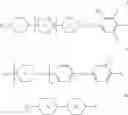
The compound represented by general formula I provided by the present invention is a polar compound containing a 2-methyl-3,4,5-trifluorobenzene structure and a difluoromethoxy bridge bond, the structure having a large dielectric anisotropy.
Particularly, the compound represented by general formula I is selected from one or more of the compounds represented by formulas I-A to I-U:
wherein R1 independently represents a C1-C7 linear alkyl group.
Preferably, the compound represented by general formula I is selected from one or more of the compounds represented by formulas I-A-1 to I-U-4:
more preferably, the compound represented by general formula I is selected from one or more of formulas I-F-2, I-F-3, I-G-2, I-G-4, I-P-1, I-P-2, I-R-2, I-R-3, I-U-2 and I-U-4.
The acetylenic compound represented by general formula II provided by the present invention has a high optical anisotropy, and plays a significant role in increasing the optical anisotropy of the composition.
Particularly, the compound represented by general formula II is selected from one or more of formulas II-A to II-D:
wherein R2 independently represents a C1-C7 linear alkyl group or a C2-C7 linear alkenyl group; and R3 independently represents a C1-C7 linear alkyl group, a C1-C7 linear alkoxy group or a C2-C7 linear alkenyl group.
Preferably, the compound represented by general formula II is selected from one or more of formulas II-A-1 to II-D-16:
more preferably, the compound represented by general formula II is selected from one or more of formulas II-A-1, II-A-6, II-A-10, II-A-35, II-C-3 and II-C-6.
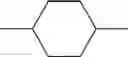
The compound represented by general formula III provided by the present invention has a bicyclic structure, and particularly, the compound represented by general formula III is selected from one or more of the following compounds:
wherein R4 independently represents a C1-C7 linear alkyl group; and R5 independently represents a C1-C7 linear alkyl group or linear alkoxy group or a C2-C7 linear alkenyl group.
Preferably, the compound represented by general formula III is selected from one or more of the compounds represented by formulas III-A-1 to III-C-24:
More preferably, the compound represented by general formula III is selected from one or more of formulas III-A-1, III-A-2, III-A-4, III-A-5 and III-C-4.
Particularly, the compound represented by general formula IV is selected from one or more of the following compounds of formulas IV-A to IV-C:
wherein R6 independently represents a C2-C10 linear alkyl group or linear alkenyl group; and R7 independently represents a C1-C8 linear alkyl group.
Preferably, the compound represented by general formula IV is selected from one or more of the structures of formulas IV-A-1 to IV-C-30:
More preferably, the compound represented by general formula IV is selected from one or more of formulas IV-A-1, IV-A-2, IV-A-5, IV-A-8, IV-A-12, IV-B-1 and IV-B-3.
Preferably, the compounds of general formulas V to IX are selected from one or more of formulas V-A to IX-N:
wherein R10 independently represents a C2-C7 linear alkyl group or linear alkenyl group; and R8, R9 and R11-R13 each independently represent a C2-C7 linear alkyl group.
The technical features of the invention lie in: since compounds of type I have a strong dielectric anisotropy, compounds of type II have a large optical anisotropy, and compounds of type IV have a high clearing point and a large K-value characteristic, the use of these three types of compounds can adjust the physical parameter properties of the liquid crystal composition; moreover, the compounds of type III have a significant effect in reducing the viscosity of the system and increasing the response speed, and are a class of compounds that are essential for formulating fast-response liquid crystal mixtures. The combined use of the above-mentioned compounds can effectively reduce the rotational viscosity of the mixed liquid crystal, improves related properties of the mixed liquid crystal, and thus reduces the response time thereof.
The method for preparing the liquid crystal composition of the present invention is not particularly limited, and the liquid crystal composition of the present invention may be produced by mixing two or more compounds using a conventional method, or may be prepared according to a conventional method.
The liquid crystal composition provided by the present invention simultaneously contains a 2-methyl-3,4,5-trifluorophenyl compound, an acetylenic compound and a non-polar bicyclic compound, has a low viscosity, high resistivity, suitable optical anisotropy, large elastic constant and excellent light stability and thermal stability, and can reduce the response time of the liquid crystal display, thereby solving the problem of a slow response speed of the liquid crystal display. In addition, the liquid crystal composition can effectively improve the contrast characteristics of IPS and FFS liquid crystal displays. Therefore, the liquid crystal composition provided by the present invention is suitable for fast-response TN, IPS and FFS-type TFT liquid crystal display devices, and is particularly suitable for IPS and FFS liquid crystal display devices.
SPECIFIC EMBODIMENTS
The following examples are intended to illustrate the invention, but not to limit the scope of the invention.
Unless otherwise indicated, the percentage in the present invention is weight percentage; the temperature unit is degrees Celsius; Δn represents optical anisotropy (at 25° C.); Δ∉ represents dielectric anisotropy (at 25° C., 1000 Hz); V10 represents voltage threshold, and is the characteristic voltage (V, at 25° C.) when the relative transmittance is changed by 10%; γ1 represents rotational viscosity (mPa·S, at 25° C.); Cp represents the clearing point (° C.) of the liquid crystal composition; and K11, K22 and K33 represent splay, twist and bend elastic constants (pN, at 25° C.), respectively.
In each of the following examples, the group structures in the liquid crystal compound are represented by the codes shown in Table 1.
| TABLE 1 |
| Group structure codes of the liquid crystal compound |
| Groups | Codes | Group names |
| C | 1,4-cyclohexylene | |
| P | 1,4-phenylene | |
| G | 2-fluoro-1,4-phenylene | |
| U | 2,6-difluoro-1,4-phenylene | |
| —O— | O | Oxygen substituent |
| —F | F | Fluorine substituent |
| —CF3 | CF3 | Trifluoromethyl |
| CnH2n+1 or CmH2m+1 | n or m | Alkyl group |
| —CF2O— | Q | Difluoromethoxy bridge bond |
| —OCHF2 | OCHF2 | Difluoromethoxy |
| A | 2,5-tetrahydropyran | |
| D | 2,6-dioxo-1,4-dioxane | |
| K | 2-methyl-3,5-difluoro-1,4- phenylene | |
| —OCF2—CF═CF2 | X | Pentafluoropropenyl ether |
| —C≡C— | T | Acetylenic bond |
| —HC═CH— | V | Alkenyl |
Taking the following compound structures as an example:
is represented as 4CDUQKF, and
is represented as 5CCPUF
In each of the following examples, the liquid crystal compositions are all prepared by a thermal dissolution method, comprising the following steps of: weighing liquid crystal compounds in percentage by weight using a balance, wherein the order of weighing and addition is not particularly specified, and usually, the weighing and mixing are carried out successively in order of the melting points of the liquid crystal compounds from high to low; heating and stirring same at 60-100° C. so that each component is melted uniformly; then subjecting same to filtration and rotary evaporation; and finally performing encapsulation to obtain a target sample.
In each of the following examples, the weight percentage of each component in the liquid crystal composition and the performance parameters of the liquid crystal composition are shown in the following tables.
Example 1
| TABLE 2 |
| Percentages by weight of each component and performance parameters of |
| the liquid crystal composition |
| Percentages by | Performance | Parameter | ||
| Types | Compound codes | weight | parameters | values |
| I | 3PGUQKF | 3 | Δn | 0.098 |
| I | 3PUQKF | 5 | Δε | +2.6 |
| I | 2APUQKF | 3 | Cp | 80 |
| II | 3CPTP2 | 5 | γ1 | 50 |
| III | 3CCV | 43 | K11 | 13.9 |
| III | 3CCV1 | 12 | K22 | 7.0 |
| III | 5PP1 | 5 | K33 | 16.1 |
| IV | VCCP1 | 10 | ||
| IV | V2CCP1 | 7 | ||
| IV | VCPP3 | 7 | ||
Example 2
| TABLE 3 |
| Percentages by weight of each component and performance parameters of |
| the liquid crystal composition |
| Percentages by | Performance | Parameter | ||
| Types | Compound codes | weight | parameters | values |
| I | 3PGUQKF | 5 | Δn | 0.098 |
| I | 3DUQKF | 5 | Δε | +2.8 |
| II | 3CPTP2 | 11 | Cp | 75 |
| III | 3CCV | 44 | γ1 | 48 |
| III | 3CCV1 | 13 | K11 | 12.8 |
| III | 5PP1 | 10 | K22 | 6.4 |
| IV | VCCP1 | 12 | K33 | 14.8 |
Example 3
| TABLE 4 |
| Percentages by weight of each component and performance parameters of |
| the liquid crystal composition |
| Percentages by | Performance | Parameter | ||
| Types | Compound codes | weight | parameters | values |
| I | 3PGUQKF | 5 | Δn | 0.099 |
| I | 2APUQKF | 4.5 | Δε | +2.6 |
| II | 3CPTP2 | 7 | Cp | 81 |
| III | 3CCV | 43 | γ1 | 52 |
| III | 3CCV1 | 12 | K11 | 13.8 |
| III | 5PP1 | 9 | K22 | 6.9 |
| IV | VCCP1 | 10 | K33 | 15.9 |
| IV | V2CCP1 | 4.5 | ||
| IV | VCPP3 | 5 | ||
Example 4
| TABLE 5 |
| Percentages by weight of each component and performance parameters of |
| the liquid crystal composition |
| Percentages by | Performance | Parameter | ||
| Types | Compound codes | weight | parameters | values |
| I | 3PGUQKF | 4 | Δn | 0.101 |
| I | 3PUQKF | 10 | Δε | +5.8 |
| I | 2APUQKF | 5 | Cp | 90 |
| II | 3CPTP2 | 5 | γ1 | 63 |
| III | 3CCV | 40 | K11 | 13.9 |
| III | 3CCV1 | 5 | K22 | 7.0 |
| IV | 3CCP1 | 5 | K33 | 16.7 |
| IV | 3CPP2 | 6 | ||
| IV | VCCP1 | 5 | ||
| VII | 3CCPOCF3 | 6 | ||
| VII | 5CCPOCF3 | 4 | ||
| VII | 2CCGF | 5 | ||
Example 5
| TABLE 6 |
| Percentages by weight of each component and performance parameters of |
| the liquid crystal composition |
| Percentages by | Performance | Parameter | ||
| Types | Compound codes | weight | parameters | values |
| I | 3PGUQKF | 5 | Δn | 0.114 |
| I | 3PUQKF | 9 | Δε | +5.2 |
| II | 3CPTP2 | 9 | Cp | 75 |
| III | 3CCV | 38 | γ1 | 48 |
| III | 3CCV1 | 5 | K11 | 12.8 |
| III | 5PP1 | 7 | K22 | 6.6 |
| IV | VCPP3 | 4 | K33 | 13.5 |
| V | 2CPGF | 7 | ||
| V | 3CPGF | 6 | ||
| VII | 2CCGF | 4 | ||
| VII | 3CCPOCF3 | 6 | ||
Example 6
| TABLE 7 |
| Percentages by weight of each component and performance parameters of |
| the liquid crystal composition |
| Percentages by | Performance | Parameter | ||
| Types | Compound codes | weight | parameters | values |
| I | 3PUQKF | 12 | Δn | 0.105 |
| I | 5PUQKF | 12 | Δε | +7.8 |
| I | 4DUQKF | 3 | Cp | 90 |
| II | 3CPTP2 | 4 | γ1 | 75 |
| III | 3CCV | 35 | K11 | 12.4 |
| III | 3CCV1 | 5 | K22 | 6.2 |
| IV | VCCP1 | 14 | K33 | 17.0 |
| V | 3CPGF | 8 | ||
| VIII | 3CGPC3 | 4 | ||
| IX | 3CCPUF | 3 | ||
Example 7
| TABLE 8 |
| Percentages by weight of each component and performance parameters of |
| the liquid crystal composition |
| Percentages by | Performance | Parameter | ||
| Types | Compound codes | weight | parameters | values |
| I | 3PUQKF | 10 | Δn | 0.104 |
| I | 5PUQKF | 10 | Δε | +7.5 |
| I | 3PGUQKF | 3 | Cp | 91 |
| I | 3DUQKF | 3 | γ1 | 74 |
| I | 3DPUQKF | 3 | K11 | 13.8 |
| II | 3CPTP2 | 4 | K22 | 6.9 |
| III | 3CCV | 30 | K33 | 17.0 |
| III | 3CCV1 | 5 | ||
| III | 3CC2V1 | 5 | ||
| IV | VCCP1 | 12 | ||
| IV | V2CCP1 | 6 | ||
| V | 3CPGF | 9 | ||
Example 8
| TABLE 9 |
| Percentages by weight of each component and performance parameters of |
| the liquid crystal composition |
| Percentages by | Performance | Parameter | ||
| Types | Compound codes | weight | parameters | values |
| I | 3PUQKF | 10 | Δn | 0.105 |
| I | 5PUQKF | 5 | Δε | +11.5 |
| I | 3PGUQKF | 2 | Cp | 94 |
| I | 3DUQKF | 4 | γ1 | 82 |
| I | 4DUQKF | 5 | K11 | 13.1 |
| I | 4DPUQKF | 4 | K22 | 6.6 |
| II | 4CPTP1 | 3 | K33 | 16.9 |
| III | 3CCV | 33 | ||
| III | 3CCV1 | 3 | ||
| IV | VCCP1 | 6 | ||
| V | 3CPGF | 9 | ||
| VII | 3CCGF | 7 | ||
| IX | 2CCPUF | 3 | ||
| IX | 3CCPUF | 3 | ||
| IX | 5CCPUF | 3 | ||
Example 9
| TABLE 10 |
| Percentages by weight of each component and performance parameters of |
| the liquid crystal composition |
| Percentages by | Performance | Parameter | ||
| Types | Compound codes | weight | parameters | values |
| I | 3PUQKF | 12 | Δn | 0.100 |
| I | 3PGUQKF | 3 | Δε | +5.8 |
| I | 2APUQKF | 4 | Cp | 91 |
| I | 3DPUQKF | 3 | γ1 | 65 |
| II | 3CPTP2 | 4 | K11 | 13.9 |
| III | 3CCV | 30 | K22 | 7.0 |
| III | 3CCV1 | 5 | K33 | 16.8 |
| III | 3CC2V1 | 5 | ||
| III | 5PP1 | 7 | ||
| IV | VCCP1 | 12 | ||
| IV | V2CCP1 | 6 | ||
| VII | 3CCGF | 9 | ||
Example 10
| TABLE 11 |
| Percentages by weight of each component and performance parameters of |
| the liquid crystal composition |
| Percentages by | Performance | Parameter | ||
| Types | Compound codes | weight | parameters | values |
| I | 3PGUQKF | 5 | Δn | 0.122 |
| I | 3PUQKF | 4 | Δε | +2.4 |
| II | 3CPTP2 | 10 | Cp | 80 |
| II | 3PTP1 | 6 | γ1 | 49 |
| II | 4PTP1 | 5 | K11 | 13.5 |
| II | 2PTP1 | 5 | K22 | 6.8 |
| III | 3CCV | 44 | K33 | 16.2 |
| III | 3CCV1 | 9 | ||
| III | 1V2PP1 | 7 | ||
| IV | VCCP1 | 5 | ||
Example 11
| TABLE 12 |
| Percentages by weight of each component and performance parameters of |
| the liquid crystal composition |
| Percentages by | Performance | Parameter | ||
| Types | Compound codes | weight | parameters | values |
| I | 3PGUQKF | 5 | Δn | 0.100 |
| I | 5PGUQKF | 3 | Δε | +3.4 |
| I | 4DPUQKF | 2 | Cp | 75 |
| I | 3APUQKF | 2 | γ1 | 49 |
| II | 3CPTP2 | 9 | K11 | 12.8 |
| II | V2PTP2V | 5 | K22 | 6.4 |
| III | 3CCV | 44 | K33 | 14.6 |
| III | 4CCV | 5 | ||
| III | 3CCV1 | 12 | ||
| III | 5PP1 | 5 | ||
| IV | VCCP1 | 8 | ||
Comparative Example 1
| TABLE 13 |
| Percentages by weight of each component and performance parameters of |
| the liquid crystal composition |
| Percentages by | Performance | Parameter | |
| Compound codes | weight | parameters | values |
| 3PGUQUF | 7 | Δn | 0.098 |
| 3APUQUF | 5 | Δε | +2.6 |
| 2PGP3 | 6 | Cp | 81 |
| 3CCV | 42 | γ1 | 52 |
| 3CCV1 | 12 | K11 | 13.8 |
| 1V2PP1 | 7 | K22 | 6.9 |
| VCCP1 | 11 | K33 | 16.0 |
| V2CCP1 | 10 | ||
The values of the performance parameters of the liquid crystal compositions obtained in example 1 and comparative example 1 are summarized and compared, and reference can be made to table 14.
| TABLE 14 |
| Comparison of performance parameters of liquid crystal compositions |
| Δn | Δε | Cp | γ1 | K11 | K22 | K33 | |
| Example 1 | 0.098 | +2.6 | 80 | 50 | 13.9 | 7.0 | 16.1 |
| Comparative | 0.098 | +2.6 | 81 | 52 | 13.8 | 6.9 | 16.0 |
| example 1 | |||||||
Upon comparison, it can be seen that, as compared with comparative example 1, the liquid crystal composition provided in example 1 has a low rotational viscosity and a large elastic constant, and therefore has a shorter response time and a faster response speed.
Comparative Example 2
| TABLE 15 |
| Percentages by weight of each component and performance parameters of |
| the liquid crystal composition |
| Percentages by | Performance | Parameter | |
| Compound codes | weight | parameters | values |
| 3PUQUF | 7 | Δn | 0.100 |
| 3CUQUF | 7 | Δε | +5.8 |
| 2PGUF | 7 | Cp | 90 |
| 3CCV | 35 | γ1 | 90 |
| 3CCV1 | 8 | K11 | 12.8 |
| VCCP1 | 10 | K22 | 6.5 |
| V2CCP1 | 6 | K33 | 16.2 |
| 2PGP3 | 4 | ||
| 2CCPUF | 5 | ||
| 3CCPUF | 5 | ||
| 3CPPC3 | 4 | ||
| 3CGPC3 | 2 | ||
The values of the performance parameters of the liquid crystal compositions obtained in example 9 and comparative example 2 are summarized and compared, and reference can be made to table 16.
| TABLE 16 |
| Comparison of performance parameters of liquid crystal compositions |
| Δn | Δε | Cp | γ1 | K11 | K22 | K33 | |
| Example 9 | 0.100 | +5.8 | 91 | 65 | 13.9 | 7.0 | 16.8 |
| Comparative | 0.100 | +5.8 | 90 | 90 | 12.8 | 6.5 | 16.2 |
| example 2 | |||||||
Upon comparison, it can be seen that, as compared with comparative example 2, the liquid crystal composition provided in example 9 has a low rotational viscosity and a large elastic constant, and therefore has a shorter response time and a faster response speed.
Although the present invention has been described in detail with general explanations and specific embodiments, it is obvious to a person skilled in the art that some modifications or improvements can be made thereto based on the present invention. Therefore, all these modifications and improvements which can be made without departing from the scope of the present invention belong to the scope claimed in the invention.
INDUSTRIAL APPLICABILITY
The liquid crystal composition provided by the present invention simultaneously contains a 2-methyl-3,4,5-trifluorophenyl compound, an acetylenic compound and a non-polar bicyclic compound, has a low viscosity, high resistivity, suitable optical anisotropy, large elastic constant and excellent light stability and thermal stability, and can reduce the response time of the liquid crystal display, thereby solving the problem of a slow response speed of the liquid crystal display. In addition, the liquid crystal composition can effectively improve the contrast characteristics of IPS and FFS liquid crystal displays. Therefore, the liquid crystal composition provided by the present invention is suitable for fast-response TN, IPS and FFS-type TFT liquid crystal display devices, and has broad application prospects and a good industrial applicability in the liquid crystal display field.
Claims
1. A liquid crystal composition, comprising, in percentages by weight, 5-40% of one or more compounds represented by general formula I, 2-30% of one or more compounds represented by general formula II, and 20-70% of one or more compounds represented by general formula III; preferably comprising 9-30% of one or more compounds represented by general formula I, 3-26% of one or more compounds represented by general formula II, and 36-67% of one or more compounds represented by general formula III,
wherein R1 independently represents a C1-C12 linear alkyl group or a C2-C12 linear alkenyl group; and R2 independently represents a C1-C12 linear alkyl group, a C1-C12 linear alkoxy group or a C2-C12 linear alkenyl group; R4 and R5 each independently represent an unsubstituted C1-C12 linear alkyl group or a C1-C12 linear alkyl group having one or more non-adjacent CH2 substituted with O, S or CH═CH;
X1 independently represents F, Cl, CN, a C1-C12 linear alkyl group, a C1-C12 linear alkoxy group or a C2-C12 linear alkenyl group;
Z1 and Z2 each independently represent a single bond or an acetylenic bond, with at least one of Z1 and Z2 being an acetylenic bond;
L1 independently represents H or F;
A1, A2 and A3 each independently represent:
A4 independently represents:
A5 and A6 each independently represent a trans-1,4-cyclohexylene group or a 1,4-phenylene group; and m and n each independently represent 0 or 1.
2. The liquid crystal composition according to claim 1, further comprising 0-30% by weight of a compound represented by general formula IV, preferably 4-24% by weight of a compound represented by general formula IV,
wherein R6 and R7 each independently represent a C1-C12 linear alkyl group or a C1-C12 linear alkyl group having one or more non-adjacent CH2 substituted with O, S or CH═CH; and
A7 is selected from one of the following structures:
3. The liquid crystal composition according to claim 1, further comprising 0-30% by weight of compounds represented by general formulas V to IX, preferably 9-25% by weight of compounds represented by general formulas V to IX,
wherein R10 independently represents a C1-C12 linear alkyl group or a C2-C12 linear alkenyl group; R8, R9 and R11-R13 each independently represent a C1-C12 linear alkyl group; X2-X5 each independently represent F, CF3, OCF3 or OCF2H; L2-L9 each independently represent H or F; and
A8 and A9 each independently represent:
4. The liquid crystal composition according to claim 3, comprising, in percentages by weight, 9-12% of one or more compounds represented by general formula I, 5-26% of one or more compounds represented by general formula II, 60-67% of one or more compounds represented by general formula III, and 5-24% of one or more compounds represented by general formula IV.
5. The liquid crystal composition according to claim 3, comprising, in percentages by weight, 14-30% of one or more compounds represented by general formula I, 3-9% of one or more compounds represented by general formula II, 30-50% of one or more compounds represented by general formula III, 4-18% of one or more compounds represented by general formula IV, and 9-23% of one or more compounds represented by general formulas V to IX.
6. The liquid crystal composition according to claim 1, wherein the compound represented by general formula I is selected from one or more of the compounds represented by formulas I-A to I-U:
wherein R1 independently represents a C1-C7 linear alkyl group; and
the compound represented by general formula II is selected from one or more of formulas II-A to II-D:
wherein R2 independently represents a C1-C7 linear alkyl group or a C2-C7 linear alkenyl group; and R3 independently represents a C1-C7 linear alkyl group, a C1-C7 linear alkoxy group or a C2-C7 linear alkenyl group;
and the compound represented by general formula III is selected from one or more of the following compounds:
wherein R4 independently represents a C1-C7 linear alkyl group; and R5 independently represents a C1-C7 linear alkyl group or linear alkoxy group or a C2-C7 linear alkenyl group.
7. The liquid crystal composition according to claim 1, wherein the compound represented by general formula I is selected from one or more of the compounds represented by formulas I-A-1 to I-U-4:
the compound represented by general formula II is selected from one or more of formulas II-A-1 to II-D-16:
and the compound represented by general formula III is selected from one or more of the compounds represented by formulas III-A-1 to III-C-24:
8. The liquid crystal composition according to claim 2, wherein the compound represented by general formula IV is selected from one or more of the structures of formulas IV-A-1 to IV-C-30:
9. The liquid crystal composition according to claim 3, wherein the compounds of general formulas V to IX are selected from one or more of the formulas V-A to IX-N:
wherein R10 independently represents a C2-C7 linear alkyl group or linear alkenyl group; and R8, R9 and R11-R13 each independently represent a C2-C7 linear alkyl group.
10. The use of the liquid crystal composition of claim 1 in TN, IPS and FFS-type TFT liquid crystal display devices.
Images & Drawings included:












Sources:
- United States Patent and Trademark Office - verify current appl. status at the USPTO↗
Similar patent applications:
- » 20160326435
Liquid crystal composition and application thereof - » 20200123442
Liquid crystal composition and application thereof - » 20150225631
Resin Composition, Application Method Thereof and Liquid Crystal Display Panel Using Same - » 20170349830
Liquid crystal compound containing difluoromethoxy bridge, composition and application thereof - » 20170349831
Liquid crystal compound containing difluormethoxy bridge, composition and application thereof - » 20170335189
Liquid crystal composition containing 2-methyl-3,4,5-trifluorobenzene liquid crystal compound and application thereof
Recent applications in this class:
- » 20250282995 2025-09-11
FERROELECTRIC NEMATIC LIQUID CRYSTALLINE MEDIUM - » 20250215322 2025-07-03
LIQUID-CRYSTAL MEDIUM - » 20250026983 2025-01-23
LIQUID-CRYSTALLINE MEDIA - » 20240002727 2024-01-04
FERROELECTRIC NEMATIC LIQUID CRYSTALLINE MEDIUM - » 20230183572 2023-06-15
Liquid crystal composition with good frequency dependence and liquid crystal display element - » 20220315838 2022-10-06
LIQUID-CRYSTALLINE MEDIA - » 20220298419 2022-09-22
LC medium - » 20220267676 2022-08-25
Liquid-crystalline medium and liquid-crystal display comprising the same and compounds - » 20210222066 2021-07-22
LIQUID CRYSTAL COMPOUND, LIQUID CRYSTAL COMPOSITION AND PHOTOELECTRIC DISPLAY DEVICE THEREOF - » 20210087469 2021-03-25
LIQUID-CRYSTALLINE MEDIUM
Recent applications for this Assignee:
- » 20230142277 2023-05-11
Polymerizable compound, preparation method therefor, and use thereof - » 20220389320 2022-12-08
Polymer-stabilized liquid crystal composition and use thereof - » 20180148398 2018-05-31
Liquid crystal compound containing a difluormethoxy bridge and application thereof - » 20170349831 2017-12-07
Liquid crystal compound containing difluormethoxy bridge, composition and application thereof - » 20170349830 2017-12-07
Liquid crystal compound containing difluoromethoxy bridge, composition and application thereof - » 20170335189 2017-11-23
Liquid crystal composition containing 2-methyl-3,4,5-trifluorobenzene liquid crystal compound and application thereof - » 20170313939 2017-11-02
Liquid crystal composition and its application