Self-adjusting device for cutting head for monoguide cutters
US20190193300A1
2019-06-27
16/323,858
2018-01-10
✅ Patent granted
US 10,639,815 B2
2020-05-05
WO; PCT/ES2018/070019; 20180110
WO; WO2018/138394; 20180802
Ghassem Alie
Hodgson Russ LLP
2038-01-10
Abstract:
The invention relates to a cutting head (2) that includes sets of bearings comprising fixed bearings (31, 32) and an adjustable bearing (33) that act on races (11, 12) of a monoguide profile disposed on different planes. Each adjustable bearing (33) is mounted on a rocker (4) having a first end (41) rotatably mounted on a shaft (5) fixed to the cutting head (2), and a second end (42) that presses against an elastic element (6) situated between the second end (42) of the rocker (4) and the case of the cutting head (2), the elastic element (6) determining the pressure of the bearings (31, 32, 33) against the races (11, 12) of the monoguide profile (1).
Inventors:
- Miguel Angel SARMIENTO 1 🇪🇸 Rubí, Barcelona, Spain
- Miguel Angel Sarmiento 1 🇪🇸 Barcelona, Spain
Assignee:
- GERMANS BOADA, S.A. 7 🇪🇸 RUBI (Barcelona), Spain
Applicant:
Interested in similar patents?
Get notified when new applications in this technology area are published.
Classification:
B28D1/228 » CPC main
Working stone or stone-like materials, e.g. brick, concrete or glass , not provided for elsewhere; Machines, devices, tools therefor by cutting, e.g. incising Hand-held or hand-operated tools
B28D1/22 IPC
Working stone or stone-like materials, e.g. brick, concrete or glass , not provided for elsewhere; Machines, devices, tools therefor by cutting, e.g. incising
B28D1/225 » CPC further
Working stone or stone-like materials, e.g. brick, concrete or glass , not provided for elsewhere; Machines, devices, tools therefor by cutting, e.g. incising for scoring or breaking, e.g. tiles
Description
OBJECT OF THE INVENTION
The object of the present invention is a self-adjusting device for a cutting head for monoguide cutters which has characteristics aimed at allowing for the self-adjustment of a cutting head with respect to a monoguide profile on which it is mounted with the possibility of moving in a longitudinal direction.
FIELD OF APPLICATION OF THE INVENTION
This invention is applicable in the field of monoguide cutters and especially, although not in a limiting way, to manual ceramic cutters.
STATE OF THE ART
Ceramic cutters which have a cutting head able to move along a monoguide profile are currently known on the market.
The aforementioned head incorporates sets of bearings that move on longitudinal races defined on the guide and arranged on perpendicular planes.
Said sets of bearings comprise fixed bearings and adjustable bearings that have the function of adjusting the play of the cutting head in such a way that possible and geometric deviations and tolerances are absorbed.
The adjustment of the adjustable bearings is done by means of a screw and locknut system, such that the nut presses the bearing or mobile, arranged between two fixed bearings, against the guide for adjusting the play of the head.
This adjustment system has the following drawbacks:
-
- Manual adjustment that depends on the criteria and the tact of each operator.
- Difficulty in establishing the appropriate pressure of the screw.
- Difficulty in centering the cutting head on the guide, with the use of a tool being necessary for this operation.
- Fixed adjustment, that does not adapt to the dimensional variations that the guide may have along the path of the cutting head.
Thus, the problem for which a solution is necessary is the development of a device for the self-adjustment of monoguide cutters, which satisfactorily solves the aforementioned drawbacks.
DESCRIPTION OF THE INVENTION
With the aim of solving the previously mentioned problems, the self-adjusting device for monoguide cutters, object of the invention, was designed, which comprises sets of bearings included in a moveable cutting head that moves along a monoguide profile and which include fixed bearings and adjustable bearings that act on longitudinal races defined on the monoguide profile and arranged on different planes, having specific constructive features aimed at maintaining the pressure of the adjustable bearings on the guide in a constant manner, without the operator having to intervene and without requiring an adjustment system by means of clamping screw and locknut.
According to the invention, to achieve the objectives proposed, each adjustable bearing is mounted on a rocker having a first end rotatably mounted on a shaft fixed to the cutting head, and a second end that presses against an elastic element situated between said second end of the rocker and the case of the cutting head.
The pressure exerted by the elastic element is determined by the design, controlling the free space between the second end of the rocker and the case of the cutting head, and the measurement of the elastic element arranged between the same.
Furthermore, through self-regulation by means of this elastic element, the bearings of the cutting head always exert the correct pressure on the guide, regardless of whether the same has positive or negative irregularities along the path of the head.
This way play is eliminated between the guide and the cutting head and, at the same time we achieve that the sliding head has quality and precision contact.
This system provides a series of relevant advantages with respect to the screw and locknut adjustment method currently used; specifically:
-
- It reduces the number of components.
- It does not require manual adjustment by the operator, such that it saves time and production costs.
- It does not depend on the tact or criteria of each operator when they are adjusting the pressure.
- The cutting head is automatically centered with the guide without the need to use any tools.
- It does not require further adjustments by the user.
- It absorbs the possible dimensional variations, both the positive and negative ones, of the guide along the path of the cutting head.
- It improves the aesthetics of the cutting head by eliminating the adjustment screws previously used which projected from the same.
DESCRIPTION OF THE FIGURES
As a complement to the description being made, and for the purpose of helping to make the characteristics of the invention more readily understandable, this specification is accompanied by a set of drawings which, by way of illustration and not limitation, represent the following.
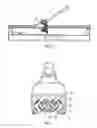
FIG. 1 shows a schematic perspective view of a manual ceramic cutter provided with a monoguide profile and of the self-adjusting device for the cutting head, according to the invention.
FIG. 2 shows a front detailed view of the cutting head and of the monoguide profile in a vertical plane cross section in which the self-adjusting device object of the invention can be seen.
FIG. 3 shows a partial elevation view of the cutting head in a vertical plane cross section, showing one of the sets of bearings intended to act on one of the sides of the monoguide profile and making up the self-adjusting device of the invention.
PREFERRED EMBODIMENT OF THE INVENTION
The exemplary embodiment shown in FIG. 1 shows a manual ceramic cutter provided with a monoguide (1) on which a cutting head (2) with the possibility of longitudinal movement is mounted.
As observed in FIGS. 2 and 3, the cutting head (2) comprises sets of bearings on the inside and on two opposite sides, each one of which comprises: a pair of fixed bearings (31, 32) longitudinally aligned and separated in the direction of movement of the cutting head (1) and an adjustable bearing (33) arranged between the two previous ones and on a plane that is perpendicular to the same.
The fixed bearings (31, 32) rest against a race (11) of the corresponding side of the guide profile (1), and the adjustable bearing (33) rests against a race (12) that is perpendicular to the previous one and corresponds to the same side of the guide profile (1).
Each adjustable bearing (33) is mounted on a rocker (4) having a first end (41) rotatably mounted on a shaft (5) fixed to the cutting head (1), and a second end (42) that presses against an elastic element (6) situated between said second end (42) of the rocker and the case of the cutting head (1).
The dimensions of the elastic element (6) and of the rocker (4) are calculated such that the adjustable bearing (33) exerts a specific pressure against the corresponding guide (12) of the monoguide profile (1) without any intervention or adjustment by the operator being necessary.
Having sufficiently described the nature of the invention, in addition to an example of preferred embodiment, it is hereby stated for the relevant purposes that the materials, shape, size and layout of the described elements may be modified, provided that it does not imply altering the essential characteristics of the invention claimed below.
Claims
1. A self-adjusting device for cutting heads for monoguide cutters, comprising:
a cutting head configured to move along a monoguide profile, which includes sets of bearings that comprise fixed bearings longitudinally aligned and separated in the direction of movement of the cutting head; and
an adjustable bearing arranged between the fixed bearings on a plane perpendicular to the fixed bearings;
wherein the fixed bearings and the adjustable bearings act on longitudinal races defined on the monoguide profile and arranged on different planes;
wherein each adjustable bearing is mounted on a rocker which has a first end rotatably mounted on a shaft fixed to the cutting head, and a second end that presses against an elastic element situated between said second end of the rocker and a case of the cutting head, said elastic element determining the pressure of the bearings against the races of the monoguide profile.
2. The device according to claim 1, wherein the cutting head comprises sets of bearings on an inside of the cutting head thereof and on opposite sides of the cutting head.
Images & Drawings included:


Sources:
- United States Patent and Trademark Office - verify current appl. status at the USPTO↗
Recent applications in this class:
- » 20250222626 2025-07-10
ADJUSTABLE TILE NIPPER - » 20180290335 2018-10-11
Cutting and separating device applicable to manual ceramic cutters - » 20170348873 2017-12-07
Portable tile cutter - » 20150202798 2015-07-23
Electric double-blade slot cutting machine - » 20150047208 2015-02-19
DOUBLE FULCRUM TOOL - » 20130180116 2013-07-18
Portable cutting machine - » 20130126574 2013-05-23
Carriage for cutting a sheet of gypsum board, cutting kit and method for implementing same
Recent applications for this Assignee:
- » 20180093393 2018-04-05
Cutting and separation head for manual ceramics cutters - » 20180050468 2018-02-22
TOOLHOLDER GUIDE SYSTEM IN MANUAL CERAMIC CUTTERS - » 20180043575 2018-02-15
Base for manual ceramic cutters - » 20180043574 2018-02-15
Removable ruler for manual ceramic cutters - » 20180043573 2018-02-15
Set square for manual ceramic cutter - » 20110023859 2011-02-03
Manual ceramics cutter