Process for Pd-catalyzed hydroxycarbonylation of diisobutene: effect of solvent
US20190194111A1
2019-06-27
16/216,004
2018-12-11
✅ Patent granted
US 10,494,324 B2
2019-12-03
-
-
Sikarl A Witherspoon
Smith, Gambrell & Russell, LLP
2038-12-11
Abstract:
Process for Pd-catalyzed hydroxycarbonylation of diisobutene: Effect of solvent
Inventors:
- Robert Franke 229 🇩🇪 Marl, Germany
- Matthias Beller 73 🇩🇪 Ostseebad Nienhagen, Germany
- Ralf Jackstell 51 🇩🇪 Rostock, Germany
- Kaiwu DONG 29 🇨🇳 Bo Zhou, China
- Rui SANG 10 🇨🇳 Liaocheng City, China
- Peter KUCMIERCZYK 47 🇩🇪 Herne, Germany
- Rui Sang 9 🇨🇳 Liaocheng, China
Assignee:
- Evonik Degussa GmbH 1,824 🇩🇪 Essen, Germany
Applicant:
Interested in similar patents?
Get notified when new applications in this technology area are published.
Classification:
B01J31/2295 » CPC further
Catalysts comprising hydrides, coordination complexes or organic compounds containing coordination complexes; Organic complexes; Unsaturated compounds used as ligands Cyclic compounds, e.g. cyclopentadienyls
B01J2531/842 » CPC further
Additional information regarding catalytic systems classified in; Complexes comprising metals of Group VIII as the central metal; Metals of the iron group Iron
B01J31/2409 » CPC further
Catalysts comprising hydrides, coordination complexes or organic compounds containing coordination complexes; Phosphines, i.e. phosphorus bonded to only carbon atoms, or to both carbon and hydrogen atoms, including e.g. sp2-hybridised phosphorus compounds such as phosphabenzene, phosphole or anionic phospholide ligands; Cyclic ligands, including e.g. non-condensed polycyclic ligands, the phosphine-P atom being a ring member or a substituent on the ring with more than one complexing phosphine-P atom
B01J2231/321 » CPC further
Catalytic reactions performed with catalysts classified in; Addition reactions at carbon centres, i.e. to either C-C or C-X multiple bonds; Addition reactions to C=C or C-C triple bonds Hydroformylation, metalformylation, carbonylation or hydroaminomethylation
C07C53/00 IPC
Saturated compounds having only one carboxyl group bound to an acyclic carbon atom or hydrogen
C07C51/14 » CPC main
Preparation of carboxylic acids or their salts, halides or anhydrides by reaction with carbon monoxide on a carbon-to-carbon unsaturated bond in organic compounds
C07C53/128 » CPC further
Saturated compounds having only one carboxyl group bound to an acyclic carbon atom or hydrogen; Acids containing more than four carbon atoms the carboxylic group being bound to a carbon atom bound to at least two other carbon atoms, e.g. neo-acids
B01J31/00 IPC
Catalysts comprising hydrides, coordination complexes or organic compounds
B01J31/24 IPC
Catalysts comprising hydrides, coordination complexes or organic compounds containing coordination complexes Phosphines, i.e. phosphorus bonded to only carbon atoms, or to both carbon and hydrogen atoms, including e.g. sp2-hybridised phosphorus compounds such as phosphabenzene, phosphole or anionic phospholide ligands
B01J31/30 » CPC further
Catalysts comprising hydrides, coordination complexes or organic compounds containing in addition, inorganic metal compounds not provided for in groups - of the platinum group metals, iron group metals or copper Halides
B01J31/22 IPC
Catalysts comprising hydrides, coordination complexes or organic compounds containing coordination complexes Organic complexes
Description
The invention relates to a process for Pd-catalyzed hydroxycarbonylation diisobutene: Effect of solvent
Carboxylic acids including propionic acid, adipic acid and fatty acids are used in the preparation of polymers, pharmaceuticals, solvents and food additives. The routes leading to carboxylic acids generally include the oxidation of hydrocarbons, alcohols or aldehydes, the oxidative cleavage of olefins by ozonolysis, the hydrolysis of triglycerides, nitriles, esters or amides, the carboxylation of Grignard or organolithium reagents, and the halogenation and subsequent hydrolysis of methyl ketones in the haloform reaction.
The hydrocarboxylation of olefins is a highly promising and environmentally-friendly method for obtaining carboxylic acids. Acetic acid is produced by carbonylation of methanol, which is carried out with iodide. In the Koch reaction, the addition of water and carbon monoxide to alkenes is catalyzed by strong bases. This method is effective with alkenes that form secondary and tertiary carbocations, e.g. isobutylene to pivalic acid. The hydrocarboxylation occurring with the simultaneous addition of CO and H2O to alkenes/alkynes provides a direct and convenient method for synthesizing carboxylic acids.
The object of the invention was to provide a process affording good conversion in the Pd-catalyzed hydroxycarbonylation of diisobutene (DIBN). This reaction should be carried out in one step.
The object is achieved by a process according to Claim 1.
Process comprising the process steps of:
a) addition of diisobutene,
b) addition of a compound comprising Pd, wherein the Pd is capable of forming a complex,
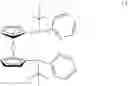
c) addition of the ligand L1:
d) addition of acetic acid,
e) feeding in CO,
f) heating the reaction mixture such that the diisobutene is converted to the compound P1:
In one variant of the process, the compound in process step b) is selected from: PdCl2, PdBr2, Pd(acac)2, Pd(dba)2 (dba=dibenzylideneacetone), PdCl2(CH3CN)2.
In one variant of the process, the compound in process step b) is Pd(acac)2.
In one variant of the process, the process comprises the additional reaction step g):
g) addition of p-toluenesulfonic acid (PTSA).
In one variant of the process, the reaction mixture is heated to a temperature in the range from 80° C. to 160° C. in process step f),
preferably to a temperature in the range from 100° C. to 140° C.
In one variant of the process, the CO is fed in in process step e) such that the reaction proceeds under a CO pressure in the range from 20 bar to 60 bar,
preferably in the range from 30 bar to 50 bar.
The invention is elucidated in more detail by means of a working example below.
A 4 ml vial was charged with [Pd(acac)2] (3.05 mg, 0.25 mol %), L1 (20.64 mg, 1.0 mol %), PTSA*H2O (28.5 mg, 3.75 mol %) and an oven-dried stirrer bar. The vial was then sealed with septa (PTFE-coated styrene-butadiene rubber) and a phenol resin cap. The vial was evacuated and refilled with argon three times. H2O (0.5 ml), acetic acid (1.5 ml) and diisobutene (DIBN) (4.0 mmol) were added to the vial with a syringe. The vial was placed in an alloy plate, which was transferred to an autoclave (300 ml) of the 4560 series from Parr Instruments under argon atmosphere. After flushing the autoclave three times with CO, the pressure of CO was increased to 40 bar at room temperature. The reaction was conducted at 120°C. for 20 h. On conclusion of the reaction, the autoclave was cooled down to room temperature and cautiously decompressed. Isooctane (100 μl) was then added as internal standard. Conversion was measured by GC analysis.
The experiment described above was repeated with variation of the solvent. All other parameters were maintained.
The results are compiled in the following table.
| Entry | Solvent | Conversion (%) | |
| 1 | 3,5,5-trimethylhexanoic acid | 88 | |
| 2 | Formic acid | 48 | |
| 3* | Acetic acid | >99 | |
| *inventive process |
As the experimental results show, the object is achieved by the inventive process.
Claims
1. Process comprising the process steps of:
a) addition of diisobutene,
b) addition of a compound comprising Pd, wherein the Pd is capable of forming a complex,
c) addition of the ligand L1:
d) addition of acetic acid,
e) feeding in CO,
f) heating the reaction mixture such that the diisobutene is converted to the compound P1:
2. Process according to claim 1,
wherein the compound in process step b) is selected from:
PdCl2, PdBr2, Pd(acac)2, Pd(dba)2 (dba=dibenzylideneacetone), PdCl2(CH3CN)2.
3. Process according to claim 1,
wherein the process comprises the additional reaction step g):
g) addition of p-toluenesulfonic acid.
4. Process according to claim 1,
wherein the reaction mixture is heated to a temperature in the range from 80° C. to 160° C. in process step f).
5. Process according to claim 1,
wherein the CO is fed in in process step e) such that the reaction proceeds under a CO pressure in the range from 20 bar to 60 bar.
Images & Drawings included:


Sources:
- United States Patent and Trademark Office - verify current appl. status at the USPTO↗
Recent applications in this class:
- » 20210253507 2021-08-19
Method for preparing 3(4),8(9)-bisformyltricyclo[5.2.1.0]decane - » 20190194113 2019-06-27
Process for Pd-catalyzed hydroxycarbonylation of diisobutene: acetic acid/diisobutene ratio - » 20190194112 2019-06-27
Process for Pd-catalyzed hydroxycarbonylation of diisobutene: sulfuric acid/ligand ratio - » 20190194110 2019-06-27
Process for the direct conversion of alkenes to carboxylic acids - » 20190194109 2019-06-27
Process for the direct conversion of diisobutene to a carboxylic acid - » 20190194108 2019-06-27
Process for Pd-catalyzed hydroxycarbonylation of diisobutene: ratio of 3,5,5-trimethylhexanoic acid/HO - » 20190135726 2019-05-09
Process for the sustainable production of acrylic acid - » 20180297926 2018-10-18
Hydroformylation process for producing 1,6-disubstituted hexane derivatives - » 20180057439 2018-03-01
Process For The Sustainable Production Of Acrylic Acid - » 20170313642 2017-11-02
Catalyst for the gas phase production of carboxylic acids
Recent applications for this Assignee:
- » 20210228653 2021-07-29
BACILLUS LICHENIFORMIS STRAIN WITH PROBIOTIC ACTIVITY - » 20200231537 2020-07-23
Reductive alkylation of amines with orthocarboxylic acid esters - » 20200230703 2020-07-23
PROCESS FOR PRODUCING TUNGSTEN OXIDE AND TUNGSTEN MIXED OXIDES - » 20200199492 2020-06-25
Biodegradable cleaning composition - » 20200165278 2020-05-28
Halogermanides and methods for the preparation thereof - » 20200115334 2020-04-16
Method for preparing methionine - » 20200109102 2020-04-09
Process for hydroformylating short-chain olefins using a heterogenized catalyst system without ionic liquid - » 20200109101 2020-04-09
Process for hydroformylating short-chain olefins in the gas phase - » 20200109056 2020-04-09
Stannous compatible silica - » 20200087446 2020-03-19
Low temperature anhydride epoxy cured systems