Penetrating prime emulsion
US20220119312A1
2022-04-21
17/505,892
2021-10-20
✅ Patent granted
US 12,269,774 B2
2025-04-08
-
-
Raymond W Addie
Head, Johnson, Kachigian & Wilkinson, PC
2043-12-25
Abstract:
A bituminous emulsion that is capable of being used as a penetrating prime emulsion. The penetrating prime emulsion may be capable of penetrating compacted soil without the use of solvent, and may toughen quickly to allow early application of a paved layer on the surface. The bituminous emulsion may comprise bituminous material and an emulsifier comprising octylphenol ethoxylates, and optionally further comprising tallow diamine betaines or other betaines.
Assignee:
- ArrMaz Products Inc. 9 🇺🇸 Mulberry, FL, United States
Applicant:
Interested in similar patents?
Get notified when new applications in this technology area are published.
Classification:
E01C19/16 » CPC further
Machines, tools or auxiliary devices for preparing or distributing paving materials, for working the placed materials, or for forming, consolidating, or finishing the paving for distributing granular or liquid materials for applying or spreading liquid materials, e.g. bitumen slurries
E01C21/00 » CPC further
Apparatus or processes for surface soil stabilisation for road building or like purposes, e.g. mixing local aggregate with binder
C04B2103/40 » CPC further
Function or property of ingredients for mortars, concrete or artificial stone Surface-active agents, dispersants
C04B24/12 IPC
Use of organic materials as active ingredients for mortars, concrete or artificial stone, e.g. plasticisers Nitrogen containing compounds organic derivatives of hydrazine
C09K17/34 » CPC further
Soil-conditioning materials or soil-stabilising materials containing organic compounds only; Prepolymers; Macromolecular compounds Bituminous materials
C04B2111/00741 » CPC further
Mortars, concrete or artificial stone or mixtures to prepare them, characterised by specific function, property or use; Uses not provided for elsewhere in for soil stabilisation Preventing erosion
C04B2111/0075 » CPC further
Mortars, concrete or artificial stone or mixtures to prepare them, characterised by specific function, property or use; Uses not provided for elsewhere in for road construction
E01C19/48 » CPC further
Machines, tools or auxiliary devices for preparing or distributing paving materials, for working the placed materials, or for forming, consolidating, or finishing the paving for laying-down the materials and consolidating them, or finishing the surface, e.g. slip forms therefor, forming kerbs or gutters in a continuous operation
C04B26/26 » CPC main
Compositions of mortars, concrete or artificial stone, containing only organic binders, e.g. polymer or resin concrete; Macromolecular compounds Bituminous materials, e.g. tar, pitch
C04B24/123 » CPC further
Use of organic materials as active ingredients for mortars, concrete or artificial stone, e.g. plasticisers; Nitrogen containing compounds organic derivatives of hydrazine Amino-carboxylic acids
E01C7/36 » CPC further
Coherent pavings made by subjecting soil to stabilisation
Description
CROSS REFERENCE
This application is based on and claims priority to U.S. Provisional Application No. 63/093,896 filed Oct. 20, 2020.
BACKGROUND OF THE INVENTION
Field of the Invention
This invention relates generally to bituminous emulsions, and more particularly, but not by way of limitation, to a bituminous emulsion for use in road applications, specifically for use as a penetrating prime solution that is essentially solvent free.
Description of the Related Art
Building of a road generally starts with some preparation of a soil substrate and is possibly followed by a granular base. A surface layer or series or surface layers are applied to the granular base to form the final road structure. The granular base can become unstable from water intrusion or vehicular traffic. If this occurs, the paved layer may become unstable and delaminate, causing poor performance.
To increase the water proofing of the granular base and toughen the soil or granular base, a penetrating prime material is routinely used. The prime material is usually a bituminous material that is applied to the compacted surface of the granular or soil base to toughen and waterproof. When sufficiently hardened, the first paved layer is usually applied. See U.S. Pat. No. 4,364,568 for a good description.
In the bituminous materials industry, penetrating prime coats or similar materials were originally low viscosity binders that were applied to a surface and were designed to penetrate, bond, and stabilize. Bitumen viscosity is generally too high to penetrate a soil or granular base and thus bitumen viscosity is typically reduced with diluent to aid penetration. The type of diluent or solvent is highly variable. Solvents may be petroleum based, plant based, or even recycled materials like waxes, recycled motor oil products, limonene, vegetable oils, tall oils, and the like. The action of the viscosity-reduced bitumen is to penetrate the granule or soil base and harden over time. Generally, the lower the viscosity the quicker and deeper the binder soaks into the surface. If no surface layers are utilized, the coating may be called a dust palliative.
As the diluent evaporates, the viscosity of the binder increases and the surface toughens. Generally, a freshly coated surface would require a week or more time to sufficiently toughen before it became suitable for a paved layer. Unfortunately, the solvent would either volatilize into the atmosphere or up into the first paved layer, or even continue to migrate through the subgrade over time.
Later, emulsified bituminous materials were used as a penetrating prime coat. Unfortunately, emulsified asphalt did not penetrate the compacted granular base or soil substrate consistently. The emulsion may pool on the surface and eventually dry out, leaving a very sticky surface. To afford better penetration into the granule surface or soil, the emulsified asphalt prime materials included sufficient amounts of solvent to allow the bitumen to penetrate.
The production of the emulsions requires an emulsifier. Suitable emulsifiers include anionic, nonionic, cationic, zwitterionic, or amphoteric emulsifiers or a combination thereof. Generally, slow setting emulsifiers have been utilized to produce penetrating prime emulsions, like lignin amines, betaines, ethoxylated nonylphenols, ethoxylated alcohols, tall oil, resins, fatty amines, fatty amine ethoxylates, and blends thereof to name a few, as well as their corresponding salts and derivatives.
Solid or granular bases that are to be stabilized with asphalt emulsions can be of varying compacted level. Loose materials contain high air voids and many emulsified products work well to penetrate. As compaction increases, most asphalt emulsion products need solvents to assist in the penetration. There is currently no test to simulate compacted soil for the purpose of determining the penetration of a bituminous emulsion. Such test would separate the current art from reality for the patents on prime coat material generally fail to penetrate a compacted specimen.
Based on the foregoing, it is desirable to provide a bituminous emulsion for use as a penetrating prime solution.
It is further desirable for the bituminous emulsion to be essentially solvent free.
It is further desirable for the bituminous emulsion to toughen quickly.
It is further desirable to provide a test procedure to compact a soil sample to simulate compacted soil in the field to test the penetration of the bituminous emulsion.
SUMMARY OF THE INVENTION
In general, in a first aspect, the invention relates to a bituminous emulsion comprising binding material and emulsifier, the emulsifier comprising octylphenol ethoxylates at a rate of 0.05% to 10% by weight of the bituminous emulsion. The bituminous emulsion may further comprise a second emulsifier at a rate of 0.05% to 10% by weight of the bituminous emulsion. The second emulsifier may comprise betaines, such as tallow diamine betaines or tallow diamine ethoxylate betaines. The bituminous emulsion may be solvent free.
In a second aspect, the invention pertains to a method of creating and using a penetrating prime emulsion. The method may comprise selecting a binding material; producing an aqueous phase, the aqueous phase comprising an emulsifier, the emulsifier comprising octylphenol ethoxylates at a rate of 0.05% to 10% by weight of the penetrating prime emulsion; and emulsifying the binding material in a range of 5% to 75% binding material phase and 10% to 95% aqueous phase to produce the penetrating prime emulsion. The aqueous phase may further comprise a second emulsifier at a rate of 0.05% to 10% by weight of the penetrating prime emulsion. The second emulsifier may comprise betaines, such as tallow diamine betaines or tallow diamine ethoxylate betaines.
The method may further comprise applying the penetrating prime emulsion to a surface. The method may further comprise waiting three days, one day, 8 hours, or one hour and then applying a paved layer to the surface.
The method may further comprise testing the penetrating prime emulsion by applying it to a compacted soil specimen. The method may further comprise first creating the compacted soil specimen by: separating the aggregate to 100% passing the #8 sieve; adding 5% water to assist compaction; compacting at 100-135 psi or higher; drying out the sample overnight at +100 C; and cooling to room temperature.
DETAILED DESCRIPTION OF THE INVENTION
The devices and methods discussed herein are merely illustrative of specific manners in which to make and use this invention and are not to be interpreted as limiting in scope.
While the devices and methods have been described with a certain degree of particularity, it is to be noted that many modifications may be made in the details of the construction and the arrangement of the devices and components without departing from the spirit and scope of this disclosure. It is understood that the devices and methods are not limited to the embodiments set forth herein for purposes of exemplification.
In general, in a first aspect, the invention relates to a composition for the production of a bituminous emulsion. The bituminous emulsion may be particularly suited for use in road applications. More specifically, the bituminous emulsion may be suitable for use as a penetrating prime emulsion. The bituminous emulsion may be used as a penetrating prime solution that is essentially solvent free.
The bituminous emulsion, when applied to a surface, may toughen quickly enough and be suitable for application of a paved layer in less than a week, in less than a few days, in less than a day, or even in less than an hour. The surface may be a granular base, which may be understood to mean divided mineral materials from quarriers, bituminous mix aggregates, milled fragments, clinker or breeze, scoria and slags, and also concrete demolition recycling products, or other surface materials.
The bituminous emulsion may comprise binding material and an emulsifier. The bituminous material may be asphalt, coal tar, bitumen, resins, other suitable material, or a combination thereof. Within the context of the present invention, the expression “bituminous material” may be understood to mean natural bitumen and bitumens derived from a mineral oil and the resulting mixes thereof. Bitumens obtained by cracking and tars are also considered here as bituminous materials within the meaning of the present invention, and also the mixes which may result therefrom. Blown bitumens—residues of distillation, vacuum distillation, or precipitation, for example obtained by propane precipitation—are examples considered within the context of this invention. Also considered here are bitumens diluted using petroleum solvents, bitumens diluted using vegetable oils, and polymer bitumens. The bituminous materials listed above may be anhydrous, as much as is possible on the industrial production scale in question.
The emulsifier may be octylphenol ethoxylates and may be used in a quantity of 0.05% to 10% by weight of the emulsion. The octylphenol ethoxylates may be used alone or in combination with betaines, which may also be used in a quantity of 0.05% to 10% by weight of the emulsion. The betaines may preferably be tallow diamine betaines, or may be tallow diamine ethoxylate betaines.
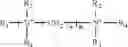
Specifically, the reaction product for use herein may either be a methylated tallow alkyl diamine betaine or a ethoxylated (or polyethoxylated) tallow alkyl diamine betaine-type surfactant. The betaine-type amphoteric surfactant may be representable by the general formula:
Where R1 is an alkyl chain, saturated or unsaturated, containing from 10 to 20 carbon atoms.
Where R2 can be H, CH3 or a group —(CH2CH2O)p—H
Where R3 can be CH3, —(CH2CH2O)p—H or R2
Where R4 can be H or —CH2CO2− Na+
Where n is an integer that can be from 0 to 3
Where m is an integer or any number greater than 0
Where p can be an integer number from 1 to 15
The process for obtaining these surfactants may be as follows: The amine, taken from a precursor of either a methylated tallow alkyl diamine or ethoxylated (or polyethoxylated) tallow alkyl diamine, is reacted with sodium 2-chloroacetate under mild reaction conditions, 75° C.-95° C., which favors fewer side products. The reaction is carried out in either water or a water-glycol blend in the presence of a base (sodium hydroxide) to keep the pH of the reaction mixture between 7 and 9. These reaction conditions afford a high conversion to the betaine-type amphoteric surfactant.
The bituminous emulsion may be created by first selecting a binding material, which may be asphalt, coal tar, bitumen, resins, other suitable material, or a combination thereof. Second, an aqueous phase may be produced by selecting a primary emulsifier, such as octylphenol ethoxylate, which may be used in a quantity of 0.05% to 10% by weight of the emulsion, and optionally selecting a secondary emulsifier, such as tallow amine betaine or other suitable emulsifiers, which also may be used in a quantity of 0.05% to 10% by weight of the emulsifier. Third, the binding material emulsion may be created by emulsifying the binding material in a range of 5% to 75% binding material phase and 10% to 95% aqueous phase.
The bituminous emulsion may be suitable for use as a penetrating prime emulsion. The penetrating prime emulsion may be applied to a surface. The emulsion may penetrate the surface, creating an essentially tack free surface. The emulsion may penetrate the surface in less than 1 hour, less than 30 minutes, less than 15 minutes, less than 5 minutes, or most preferably less than 1 minute. The emulsion may toughen quickly, allowing application of a paved layer in less than 3 days, less than 1 day, less than 8 hours, or most preferably less than 1 hour.
The bituminous emulsion may be tested by applying it to a simulated compacted soil specimen. The simulated compacted soil specimen may be produced according to the following steps:
-
- 1. Separate the aggregate to 100% passing the #8 sieve
- 2. Add 5% water to assist compaction
- 3. Compact at 100-135 psi or higher
- 4. Dry out the sample overnight at +100 C
- 5. Cool to room temperature
This compacted specimen may then be used to determine the penetration of the bituminous emulsion. This test may separate the current art from reality for the patents on prime coat material generally fail to penetrate a compacted specimen.
EXAMPLES
Simulated compacted soil specimens prepared as described above were used to test a variety of emulsions, both with and without fuel oil as a solvent. In each instance, the emulsion was applied to the simulated compacted soil specimen. The time in seconds for the emulsion to soak into the compacted soil specimen was recorded, as was the condition of the cured surface.
The results of testing with a typical chemistry is shown below:
| Penetra- | ||||
| Nouryon | tion | |||
| RedicoteE-11 | 1# FO | Sec | Depth mm | Cured Surface |
| 2.0% | 30% | 231 | 5 | Non Tacky or Adhesive |
| 2.0% | 20% | 300+ | 3 | Tacky and Adhesive |
| 2.0% | 10% | 300+ | 2 | Very Tacky and Adhesive |
| 2.0% | 0% | 300+ | 1 | Very Tacky and Adhesive |
| PG 58-28 | ||||
| Asphalt | ||||
As fuel oil is added, eventually the emulsion soaks into the compacted substrate. In this case, E-11 requires up to 30% fuel oil to penetrate the surface in less than 5 minutes. At 20% or less, the surface after full penetration is still tacky or very tacky to the touch (sticky) whereby tires of vehicles will probably pick-up the asphalt layer as traffic drives. This is a typical chemistry used and is considered as state of the art.
Non-ionic chemistry, specifically ethoxylated nonylphenols, do not work at all:
| Penetration | ||||
| NPE 30 | 1# FO | Sec | Depth mm | Cured Surface |
| 2.0% | 30% | 300+ | 1 | very tacky and adhesive |
| 2.0% | 20% | 300+ | 1 | very tacky and adhesive |
| 2.0% | 10% | 300+ | 1 | very tacky and adhesive |
| 2.0% | 0% | 300+ | 1 | very tacky and adhesive |
| PG 58-28 | ||||
| Asphalt | ||||
Surprisingly, octylphenol ethoxylated was found to work well, without the necessity of fuel oil:
| Octylphenol | Penetra- | |||
| Ethoxylate, | tion | |||
| 30 mol | 1# FO | Sec | Depth mm | Cured Surface |
| 1.5% | 0% | 41 | 3 | Non Tacky or adhesive |
| 1.3% | 0% | 52 | 3 | Tacky and Adhesive |
| 1.0% | 0% | 132 | 1 | Very Tacky and Adhesive |
| PG 58-28 | ||||
| Asphalt | ||||
Even at lower chemical loadings, the octylphenol ethoxylate penetrates very quickly, almost instantaneously, and at 1.25% or higher, the use of octylphenol ethoxylate creates a suitable surface for repaving.
Lastly, a combination of emulsifiers was found to be even more preferred. One non-limiting example is as follows:
| Octylphenol | Tallow | Total | Penetra- | ||
| Ethoxylate, | Diamine | Emul- | tion | ||
| 30 mol | Betaine | sifier | Sec | Depth mm | Cured Surface |
| 1.50% | 0.50% | 2.00% | 16 | 6 | Non Tacky or |
| Adhesive | |||||
| 1.13% | 0.38% | 1.51% | 18 | 4 | Non Tacky or |
| Adhesive | |||||
| 0.75% | 0.25% | 1.00% | 27 | 3 | Non Tacky or |
| Adhesive | |||||
| PG 58-28 | |||||
| Asphalt | |||||
The octylphenol ethoxylate and betaine also perform remarkable in dust control applications without the need for fuel oil. Typical dust control dilutions like at 20% solids, penetrate deep with no residual tack:
| Octylphenol | Tallow | Total | Penetra- | ||
| Ethoxylate, | Diamine | Emul- | tion | ||
| 30 mol | Betaine | sifier | Sec | Depth mm | Cured Surface |
| 1.50% | 0.50% | 2.00% | 2 | 7 | Non Tacky or |
| Adhesive | |||||
| PG 58-28 | |||||
| Asphalt | |||||
This is opposed to Nouryon RedicoteE-11, which requires high percentages of fuel oil to perform:
| Penetra- | ||||
| Nouryon | tion | |||
| RedicoteE-11 | 1# FO % | Sec | Depth mm | Cured Surface |
| 2.00% | 20% | 52 | 6 | Non Tacky or Adhesive |
| 2.00% | 0% | 25 | 2 | Tacky and Adhesive |
| PG 58-28 | ||||
| Asphalt | ||||
Whereas, the devices and methods have been described in relation to the drawings and claims, it should be understood that other and further modifications, apart from those shown or suggested herein, may be made within the spirit and scope of this invention.
Claims
What is claimed is:1. A bituminous emulsion comprising:
binding material; and
emulsifier, the emulsifier comprising octylphenol ethoxylates at a rate of 0.05% to 10% by weight of the bituminous emulsion.
2. The bituminous emulsion of claim 1 further comprising a second emulsifier at a rate of 0.05% to 10% by weight of the bituminous emulsion.
3. The bituminous emulsion of claim 2 where the second emulsifier comprises betaines.
4. The bituminous emulsion of claim 3 where the betaines are methylated tallow alkyl diamine betaines.
5. The bituminous emulsion of claim 3 where the betaines are ethoxylated or polyethoxylated tallow alkyl diamine betaines.
6. The bituminous emulsion of claim 1 where the bituminous emulsion is solvent free.
7. A method of creating and using a penetrating prime emulsion, the method comprising:
selecting a binding material;
producing an aqueous phase, the aqueous phase comprising an emulsifier, the emulsifier comprising octylphenol ethoxylates at a rate of 0.05% to 10% by weight of the penetrating prime emulsion; and
emulsifying the binding material in a range of 5% to 75% binding material phase and 10% to 95% aqueous phase to produce the penetrating prime emulsion.
8. The method of claim 7, the aqueous phase further comprising a second emulsifier at a rate of 0.05% to 10% by weight of the penetrating prime emulsion.
9. The method of claim 8 where the second emulsifier comprises betaines.
10. The method of claim 9 where the betaines are methylated tallow alkyl diamine betaines.
11. The method of claim 9 where the betaines are ethoxylated or polyethoxylated tallow alkyl diamine betaines.
12. The method of claim 7 where the penetrating prime emulsion is solvent free.
13. The method of claim 7 further comprising applying the penetrating prime emulsion to a surface.
14. The method of claim 13 further comprising:
waiting three days; and
then applying a paved layer to the surface.
15. The method of claim 13 further comprising:
waiting one day; and
then applying a paved layer to the surface.
16. The method of claim 13 further comprising:
waiting 8 hours; and
then applying a paved layer to the surface.
17. The method of claim 13 further comprising:
waiting one hour; and
then applying a paved layer to the surface.
18. The method of claim 7 further comprising testing the penetrating prime emulsion by applying it to a compacted soil specimen.
19. The method of claim 18 further comprising first creating the compacted soil specimen by:
separating the aggregate to 100% passing the #8 sieve;
adding 5% water to assist compaction;
compacting at 100-135 psi or higher;
drying out the sample overnight at +100 C; and
cooling to room temperature
20. A method of dust control, the method comprising:
applying a bituminous emulsion to a surface, the bituminous emulsion comprising binding material and emulsifier, the emulsifier comprising octylphenol ethoxylates at a rate of 0.05% to 10% by weight of the bituminous emulsion.
21. The method of claim 20 where the bituminous emulsion further comprises a second emulsifier at a rate of 0.05% to 10% by weight of the bituminous emulsion.
22. The bituminous emulsion of claim 21 where the second emulsifier comprises betaines.
23. The bituminous emulsion of claim 22 where the betaines are methylated tallow alkyl diamine betaines.
24. The bituminous emulsion of claim 22 where the betaines are ethoxylated or polyethoxylated tallow alkyl diamine betaines.
25. The bituminous emulsion of claim 20 where the bituminous emulsion is solvent free.
Images & Drawings included:
Sources:
- United States Patent and Trademark Office - verify current appl. status at the USPTO↗
Recent applications in this class:
- » 20250289758 2025-09-18
Paving Asphalt Binder - » 20250206667 2025-06-26
ELECTRICALLY-CONDUCTIVE ASPHALT CONCRETE CONTAINING CARBON FIBERS - » 20250206666 2025-06-26
COAL-DERIVED CARBON-BASED STRUCTURAL UNITS AND METHODS FABRICATION - » 20250145529 2025-05-08
MIXED WASTE PLASTICS COMPATIBILIZERS FOR ASPHALT - » 20250034043 2025-01-30
Basalt Fiber Reinforced Asphalt Concrete - » 20240270648 2024-08-15
METHODS & COMPOSITIONS TO INCREASE PERFORMANCE OF ASPHALT CEMENT CONCRETE COMPRISING RECYCLED ASPHALT PAVEMENT - » 20240076236 2024-03-07
REJUVENATING COMPOUNDS IN HIGH PERFORMANCE ASPHALT COMPOSITIONS WITH HIGH RECYCLED CONTENT - » 20240010562 2024-01-11
RUBBER-CONTAINING ASPHALT COMPOSITIONS AND RELATED METHODS - » 20230374391 2023-11-23
Asphalt air blowing with liquid jet ejector and coil - » 20230357083 2023-11-09
DUAL APPLICATION OF ROOFING GRANULES TO BITUMINOUS ROOFING MATERIAL
Recent applications for this Assignee:
- » 20230348336 2023-11-02
DUST AND ANTICAKING RESISTANT FERTILIZER - » 20220388924 2022-12-08
DUST SUPPRESSANT AND ANTI-CAKING COATING FOR HYGROSCOPIC SUBSTRATES - » 20220348519 2022-11-03
GREEN COATING CONTAINING BIOSTIMULANTS FOR HYGROSCOPIC SUBSTRATES - » 20220348518 2022-11-03
NOVEL CHEMISTRIES TO ACHIEVE A TOTAL AGRONOMIC COATING CONTAINING MICRONUTRIENTS AND/OR BIOSTIMULANTS - » 20220348517 2022-11-03
NOVEL CHEMISTRIES TO ACHIEVE A TOTAL AGRONOMIC COATING CONTAINING MICRONUTRIENTS AND/OR BIOCATALYSTS - » 20220281781 2022-09-08
BINDERS FOR HYDROSCOPIC SUBSTRATES - » 20220055965 2022-02-24
Fertilizer coating for dust control and/or anti-caking - » 20210395148 2021-12-23
STRAIN TOLERANT RECYCLED ASPHALT PAVEMENT COMPOSITION