Environmental barrier fiber coating
US20160159701A1
2016-06-09
14/207,102
2014-03-12
✅ Patent granted
US 9,676,674 B2
2017-06-13
-
-
Noah Wiese
Brinks Gilson & Lione
2035-06-12
Abstract:
A fiber having an environmental barrier coating is provided that includes, in one illustrative form, a Hi Nicalon preform assembled in a tooling for chemical vapor infiltration and cleaned to remove sizing char from fibers of the Hi Nicalon preform; a ytterbium doped silicon carbide coat located over the Hi Nicalon preform; a boron nitride interface coat applied over the ytterbium doped silicon carbide coat; and a silicon carbide coat applied over the boron nitride interface coat.
Assignee:
- ROLLS-ROYCE CORPORATION 1,426 🇺🇸 INDIANAPOLIS, IN, United States
Applicant:
Interested in similar patents?
Get notified when new applications in this technology area are published.
Classification:
C04B35/563 » CPC further
Shaped ceramic products characterised by their composition ; Ceramics compositions ; Processing powders of inorganic compounds preparatory to the manufacturing of ceramic products based on non-oxide ceramics based on carbides or oxycarbides based on boron carbide
C04B35/565 » CPC further
Shaped ceramic products characterised by their composition ; Ceramics compositions ; Processing powders of inorganic compounds preparatory to the manufacturing of ceramic products based on non-oxide ceramics based on carbides or oxycarbides based on silicon carbide
C04B35/573 » CPC further
Shaped ceramic products characterised by their composition ; Ceramics compositions ; Processing powders of inorganic compounds preparatory to the manufacturing of ceramic products based on non-oxide ceramics based on carbides or oxycarbides based on silicon carbide obtained by reaction sintering or recrystallisation
C04B35/6286 » CPC further
Shaped ceramic products characterised by their composition ; Ceramics compositions ; Processing powders of inorganic compounds preparatory to the manufacturing of ceramic products; Forming processes; Processing powders of inorganic compounds preparatory to the manufacturing of ceramic products; Preparing or treating the powders individually or as batches ; preparing or treating macroscopic reinforcing agents for ceramic products, e.g. fibres; mechanical aspects section; Coating the powders or the macroscopic reinforcing agents; Coating fibres with non-oxide ceramics Carbides
C04B35/62884 » CPC further
Shaped ceramic products characterised by their composition ; Ceramics compositions ; Processing powders of inorganic compounds preparatory to the manufacturing of ceramic products; Forming processes; Processing powders of inorganic compounds preparatory to the manufacturing of ceramic products; Preparing or treating the powders individually or as batches ; preparing or treating macroscopic reinforcing agents for ceramic products, e.g. fibres; mechanical aspects section; Coating the powders or the macroscopic reinforcing agents by gas phase techniques
C04B35/62894 » CPC further
Shaped ceramic products characterised by their composition ; Ceramics compositions ; Processing powders of inorganic compounds preparatory to the manufacturing of ceramic products; Forming processes; Processing powders of inorganic compounds preparatory to the manufacturing of ceramic products; Preparing or treating the powders individually or as batches ; preparing or treating macroscopic reinforcing agents for ceramic products, e.g. fibres; mechanical aspects section; Coating the powders or the macroscopic reinforcing agents with more than one coating layer
C04B35/62897 » CPC further
Shaped ceramic products characterised by their composition ; Ceramics compositions ; Processing powders of inorganic compounds preparatory to the manufacturing of ceramic products; Forming processes; Processing powders of inorganic compounds preparatory to the manufacturing of ceramic products; Preparing or treating the powders individually or as batches ; preparing or treating macroscopic reinforcing agents for ceramic products, e.g. fibres; mechanical aspects section; Coating the powders or the macroscopic reinforcing agents Coatings characterised by their thickness
C09D1/00 » CPC further
Coating compositions, e.g. paints, varnishes or lacquers, based on inorganic substances
C09D5/00 » CPC further
Coating compositions, e.g. paints, varnishes or lacquers, characterised by their physical nature or the effects produced ; Filling pastes
C23C16/325 » CPC further
Chemical coating by decomposition of gaseous compounds, without leaving reaction products of surface material in the coating, i.e. chemical vapour deposition [CVD] processes characterised by the deposition of inorganic material, other than metallic material; Deposition of compounds, mixtures or solid solutions, e.g. borides, carbides, nitrides; Carbides Silicon carbide
C23C16/342 » CPC further
Chemical coating by decomposition of gaseous compounds, without leaving reaction products of surface material in the coating, i.e. chemical vapour deposition [CVD] processes characterised by the deposition of inorganic material, other than metallic material; Deposition of compounds, mixtures or solid solutions, e.g. borides, carbides, nitrides; Nitrides Boron nitride
C04B2235/3224 » CPC further
Aspects relating to ceramic starting mixtures or sintered ceramic products; Composition of constituents of the starting material or of secondary phases of the final product; Constituents and secondary phases not being of a fibrous nature; Metal oxides, mixed metal oxides, or oxide-forming salts thereof, e.g. carbonates, nitrates, (oxy)hydroxides, chlorides Rare earth oxide or oxide forming salts thereof, e.g. scandium oxide
C04B2235/3225 » CPC further
Aspects relating to ceramic starting mixtures or sintered ceramic products; Composition of constituents of the starting material or of secondary phases of the final product; Constituents and secondary phases not being of a fibrous nature; Metal oxides, mixed metal oxides, or oxide-forming salts thereof, e.g. carbonates, nitrates, (oxy)hydroxides, chlorides; Rare earth oxide or oxide forming salts thereof, e.g. scandium oxide Yttrium oxide or oxide-forming salts thereof
C04B2235/428 » CPC further
Aspects relating to ceramic starting mixtures or sintered ceramic products; Composition of constituents of the starting material or of secondary phases of the final product; Constituents and secondary phases not being of a fibrous nature; Non metallic elements added as constituents or additives, e.g. sulfur, phosphor, selenium or tellurium Silicon
C04B2235/614 » CPC further
Aspects relating to ceramic starting mixtures or sintered ceramic products; Aspects relating to the preparation, properties or mechanical treatment of green bodies or pre-forms Gas infiltration of green bodies or pre-forms
C04B2235/616 » CPC further
Aspects relating to ceramic starting mixtures or sintered ceramic products; Aspects relating to the preparation, properties or mechanical treatment of green bodies or pre-forms Liquid infiltration of green bodies or pre-forms
B32B9/00 IPC
Layered products characterised by particular substances used
B32B9/00 IPC
Layered products comprising a layer of a particular substance not covered by groups -
D02G3/00 IPC
Yarns or threads, e.g. fancy yarns; Processes or apparatus for the production thereof, not otherwise provided for
C04B41/85 » CPC main
After-treatment of mortars, concrete, artificial stone or ceramics; Treatment of natural stone of only ceramics; Coating or impregnation with inorganic materials
C04B35/628 IPC
Shaped ceramic products characterised by their composition ; Ceramics compositions ; Processing powders of inorganic compounds preparatory to the manufacturing of ceramic products; Forming processes; Processing powders of inorganic compounds preparatory to the manufacturing of ceramic products; Preparing or treating the powders individually or as batches ; preparing or treating macroscopic reinforcing agents for ceramic products, e.g. fibres; mechanical aspects section Coating the powders or the macroscopic reinforcing agents
C04B35/80 IPC
Shaped ceramic products characterised by their composition ; Ceramics compositions ; Processing powders of inorganic compounds preparatory to the manufacturing of ceramic products; Ceramic products containing macroscopic reinforcing agents containing non-metallic materials Fibres, filaments, whiskers, platelets, or the like
C04B41/88 » CPC further
After-treatment of mortars, concrete, artificial stone or ceramics; Treatment of natural stone of only ceramics; Coating or impregnation with inorganic materials Metals
C23C16/32 IPC
Chemical coating by decomposition of gaseous compounds, without leaving reaction products of surface material in the coating, i.e. chemical vapour deposition [CVD] processes characterised by the deposition of inorganic material, other than metallic material; Deposition of compounds, mixtures or solid solutions, e.g. borides, carbides, nitrides Carbides
C23C16/34 IPC
Chemical coating by decomposition of gaseous compounds, without leaving reaction products of surface material in the coating, i.e. chemical vapour deposition [CVD] processes characterised by the deposition of inorganic material, other than metallic material; Deposition of compounds, mixtures or solid solutions, e.g. borides, carbides, nitrides Nitrides
Description
RELATED APPLICATIONS
This application is related to and claims priority to U.S. Provisional Patent Application Ser. No. 61/784,653, filed on Mar. 14, 2013 entitled “Environmental Barrier Fiber Coating.” The subject matter disclosed in that provisional application is hereby expressly incorporated into the present application in its entirety.
FIELD OF THE DISCLOSURE
The present disclosure is related to environmental barrier coatings, and particularly to environmental barrier coatings located adjacent the fiber.
BACKGROUND AND SUMMARY
Economical and environmental concerns, i.e., improving efficiency and reducing emissions, are driving forces behind the ever increasing demand for higher gas turbine inlet temperatures. A limitation to the efficiency and emissions of many gas turbine engines is the temperature capability of hot section components such as blades, vanes, blade tracks, and combustor liners. Technology improvements in cooling, materials, and coatings are required to achieve higher inlet temperatures. As the temperature capability of Ni-based superalloys has approached their intrinsic limit, further improvements in their temperature capability have become increasingly difficult. Therefore, the emphasis in gas turbine materials development has shifted to thermal barrier coatings (TBC) and next generation, high temperature materials, such as ceramic-based materials.
Silicon Carbide/Silicon Carbide (SiC/SiC) Ceramic Material Composite (CMC) materials are prime candidates to replace Ni-based superalloys for hot section structural components for next generation gas turbine engines. The key benefit of SiC/SiC CMC engine components is their excellent high temperature mechanical, physical, and chemical properties which allow gas turbine engines to operate at much higher temperatures than the current engines having superalloy components. SiC/SiC CMCs also provide the additional benefit of damage tolerance, which monolithic ceramics do not possess.
The present disclosure is related to environmental barrier coatings that extend the life of components in a turbine environment.
An illustrative embodiment of the present disclosure provides a fiber having an environmental barrier coating, comprising: a Hi Nicalon preform assembled in a tooling for chemical vapor infiltration and cleaned to remove sizing char from fibers of the Hi Nicalon preform; a ytterbium doped silicon carbide coat located over the Hi Nicalon preform; a boron nitride interface coat applied over the ytterbium doped silicon carbide coat; and a silicon carbide coat applied over the boron nitride interface coat.
In the above and other illustrative embodiments the fiber having the environmental barrier coating may further comprise: the boron nitride interface coat has a thickness of about 0.5 pμm; the silicon carbide coat has a thickness of about 2 μm; the Hi Nicalon preform includes about 36% fiber volume and cleaned using air at about 600 degrees C.; the preform being completed with slurry and melt infiltration; the ytterbium doped silicon carbide coat being applied by chemical vapor infiltration; and the silicon carbide coat being applied by chemical vapor infiltration.
Another illustrative embodiment of the present disclosure provides a fiber having an environmental barrier coating, comprising: a Hi Nicalon S fiber; the Hi Nicalon S fiber is coated in tow form with yttrium doped silicon carbide; and a silicon doped boron nitride coat applied over the yttrium doped silicon carbide.
In the above and other illustrative embodiments the fiber having the environmental barrier coating may further comprise: the Hi Nicalon S fiber being coated with about 1 μm of the yttrium doped silicon carbide; the silicon doped boron nitride coat having a thickness of about 0.3 μm; the fiber being coated with silicon nitride of about 0.3 μm and silicon carbide of about 0.1 μm; the tow is processed with a silicon carbide slurry and binders to form a uni-directional tape; the uni-directional tape is laminated and shaped, then cured; a resulting body being infiltrated with silicon to complete a CMC component; the yttrium doped silicon carbide being applied by a chemical vapor deposition process; and the silicon doped boron nitride coat being applied by the chemical vapor deposition process.
Another illustrative embodiment of the present disclosure provides a fiber having an environmental barrier coating, comprising: a T-300 carbon fiber preform assembled in tooling for chemical vapor infiltration; alternating layers of silicon carbide and boron carbide are applied over the preform; and a silicon doped boron nitride interface coat applied over the silicon carbide coat.
In the above and other illustrative embodiments the fiber having the environmental barrier coating may further comprise: the T-300 carbon fiber preform includes about 36% fiber volume, the silicon carbide coat and boron carbide coat each have a thickness of about 0.1 μm each for a total of 0.7 μm; and wherein the silicon doped boron nitride interface coat has a thickness of about 0.5 μm; the matrix densification continues by chemical vapor infiltration with alternating layers of silicon carbide and boron carbide at about a nominal thickness of about 0.1 μm until full density is achieved; and the alternating layers of silicon carbide and boron carbide include four layers of silicon carbide and three layers of boron carbide.
It should be appreciated that the present application discloses one or more of the features recited in the appended claims and/or the following features which alone or in any combination may comprise patentable subject matter.
BRIEF DESCRIPTION OF THE DRAWINGS
FIG. 1 is a flow diagram showing a process for applying an environmental barrier coating on a fiber or preform matrix;
FIG. 2 is an end sectional view of an illustratively-shaped PRIOR ART composite;
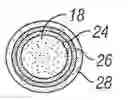
FIG. 3 is an end sectional view of one embodiment of an environmental barrier fiber coating; and
FIG. 4 is an end sectional view of an environmental barrier multi-layer fiber coating.
DETAILED DESCRIPTION
The present disclosure includes a fiber coating that incorporates at least one layer prior to the fiber interface coating to improve chemical compatibility of the fiber and interface coating. Illustratively, the first coating is bonded to the fiber and is followed by an interface coating and, optionally, additional coatings. The coating may be a slightly altered composition of the fiber or a totally different composition. The coating acts as a barrier to oxygen and steam when the composite is cracked or the fiber is exposed on the edges or the surface. The coating may inherently be resistant to high temperature oxygen, steam and other fiber damaging compounds or it may react with the environment to create a stable, protective compound.
The coating may also “heal” surface flaws on the fiber and increase the effective fiber volume by increasing the diameter of the fiber. The coating may be uniform in composition and structure, graded intentionally to produce a better match between the fiber and the interface coating or consist of multiple thin layers prior to the interface coating. The coating may also be followed by other functional coatings prior to the interface coating to improve structural performance or improve compatibility with the interface coating, or interface coating deposition process.
An oxidation resistant coating may range from about 0.01 μm to about 2 μm. The coating may be deposited by chemical vapor deposition, physical vapor deposition (including directed vapor deposition) or other suitable means. The fiber in the composite could be carbon, ceramic (silicon carbide, alumina, aluminosilicate, SiNC, etc.) or glass. The coating (or coating layers) may include elemental, binary or ternary compounds of the following elements: carbon, nitrogen, oxygen, silicon, germanium, boron, aluminum, titanium, zirconium, hafnium, vanadium, niobium, tantalum, chromium, molybdenum, nickel, scandium, yttrium, ytterbium and rhenium.
Illustratively, it may be desirable to tailor the coating composition and/or structure to produce a slightly lower modulus than the fiber to reduce stress in the coating layer and delay surface cracking.
Prior to the structural coating, the fiber may be cleaned to remove polymer fiber coatings (sizing). This may be done at any time prior to the coating using solvents, hot air, other hot gases or other means. The cleaning process may enhance the bonding between the fiber and oxidation barrier coating.
A flow diagram depicting a process of applying the environmental barrier coating on fiber 2 is shown in FIG. 1. Process 2 includes first providing a fiber material, textile, or preform for processing at 4. The material may illustratively be prepared by cleaning and heating it as indicated at 6 to remove sizing char, for example. The fiber may then be coated with its first environmental barrier coating at 8. Such a coating may be ytterbium doped silicon carbide. After coating 8, a fiber interface coating 10, such as a boron nitride coating may be applied over top. Next, structural and protective coatings 12 may be applied over the interface coating 10. Such an illustrative example includes a silicon carbide coating. Additional fiber layers may be applied at 14. Lastly, a CMC matrix 16 may be completed with slurry and melt infiltration.
An end cross-sectional view of a PRIOR ART fiber material 18 and coating is shown in FIG. 2. The prior art coating includes an interface coating 20 surrounding the periphery of fiber material 18. Structural layer 22 is then applied over interface coating 20.
In contrast, the end sectional view of fiber material 18 in FIG. 3 includes environmental barrier coating 24. This coating is applied according to step 8 from FIG. 1. An interface coating 26 as applied at 10 in FIG. 1 is then applied over environmental barrier coating 24. And lastly, structural layer 28 is applied over interface coating 26 as described with respect to step 12 in FIG. 1.
Advantages may include extending fiber life and, therefore, composite life; reducing or eliminating damage to fiber surfaces during interface coating deposition (e.g. incompatibility of carbon and boron nitride deposition); providing additional layers that provide an opportunity to manage thermal and mechanical incompatibilities between a fiber and subsequent coatings; increasing ultimate strength resulting from surface defect reduction; and increasing creep strength if the fiber coating has a higher creep capability than the fiber.
The view of FIG. 4 shows fiber 18 having a multi-layer environmental barrier coating 30 applied over top. The interface coating 26 is then applied over coating 30. And a structural layer or EBC multi-layer 32 is applied over interface coating 26.
The following are non-limiting illustrative embodiments of environmental barrier coatings:
Preform Based CMC
1. A Hi Nicalon preform is constructed at 36% fiber volume and assembled in tooling for Chemical Vapor Infiltration (CVI);
2. the preform is cleaned using air at about 600 degrees C. to remove sizing char from the fiber;
3. the fiber is coated with 1 μm of ytterbium doped silicon carbide (SiC) by CVI;
4. a boron nitride (BN) interface coating is applied at 0.5 μm;
5. a SiC coating of 2 μm is applied by CVI; and
6. the CMC matrix is completed with slurry and melt infiltration.
The composite demonstrates improved life after matrix cracking as a result of the well-bonded, environmentally resistant layer on the fiber.
CMC Made with Pre-coated Fiber
1. A Hi Nicalon S fiber is coated in tow form with 1 μm of yttrium doped SiC by a chemical vapor deposition (CVD) process;
2. a subsequent CVD process applies a silicon doped boron nitride coating of 0.3 μm;
3. the fiber in the tow is coated with silicon nitride of 0.3 um and SiC of 0.1 μm;
4. the tow is processed with a SiC slurry and binders to form a uni-directional tape;
5. the tapes are laminated and shaped then cured; and
6. the resulting body is infiltrated with Si to complete the CMC component.
The composite demonstrates improved life after matrix cracking as a result of the well-bonded, environmentally resistant layer on the fiber.
Preform Based CMC II
1. A T-300 carbon fiber preform is constructed at 36% fiber volume and assembled in tooling for CVI;
2. the fiber is coated with alternating layers of SiC (four layers) and boron carbide (three layers) nominally 0.1 μm each for a total of 0.7 μm;
3. a silicon doped BN interface coating is applied at 0.5 μm; and
4. matrix densification continues by CVI with alternating layers of SiC and boron carbide nominally 0.1 μm thick until full density is achieved.
The composite demonstrates improved life after matrix cracking and interface coating cracking as a result of the well-bonded, environmentally resistant layer on the fiber. It may be beneficial to use both a coating to protect the fiber that is well bonded (this disclosure) in conjunction with a fiber interface coating that demonstrates improved environmental resistance.
While the disclosure has been described in this detailed description, the same is to be considered as exemplary and not restrictive in character, it being understood that only illustrative embodiments thereof have been described and that changes and modifications that come within the spirit of the disclosure are desired to be protected.
Claims
What is claimed is:1. Fiber having an environmental barrier coating, comprising:
a Hi Nicalon preform assembled in a tooling for chemical vapor infiltration and cleaned to remove sizing char from fibers of the Hi Nicalon preform;
a ytterbium doped silicon carbide coat located over the Hi Nicalon preform;
a boron nitride interface coat applied over the ytterbium doped silicon carbide coat; and
a silicon carbide coat applied over the boron nitride interface coat.
2. The fiber having the environmental barrier coating of claim 1, wherein the boron nitride interface coat has a thickness of about 0.5 μm.
3. The fiber having the environmental barrier coating of claim 1, wherein the silicon carbide coat has a thickness of about 2 μm.
4. The fiber having the environmental barrier coating of claim 1, wherein the Hi Nicalon preform includes about 36% fiber volume and cleaned using air at about 600 degrees C.
5. The fiber having the environmental barrier coating of claim 1, wherein the preform is completed with slurry and melt infiltration.
6. The fiber having the environmental barrier coating of claim 1, wherein the ytterbium doped silicon carbide coat is applied by chemical vapor infiltration.
7. The fiber having the environmental barrier coating of claim 1, wherein the silicon carbide coat is applied by chemical vapor infiltration.
8. Fiber having an environmental barrier coating, comprising:
a Hi Nicalon S fiber;
wherein the Hi Nicalon S fiber is coated in tow form with yttrium doped silicon carbide; and
a silicon doped boron nitride coat applied over the yttrium doped silicon carbide.
9. The fiber having the environmental barrier coating of claim 8, wherein the Hi Nicalon S fiber is coated with about 1 μm of the yttrium doped silicon carbide.
10. The fiber having the environmental barrier coating of claim 8, wherein the silicon doped boron nitride coat has a thickness of about 0.3 μm.
11. The fiber having the environmental barrier coating of claim 8, wherein the fiber is coated with silicon nitride of about 0.3 μm and silicon carbide of about 0.1 μm.
12. The fiber having the environmental barrier coating of claim 8, wherein the tow is processed with a silicon carbide slurry and binders to form a uni-directional tape.
13. The fiber having the environmental barrier coating of claim 12, wherein the uni-directional tape is laminated and shaped, then cured.
14. The fiber having the environmental barrier coating of claim 8, wherein a resulting body is infiltrated with silicon to complete a CMC component.
15. The fiber having the environmental barrier coating of claim 8, wherein the yttrium doped silicon carbide is applied by a chemical vapor deposition process.
16. The fiber having the environmental barrier fiber coating of claim 8, wherein the silicon doped boron nitride coat is applied by the chemical vapor deposition process.
17. Fiber having an environmental barrier coating, comprising:
a T-300 carbon fiber preform assembled in tooling for chemical vapor infiltration;
alternating layers of silicon carbide and boron carbide are applied over the preform; and
a silicon doped boron nitride interface coat applied over the silicon carbide coat.
18. The fiber having the environmental barrier coating of claim 17, wherein the T-300 carbon fiber preform includes about 36% fiber volume, the silicon carbide coat and boron carbide coat each have a thickness of about 0.1 μm each for a total of 0.7 μm; and wherein the silicon doped boron nitride interface coat has a thickness of about 0.5 μm.
19. The fiber having the environmental barrier coating of claim 17, wherein the matrix densification continues by chemical vapor infiltration with alternating layers of silicon carbide and boron carbide at about a nominal thickness of about 0.1 μm until full density is achieved.
20. The fiber having the environmental barrier coating of claim 17, wherein the alternating layers of silicon carbide and boron carbide include four layers of silicon carbide and three layers of boron carbide.
Images & Drawings included:

Sources:
- United States Patent and Trademark Office - verify current appl. status at the USPTO↗
Similar patent applications:
Recent applications in this class:
- » 20240076245 2024-03-07
ADVANCED COATING CHEMISTRIES FOR CMCS - » 20220055956 2022-02-24
Machinable coatings fabricated by slurry methods for use on ceramic matrix composites - » 20220002209 2022-01-06
Protective Coating for Ceramic Matrix Composites - » 20190144346 2019-05-16
Compositions containing gallium and/or indium and methods of forming the same - » 20180079691 2018-03-22
SILICATE COATING FOR IMPROVED ACOUSTICAL PANEL PERFORMANCE AND METHODS OF MAKING SAME - » 20170341992 2017-11-30
Method for post-processing colored zirconium oxide ceramic - » 20170121232 2017-05-04
COATING INTERFACE - » 20170101348 2017-04-13
Articles with enhanced temperature capability - » 20150361003 2015-12-17
Carbon article having an improved primer coating and an improved anti-oxidant coating - » 20150008613 2015-01-08
Method of fabricating a part out of CMC material
Recent applications for this Assignee:
- » 20250179928 2025-06-05
TURBINE SHROUD ASSEMBLY WITH ANGLED COOLING HOLES - » 20250163821 2025-05-22
TRAVEL STOP FOR A TIP CLEARANCE CONTROL SYSTEM - » 20250163820 2025-05-22
ADJUSTABLE POSITION IMPELLER SHROUD FOR CENTRIFUGAL COMPRESSORS - » 20250074613 2025-03-06
Aircraft Override For An Energy Storage System - » 20250067223 2025-02-27
Uncommanded or Uncontrollable High Thrust Detection and Mitigation - » 20250067222 2025-02-27
Fuel unit health monitoring system - » 20250044168 2025-02-06
TEMPERATURE MEASUREMENT SYSTEM - » 20250044159 2025-02-06
TEMPERATURE MEASUREMENT SYSTEM - » 20250035045 2025-01-30
MOTOR AND MOTOR CONTROLLER THERMAL MANAGEMENT FEATURES - » 20240380295 2024-11-14
ELECTRICAL ENERGY SYSTEM HAVING ACTIVE SEGMENTS FOR VARIABLE VOLTAGE GENERATION