CERAMIC THERMAL BARRIER COATING SYSTEM COMPRISING A LAYER PROTECTING AGAINST CMAS
US20170073819A1
2017-03-16
15/125,202
2015-03-05
Abstract:
The application relates to a ceramic coating system for thermal insulation which contains further layers for protecting against the penetration of CMAS. The application of two additional layers which consist/comprise of platinum titanium oxide, magnesium aluminate or iron aluminate and an outer aluminum or aluminum oxide layer to a ceramic layer system, thereby sufficiently protecting same from CMAS attacks at higher temperatures is provided.
Inventors:
- ALEXANDER RÖTZHEIM 1 🇩🇪 MÜLHEIM/RUHR, Germany
- WERNER STAMM 4 🇩🇪 MÜLHEIM AN DER RUHR, Germany
Assignee:
- Siemens Aktiegesellschaft 18 🇩🇪 Munchen, Germany
Interested in similar patents?
Get notified when new applications in this technology area are published.
Classification:
C23C28/322 » CPC main
Coating for obtaining at least two superposed coatings either by methods not provided for in a single one of groups - or by combinations of methods provided for in subclasses and or; Coatings combining at least one metallic layer and at least one inorganic non-metallic layer including at least one pure metallic layer only coatings of metal elements only
C23C28/345 » CPC further
Coating for obtaining at least two superposed coatings either by methods not provided for in a single one of groups - or by combinations of methods provided for in subclasses and or; Coatings combining at least one metallic layer and at least one inorganic non-metallic layer including at least one inorganic non-metallic material layer, e.g. metal carbide, nitride, boride, silicide layer and their mixtures, enamels, phosphates and sulphates with at least one oxide layer
C23C28/3455 » CPC further
Coating for obtaining at least two superposed coatings either by methods not provided for in a single one of groups - or by combinations of methods provided for in subclasses and or; Coatings combining at least one metallic layer and at least one inorganic non-metallic layer including at least one inorganic non-metallic material layer, e.g. metal carbide, nitride, boride, silicide layer and their mixtures, enamels, phosphates and sulphates with at least one oxide layer with a refractory ceramic layer, e.g. refractory metal oxide, ZrO, rare earth oxides or a thermal barrier system comprising at least one refractory oxide layer
C04B37/026 » CPC further
Joining burned ceramic articles with other burned ceramic articles or other articles by heating with metallic articles characterised by the interlayer used consisting of metals or metal salts
C04B2237/123 » CPC further
Aspects relating to ceramic laminates or to joining of ceramic articles with other articles by heating; Aspects relating to interlayers, e.g. used to join ceramic articles with other articles by heating; Metallic interlayers based on iron group metals, e.g. steel
C04B2237/348 » CPC further
Aspects relating to ceramic laminates or to joining of ceramic articles with other articles by heating; Composition of layers of ceramic laminates or of ceramic or metallic articles to be joined by heating, e.g. Si substrates; Ceramic; Oxidic; Refractory metal oxides Zirconia, hafnia, zirconates or hafnates
C23C28/00 IPC
Coating for obtaining at least two superposed coatings either by methods not provided for in a single one of groups - or by combinations of methods provided for in subclasses and or
C04B37/02 IPC
Joining burned ceramic articles with other burned ceramic articles or other articles by heating with metallic articles
Description
CROSS-REFERENCE TO RELATED APPLICATIONS
This application claims priority to PCT Application No. PCT/EP2015/054601, having a filing date of Mar. 5, 2015, based off of DE Application No. 10 2014 205 491.5 having a filing date of Mar. 25, 2014, the entire contents of which are hereby incorporated by reference.
FIELD OF TECHNOLOGY
The following relates to a ceramic coating system for thermal insulation which contains further layers for protecting against the penetration of CMAS.
BACKGROUND
A hot gas path of a gas turbine contains components which are coated with thermal barrier coatings consisting/comprising of partially stabilized zirconium and/or gadolinium zirconate in order to lower the metal temperature. The present-day surface temperatures of the ceramics in combination with impurities such as CMAS lead to chemical attacks on the ceramics and also to the penetration of liquid phases into the pores of the ceramic. At the same time, the abrasion of the compressor abradables of an upstream compressor leads to unique nickel coatings on the layers. This too leads to instances of TBC spalling as a result of reduced thermal expansions. At present, there is no system protecting against this multiple attack.
SUMMARY
An aspect relates to a coating system which solves the aforementioned problem.
BRIEF DESCRIPTION
Some of the embodiments will be described in detail, with reference to the following figures, wherein like designations denote like members, wherein:
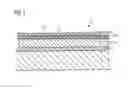
FIG. 1 shows a coating system, and
FIG. 2 shows a list of superalloys.
DETAILED DESCRIPTION
The figure and the description represent only exemplary embodiments of the invention.
A platinum layer is preferably applied to a thermal barrier layer 10 as a lower erosion-resistant layer 13.
This lower erosion-resistant layer 13 is to prevent the penetration of the CMAS (CMAF) layer.
The coating can be effected by vapor deposition, sputtering. This lower erosion-resistant layer 13 can have a layer thickness of between several um and 100 μm.
Furthermore, a layer consisting of aluminum particles, preferably with a thickness of 50 μm to 300 μm, is applied to said lower erosion-resistant layer 13.
Hollow balls of aluminum oxide are formed by a preferable heat treatment of the aluminum layer. At the same time, the balls bind to the platinum through the formation of platinum aluminide. The platinum has a coefficient of expansion adapted to the thermal barrier layer.
Applied aluminum oxide has a relatively low coefficient of expansion, and, in combination with the nickel (originates from the compressor abrasion), the aluminum oxide spalls off. The remaining platinum layer then affords protection against the penetration of liquid deposits. The platinum layer can preferably also be replaced by titanium oxide or Mg2AlO4 and/or Fe2AlO4.
The inventive step is based on the application of the multiple layer, which affords protection both against nickel deposits and against CMAS. Since the nickel deposits arise only briefly and at the start of the operating time, what is formed is a layer which acts briefly here and has a layer with long-term action against CMAS or similar attacks.
FIG. 1 shows a coating system 1 according to embodiments of the invention comprising a substrate 4.
Particularly in the case of turbine components, the substrate 4 is a nickel-based or cobalt-based superalloy, in particular as shown in FIG. 2.
Various metallic bonding layers 7 may be present on the substrate 4.
Here, what is involved is preferably an overlay layer consisting of an alloy of the MCrAlX type, where X is optional and in particular is yttrium (Y), rhenium (Re) and/or tantalum (Ta) and/or iron (Fe).
An oxide layer has already grown (TGO aluminum oxide, not shown) on the metallic bonding layer 7, and a further ceramic thermal barrier layer material 10 is present on said oxide layer.
This ceramic thermal barrier layer material 10 can be a zirconium oxide layer with various stabilizers and/or a pyrochlore structure or else a two-ply or multi-ply TBC, in particular an inner zirconium oxide layer with an outer pyrochlore structural layer, in particular gadolinium zirconate (GZO).
Such coating systems are known and, according to embodiments of the invention, additionally comprise a lower erosion-resistant layer 13 consisting of platinum, titanium oxide, magnesium aluminate (Mg2AlO4) or iron aluminate (Fe2AlO4).
Mixtures thereof can be used.
The outermost erosion-resistant layer 16 comprises aluminum or aluminum oxide.
Mixtures thereof can be used.
Examples of a material sequence of the system:
- Substrate -MCrAlX—ZrO2_Mg2AlO4_Al
- Substrate -MCrAlX—ZrO2_Fe2AlO4_Al
- Substrate -MCrAlX—ZrO2—Pt—Al
- Substrate -MCrAlX—ZrO2_GZO—Mg2AlO4_Al
- Substrate -MCrAlX—ZrO2_GZO—Fe2AlO4_Al
- Substrate -MCrAlX—ZrO2-GZO—Pt_Al
- Substrate -MCrAlX—ZrO2—Mg2AlO4_Al2O3
- Substrate -MCrAlX—ZrO2_Fe2AlO4—Al2O3
- Substrate -MCrAlX—ZrO2_Pt_Al2O3
- Substrate -MCrAlX—ZrO2_GZO—Mg2AlO4_Al2O3
- Substrate -MCrAlX—ZrO2_GZO—Fe2AlO4—Al2O3
- Substrate -MCrAlX—ZrO2_GZO—Pt—Al2O3
Although the present invention has been disclosed in the form of preferred embodiments and variations thereon, it will be understood that numerous additional modifications and variations could be made thereto without departing from the scope of the invention.
For the sake of clarity, it is to be understood that the use of ‘a’ or ‘an’ throughout this application does not exclude a plurality, and ‘comprising’ does not exclude other steps or elements.
Claims
1. A ceramic thermal barrier coating system, which comprises at least: a substrate,
of a nickel-based or cobalt-based superalloy,
a metallic adhesion promoter layer,
of the MCrAlX type, where X=Y, Re, Ta, or Fe,
a ceramic thermal barrier layer,
a two-ply erosion-resistant layer,
which is applied directly to the ceramic thermal barrier layer, and
in which a material selected from the group consisting of platinum, titanium oxide, magnesium aluminate and iron aluminate is selected for the lower erosion-resistant layer, and
wherein at least one of aluminum and aluminum oxide is applied directly to the lower erosion-resistant layer as the outermost erosion-resistant layer.
2. The coating system as claimed in claim 1, in which the metallic adhesion promoter layer represents an overlay layer of the composition MCrAlX, including NiCoCrAlY, NiCoCrAlTa, NiCoCrAlYTa, NiCoCrAlYRe or NiCoCrAlRe.
3. The coating system as claimed in claim 1, in which the ceramic thermal barrier layer has the greatest layer thickness of the four layers is 10% thicker.
4. The coating system as claimed in claim 1, in which the ceramic thermal barrier layer comprises a single-ply zirconium oxide layer.
5. The coating system as claimed in claim 1, in which the ceramic thermal barrier layer represents a two-ply ceramic layer comprising
a lower zirconium oxide layer
and an outer pyrochlore layer,
having a gadolinium zirconate layer.
6. The coating system as claimed in claim 1, in which the lower erosion-resistant layer has a thickness of 2 μm to 200 μm.
7. The coating system as claimed in claim 1, in which the outermost erosion-resistant layer has a thickness of 50 μm to 300 μm.
8. The coating system as claimed in claim 1, in which the outer erosion-resistant layer comprises aluminum and has hollow balls as a result of a heat treatment.
Images & Drawings included:


Sources:
- United States Patent and Trademark Office - verify current appl. status at the USPTO↗
Recent applications in this class:
- » 20240254631 2024-08-01
METHOD FOR COATING ZINC DIE-CAST PARTS, MULTI-LAYERED COATING FOR THE PROTECTION OF ZINC DIE-CAST PARTS, AND COATED ZINC DIE-CAST PART - » 20230399752 2023-12-14
Commercially Viable Biosensor Manufacture - » 20230349050 2023-11-02
METHODS OF FABRICATING SAMPLE WAFERS - » 20230002911 2023-01-05
Bi-layer protective coatings for metal components - » 20220235468 2022-07-28
Laminate - » 20220228268 2022-07-21
Copper foil with anti-wrinkle property, electrode comprising same, secondary battery comprising same, and manufacturing method therefor - » 20190301025 2019-10-03
Fabrication of metallic optical metasurfaces - » 20120276413 2012-11-01
PROCESS FOR SURFACE TREATING IRON-BASED ALLOY AND ARTICLE - » 20120219819 2012-08-30
Housing and method for making the same - » 20120164471 2012-06-28
Housing and method for making the same
Recent applications for this Assignee:
- » 20190107146 2019-04-11
Bearing arrangement - » 20170314399 2017-11-02
LONG, CONTINUOUS ENGRAVING ALONG A ROW OF COOLING HOLES - » 20170298782 2017-10-19
System and method for increasing the responsiveness of a duct fired, combined cycle, power generation plant - » 20170180354 2017-06-22
Use of certificates using a positive list - » 20160313381 2016-10-27
Method for determining the supply voltages of a load, and load - » 20160311449 2016-10-27
Rail vehicle - » 20160281248 2016-09-29
Electrolysis stack and electrolyzer - » 20130283583 2013-10-31
Turbine extension nut support tool - » 20130241575 2013-09-19
Electric machine - » 20120291438 2012-11-22
Burner system and method for damping such a burner system