Method for detecting particulate radiation
US20170134674A1
2017-05-11
15/218,465
2016-07-25
✅ Patent granted
US 10,122,946 B2
2018-11-06
-
-
Edwin Gunberg
Scheinberg & Associates, P.C. | Michael O. Scheinberg
2036-07-25
Abstract:
When detecting particulate radiation, such as electrons, with a pixelated detector, a cloud of electron/hole pairs is formed in the detector. Using the signal caused by this cloud of electron/hole pairs a position of the impact is estimated. When the size of the cloud is comparable to the pixel size, or much smaller, the estimated position shows a strong bias to the center of the pixel and the corners, as well to the middle of the borders. This hinders forming an image with super-resolution. By shifting the position or by attributing the electron to several sub-pixels this bias can be countered, resulting in a more truthful representation.
Inventors:
- Bart Jozef Janssen 22 🇳🇱 Eindhoven, Netherlands
- Erik Michiel Franken 6 🇳🇱 Nuenen, Netherlands
- Maarten Kuijper 12 🇳🇱 Helmond, Netherlands
- Lingbo Yu 4 🇳🇱 Eindhoven, Netherlands
Assignee:
- FEI Company 857 🇺🇸 Hillsboro, OR, United States
Applicant:
Interested in similar patents?
Get notified when new applications in this technology area are published.
Classification:
G06T3/40 IPC
Geometric image transformation in the plane of the image Scaling the whole image or part thereof
G06T3/4069 » CPC further
Geometric image transformation in the plane of the image; Scaling the whole image or part thereof; Super resolution, i.e. output image resolution higher than sensor resolution by subpixel displacement
H01L27/14659 » CPC further
Devices consisting of a plurality of semiconductor or other solid-state components formed in or on a common substrate including semiconductor components sensitive to infra-red radiation, light, electromagnetic radiation of shorter wavelength or corpuscular radiation and specially adapted either for the conversion of the energy of such radiation into electrical energy or for the control of electrical energy by such radiation; Devices controlled by radiation; Imager structures; Photodiode arrays; MOS imagers; X-ray, gamma-ray or corpuscular radiation imagers Direct radiation imagers structures
H04N5/349 » CPC main
Details of television systems; Transforming light or analogous information into electric information using solid-state image sensors [SSIS]; Extracting pixel data from an image sensor by controlling scanning circuits, e.g. by modifying the number of pixels having been sampled or to be sampled for increasing resolution by shifting the sensor relative to the scene, e.g. microscanning
H01L27/146 IPC
Devices consisting of a plurality of semiconductor or other solid-state components formed in or on a common substrate including semiconductor components sensitive to infra-red radiation, light, electromagnetic radiation of shorter wavelength or corpuscular radiation and specially adapted either for the conversion of the energy of such radiation into electrical energy or for the control of electrical energy by such radiation; Devices controlled by radiation Imager structures
H04N5/378 » CPC further
Details of television systems; Transforming light or analogous information into electric information using solid-state image sensors [SSIS]; SSIS architecture; Circuitry associated therewith Readout circuits, e.g. correlated double sampling [CDS] circuits, output amplifiers or A/D converters
G01T1/247 » CPC further
Measuring X-radiation, gamma radiation, corpuscular radiation, or cosmic radiation; Measuring radiation intensity with semiconductor detectors Detector read-out circuitry
G01T1/24 IPC
Measuring X-radiation, gamma radiation, corpuscular radiation, or cosmic radiation; Measuring radiation intensity with semiconductor detectors
Description
The invention relates to a method of detecting particulate radiation using a semiconductor based pixelated detector, the detector pixels having a detector pixel size, the detector sensitive to the particulate radiation, each particle of the particulate radiation causing a multitude of electron/hole pairs in the semiconductor material of the detector, the multitude of electron/hole pairs having a centroid and a centroid extent, the extent of the centroid larger than the detector pixel size, the method comprising:
-
- A step of intercepting a particle of the particulate radiation,
- A step of estimating the number of electron/hole pairs for a number of adjacent detector pixels,
- A step of estimating the position of the centroid of the number of electron/hole pairs using the estimates of electron/hole pairs in adjacent detector pixels,
- A step of estimating the impact position of the particle using said estimated position of the centroid,
- A step of forming a pixelated image using the estimated position of a multitude of estimated impact positions, the pixelated image consisting of image pixels having an intensity,
Such a method is known inter alia from the “K2 Direct Detection Cameras”, commercially available from Gatan Inc., 5794 W. Las Positas Blvd., Pleasanton, Calif. 94588, USA.
The known method describes a pixelated detector intercepting radiation in the form of energetic electrons. Each intercepted electron causes a cloud of electron/hole pairs in the semiconductor material of the detector, thereby causing a signal in the detector pixel(s) where it is detected. As the diameter of the cloud (the centroid) is larger than the diameter of the detector pixels, one impinging electron causes a signal in multiple detector pixels. Using the signal of different detector pixels, an estimate of the impact position is determined with a resolution better than the detector's pixel size, in this case with a resolution of half a detector pixel diameter. This is used to form an image with super-resolution (as the resolution is better than the detector pixel size).
The method does not disclose how the impact position is determined or estimated. The method has not proven to give results for a resolution other than half a detector pixel or a (multiple of a) whole detector pixel.
It is noted that in many cases the extent of the centroid can be characterized with a FWHM (Full Width at Half Maximum) diameter.
The invention intends to provide a method with improved resolution and/or signal-to-noise (S/N) ratio compared to the known method.
To that end the method is characterized in that when estimating the impact position said estimate has a position dependent bias depending on the position within the detector pixel, and the contribution of each estimated impact position to corresponding image pixels is adjusted to counter the effect of said position dependent bias.
Inventors found that the response of a detector pixel to an impinging particle not only depends on different responses between pixels (inter-pixel differences or inter-pixel non-uniformity), but that when estimating the position within the detector pixel the probability that a particle is allocated to a position on the detector pixel (the position dependent bias) is non-uniform: said position dependent bias depends (reproducibly) on the position on the detector pixel and thus introduces an intra-pixel non-uniformity).
This can be explained as follows: assume that the extent of the cloud of electron/hole pairs is smaller than the pixel size, then if the adjacent detector pixels show no electron/hole pairs (all electron/hole pairs are generated within one detector pixel) the position will be allocated to the middle of the detector pixel, as there is no ground to allocate it to another position. Only when the particle hits near the border between two detector pixels (thus causing electron/hole pairs in two detector pixels) a position near the border can be determined, but where along the border is unknown: therefore the position of the particle will be associated to the middle of the border. Only near the corners a true positioning in two directions can be performed. For an extent much larger than the detector pixel size the effect (non-uniformity) smears out. For a centroid size (slightly) larger than the pixel size, the estimated positions cluster near the center of the detector pixel, to a lesser extent to the center of the borders, and to the corners.
Inventors experimented to find a solution to counter the effect of said position dependent bias. The most obvious solution coming to mind of the skilled artisan is to attach a lower probability to the events near the peaks. In an image this is realized by scaling the intensity of image pixels corresponding to high probability locations. However, this has no physical basis: such scaling implies that only part of a particle detected at the position with a high probability is imaged. Also, part of the information is lost, resulting in an increase in noise. The method according to the invention, with or without improved resolution, can also be used for improved S/N ratio near the Nyquist frequency (the Nyquist frequency governed by the detector pixel size).
Inventors found that by adjusting the contribution of each impact position to corresponding image pixels to counter the effect of said position dependent bias, the effect of the position dependent bias can be countered.
The contribution of each estimated impact position to corresponding image pixels may comprise the adjustment of the estimated position within the detector pixel, the adjustment a function of the estimated position within the detector pixel. This may be achieved using a mathematical function, preferably a spline function, or using a look-up table (LUT). When using a LUT, the adjustment of the position may be based on one LUT value, or on an interpolation of more than one LUT values. This results in an adjusted estimated position.
Alternatively or additionally the contribution of each estimated impact position to corresponding image pixels may comprise adding intensity to more than one image pixels, the adding a function of the estimated position (or adjusted estimated position) within the detector pixel.
The adding of intensity to more than one image pixel may be derived using a LUT, the LUT values a function of the estimated position within the pixel. The LUT may show a large number of values, each value corresponding to a rounded estimated position. This introduces a (small) rounding in positional information. Preferably the values are derived from an interpolation in the LUT, the interpolation based on the estimated position within the detector pixel. Less rounding is then to be expected. Alternatively the adding of intensity may be derived from a mathematical function, preferably a spline function.
In yet another embodiment the particulate radiation is particulate radiation from the group of electrons, ions, and X-rays
It is noted that the invention does not relate to PALM or dSTORM, as these super-resolution methods detect a multitude of particles captured by one pixel, each particle a photon of visible light, each photon causing (at most) one electron/hole pair, followed by determining the centroid of several adjacent pixels.
It is further noted that for Gatan's S2 camera the only known super-resolution setting is half the pixel size. Nowhere does Gatan disclose that the estimated position is shifted to counter clustering at half the pixel size. As the position dependent bias error introduces a non-uniformity at twice the pixel size, this is hard to detect when the super-resolution is set to exactly half the pixel size
The method is compatible with particulate radiation from the group of electron, ions, and X-ray photons.
In an embodiment the method further comprises obtaining a pixelated image using the estimates of the impact position of a multitude of particles, the estimate of the impact position of each particle contributing to the intensity of several image pixels.
It is noted that when attributing the detected particle to only one pixel of the image, Moiré effects and interferences can occur. Inventors found that to avoid this, the contribution of each particle is best spread out over several pixels.
It is noted that as long as the point spread function (PSF) used to spread out the contribution is known, this is a reversible method and the original position can be derived by deconvolution of the image intensities and the (known) PSF.
Preferably the several image pixels are adjacent image pixels, but the amount of pixels need not be limited to the image pixels directly bordering the pixel corresponding to the estimated impact position.
It is noted that although particularly useful for the method of the invention, also other methods for detecting particulate radiation may benefit from obtaining a pixelated image using the estimates of the impact position of a multitude of particles, the estimate of the impact position of each particle contributing to the intensity of several image pixels.
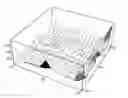
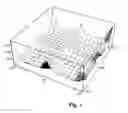
The invention is now elucidated using FIG. 1.
To that end FIG. 1 schematically shows the position dependent bias across the pixel. This concerns actual measurements where a large number of electrons impacted on a pixelated detector, the pixelated detector having a pixel size of 14×14 μm2, while the FWHM size of the cloud of electron/hole pairs is estimated to be 22 μm (1.6 times the pixel size). Note that the irradiation was uniform. Clearly the estimated position is not uniform, indicating that there is a position dependent bias. This position dependent bias can be countered by shifting of the position, using a vector field for each sub-pixel, or using a function where the adjusted position (u,v) is a function of the detected position (x,y), thus (u,v)=F(x,y), or it can be countered by spreading the contribution of one event (impact) over several image pixels or sub-pixels (representing the impact position as a ‘blob’ contributing to several detector sub-pixels, the blob a position dependent blob. It is noted that one sub-pixel may show a one-to-one relation to an image pixel, or several sub-pixels may contribute to one image pixel. In any event it is favorable to spread the information representing one estimated impact is spread over several image pixels. This spreading over several image pixels (further referred to as spreading) is in itself counter-intuitive, as it gives a result similar to blurring, but the spreading eliminates (or greatly reduces) Moiré-effects and interferences.
It is noted that when using appropriate spreading, and assuming the image is a sparse image (so: in most cases one or no impacts per image pixel) the estimated impact positions can be perfectly retrieved from the image, that is: no positional information is lost. In case of a non-sparse image the positional information of each individual estimated impact cannot be retrieved, but the information is incorporated in the image.
It is further noted that this spreading (effectively a spatial low-pass filter) may be followed by a high-pass filter to improve the image quality (crisp the image) with minimal loss of information.
The shifting and/or spreading should take place before attributing the information to an image pixel. When the spreading is done after combining detector images, information is lost. Shifting after combining is not possible. From this inventors concluded that any correction should be performed on the level where single impact events are handled, ideally by shifting the estimated impact position and spreading the information over several image pixels. A similar (although slightly inferior) result can be achieved when the impact is attributed to a group of detector sub-pixels (the sub-pixels used to construct an image) or a group of image pixels.
If the shift or the spreading is performed with a higher resolution than the image representation, the high-frequency information (for example above half of the Nyquist frequency) is better represented, resulting in an improved S/N ratio.
It is noted that all this does not take away the need to correct for before mentioned inter-pixel differences.
Summarizing, when detecting particulate radiation, such as electrons, with a pixelated detector, a cloud of electron/hole pairs is formed in the detector. Using the signal caused by this cloud of electron/hole pairs a position of the impact is estimated. Inventors found that, when the size of the cloud is comparable to the pixel size, or much smaller, the estimated position shows a strong bias to the center of the pixel and the corners, as well to the middle of the borders. This hinders forming an image with super-resolution. By shifting the position or by attributing the electron to several sub-pixels this bias can be countered, resulting in a more truthful representation. It is noted that shifting and/or spreading should take place before attributing the information to an image pixel, and before adding the events per sub-pixel.
When the spreading is done after combining detector images, information is lost. It is noted that shifting after combining detector images is not possible.
Claims
1. A method of detecting particulate radiation using a semiconductor based pixelated detector, the detector pixels having a detector pixel size, the detector sensitive to the particulate radiation, each particle of the particulate radiation causing a multitude of electron/hole pairs in the semiconductor material of the detector, the multitude of electron/hole pairs having a centroid and a centroid extent, the extent of the centroid extent larger than the detector pixel size, the method comprising:
intercepting a particle of the particulate radiation,
estimating the number of electron/hole pairs for a number of adjacent detector pixels,
estimating the position of the centroid of the number of electron/hole pairs using the estimates of electron/hole pairs in adjacent detector pixels,
estimating the impact position of the particle using said estimated position of the centroid, said estimated impact position having a position dependent bias depending on the position within the detector pixel,
forming a pixelated image using the estimated position of a multitude of estimated impact positions, the pixelated image consisting of image pixels having an intensity, and
adjusting the contribution of each estimated impact position to corresponding image pixels to counter the effect of said position dependent bias.
2. The method of claim 1 in which the adjustment of the contribution of each estimated impact position to corresponding image pixels comprises the adjustment of the estimated position, the adjustment a function of the estimated impact position relative to the detector pixel.
3. The method of claim 1 in which the adjustment of the contribution of each estimated impact position to corresponding image pixels comprises adding intensity to more than one image pixel.
4. The method of claim 2 in which the function is a function from the group of spline functions.
5. The method of any of claim 2 in which the function is stored in a look-up table (LUT).
6. The method of any of claim 1, in which the particulate radiation is particulate radiation from the group of electrons, ions, and X-rays.
7. The method of claim 2, in which the adjustment of the contribution of each estimated impact position to corresponding image pixels comprises adding intensity to more than one image pixel.
8. The method of claim 3, in which the function is a function from the group of spline functions.
9. The method of claim 3, in which the function is stored in a look-up table (LUT).
10. The method of claim 2, in which the particulate radiation is particulate radiation from the group of electrons, ions, and X-rays.
11. The method of claim 3, in which the particulate radiation is particulate radiation from the group of electrons, ions, and X-rays.
12. The method of claim 4, in which the particulate radiation is particulate radiation from the group of electrons, ions, and X-rays.
13. The method of claim 5, in which the particulate radiation is particulate radiation from the group of electrons, ions, and X-rays.
Images & Drawings included:
Sources:
- United States Patent and Trademark Office - verify current appl. status at the USPTO↗
Similar patent applications:
- » 20190075258
Method for detecting particulate radiation
Recent applications in this class:
- » 20210144316 2021-05-13
Device and method for forming higher resolution image of image target - » 20200358971 2020-11-12
Image sensor with pixels including photodiodes sharing floating diffusion region - » 20190174078 2019-06-06
Recovery of pixel resolution in scanning imaging - » 20190075258 2019-03-07
Method for detecting particulate radiation - » 20180324369 2018-11-08
Solid-state image pickup device, manufacturing method therefor, and electronic apparatus - » 20180255251 2018-09-06
Image pickup apparatus and image processing method - » 20180152648 2018-05-31
Image processing method and apparatus, and electronic device - » 20180041720 2018-02-08
Inspection apparatus, method for controlling inspection apparatus, and program - » 20180020170 2018-01-18
Method and a device for acquiring an image having two-dimensional spatial resolution and spectral resolution - » 20170324912 2017-11-09
Light field camera
Recent applications for this Assignee:
- » 20250273426 2025-08-28
SAMPLE TIP - » 20250231130 2025-07-17
IMPROVED SCANNING ELECTRON MICROSCOPE AND METHOD OF USING THE SAME - » 20250201512 2025-06-19
LIVE-ASSISTED IMAGE ACQUISITION METHOD AND SYSTEM WITH CHARGED PARTICLE MICROSCOPY - » 20250191873 2025-06-12
OBJECTIVE LENSES, CHARGED PARTICLE MICROSCOPES INCLUDING THE SAME, AND ASSOCIATED METHODS - » 20250182997 2025-06-05
TRANSMISSION ELECTRON MICROSCOPE WITH VARIABLE EFFECTIVE FOCAL LENGTH - » 20250174428 2025-05-29
SEGMENTED ENDPOINTING FOR SAMPLE PREPARATION - » 20250159789 2025-05-15
SYSTEM AND METHOD FOR SPECTROMETRY OF A SAMPLE IN A PLASMA - » 20250157780 2025-05-15
METHODS FOR DETERMINING THE VIRTUAL SOURCE LOCATION OF A LIQUID METAL ION SOURCE - » 20250157779 2025-05-15
MINIMIZATION OF ENERGY SPREAD IN FOCUSED ION BEAM (FIB) SYSTEMS - » 20250155387 2025-05-15
BIFOCAL ELECTRON MICROSCOPE