Device for removing heat
US20190341333A1
2019-11-07
16/465,512
2017-11-16
✅ Patent granted
US 10,665,527 B2
2020-05-26
WO; PCT/EP2017/079460; 20171116
WO; WO2018/099729; 20180607
Ahmed N Sefer
Muncy, Geissler, Olds & Lowe, PC
2037-11-16
Abstract:
Removing device including: a heat exchanger that is mounted on a platen so that the exchanger lies above and a distance away from an electronic component; a chassis that lies between the electronic component and the platen, and device for fastening the chassis to the platen or to the electronic board; a rigid heat sink that is mounted on the chassis in order to slide perpendicularly to the electronic board and that has a first end making contact with the component and a second end in abutment against a thermally conductive layer that is fastened to the platen in order to elastically return the rigid heat sink into abutment against the electronic component whatever the thickness of the electronic component. Electronic equipment having such a removing device.
Assignee:
- SAGEMCOM BROADBAND SAS 216 🇫🇷 Rueil Malmaison, France
Applicant:
Interested in similar patents?
Get notified when new applications in this technology area are published.
Classification:
H01L23/4338 » CPC main
Details of semiconductor or other solid state devices; Arrangements for cooling, heating, ventilating or temperature compensation ; Temperature sensing arrangements; Fillings or auxiliary members in containers or encapsulations selected or arranged to facilitate heating or cooling; Auxiliary members in containers characterised by their shape, e.g. pistons Pistons, e.g. spring-loaded members
H01L23/3672 » CPC further
Details of semiconductor or other solid state devices; Arrangements for cooling, heating, ventilating or temperature compensation ; Temperature sensing arrangements; Selection of materials, or shaping, to facilitate cooling or heating, e.g. heatsinks; Cooling facilitated by shape of device Foil-like cooling fins or heat sinks
H01L23/49855 » CPC further
Details of semiconductor or other solid state devices; Arrangements for conducting electric current to or from the solid state body in operation, e.g. leads, terminal arrangements ; Selection of materials therefor consisting of soldered constructions; Leads, on insulating substrates, for flat-cards, e.g. credit cards
H01L23/66 » CPC further
Details of semiconductor or other solid state devices; Structural electrical arrangements for semiconductor devices not otherwise provided for, e.g. in combination with batteries; Impedance arrangements High-frequency adaptations
H01L2223/6644 » CPC further
Details relating to semiconductor or other solid state devices covered by the group; Structural electrical arrangements for semiconductor devices not otherwise provided for; Impedance arrangements; High-frequency adaptations Packaging aspects of high-frequency amplifiers
H01L23/433 IPC
Details of semiconductor or other solid state devices; Arrangements for cooling, heating, ventilating or temperature compensation ; Temperature sensing arrangements; Fillings or auxiliary members in containers or encapsulations selected or arranged to facilitate heating or cooling Auxiliary members in containers characterised by their shape, e.g. pistons
F28F3/04 » CPC further
Plate-like or laminated elements; Assemblies of plate-like or laminated elements; Elements or assemblies thereof with means for increasing heat-transfer area, e.g. with fins, with recesses, with corrugations the means being integral with the element
H01L23/367 IPC
Details of semiconductor or other solid state devices; Arrangements for cooling, heating, ventilating or temperature compensation ; Temperature sensing arrangements; Selection of materials, or shaping, to facilitate cooling or heating, e.g. heatsinks Cooling facilitated by shape of device
H01L23/498 IPC
Details of semiconductor or other solid state devices; Arrangements for conducting electric current to or from the solid state body in operation, e.g. leads, terminal arrangements ; Selection of materials therefor consisting of soldered constructions Leads, on insulating substrates,
H01L23/552 » CPC further
Details of semiconductor or other solid state devices Protection against radiation, e.g. light or electromagnetic waves
Description
The invention relates to the field of devices for removing heat generated by electronic components.
BACKGROUND OF THE INVENTION
The efficiency of heat dissipation is of crucial importance in the design of numerous pieces of electronic equipment, in particular when the electronic equipment includes electronic components presenting high energy density, and the electronic equipment needs to satisfy requirements for reducing weight and size.
The power dissipated per unit area inside such a piece of electronic equipment can be very large and can lead to a rise in temperature that can in turn lead to failure of the electronic components of the electronic equipment.
With reference to FIG. 1, this problem is particularly difficult to handle when electronic components presenting high energy density are involved, such as radiofrequency power amplifiers 1, which components are positioned inside a shielding cover 2 in order to isolate the radiofrequency power amplifiers 1 electromagnetically.
In order to remove the heat produced by the amplifiers 1, it is known to position a thermal pad on the amplifiers 1. Nevertheless, such a thermal pad is not electromagnetically transparent because its relative permittivity εr is greater than 1. Furthermore, the relatively large size of the thermal pad, which covers an area considerably larger than the area of the amplifiers 1 in order to compensate for drifts in the positioning of the thermal pad, runs the risk of leading to coupling between an input and an output of the circuit constituted by the amplifiers 1, thereby reducing the efficiency of said circuit.
It is also known to cool the amplifiers 1 by making use solely of the heat-dissipating capability of the electronic card 3 on which the amplifiers 1 are mounted. Heat is then removed by the base of each amplifier 1 to the electronic card 3. Nevertheless, the heat removed from any one amplifier 1 then contributes to heating the other amplifiers 1.
With reference to FIG. 2, it is also known to mount a dissipater with fins 5 on the top wall of the shielding cover 2.
Finally, it is known to make use of a fan in order to cool the shielding cover 2 and the amplifiers 1 present inside the shielding cover 2.
OBJECT OF THE INVENTION
An object of the invention is to improve the removal of heat produced by an electronic component.
SUMMARY OF THE INVENTION
In order to achieve this object, there is provided a heat sink device for removing heat produced by at least one electronic component mounted on an electronic card, the heat sink device comprising:
-
- a heat dissipater mounted on a plate provided with means for fastening it on the electronic card so that the dissipater extends over and at a distance from the electronic component;
- a bridge extending between the electronic component and the plate, and fastener means for fastening the bridge to the plate or to the electronic card;
- a rigid thermal drain that is mounted on the bridge to slide perpendicularly to the electronic card and that has a first end in contact with the component and a second end pressing against an elastically deformable and thermally conductive layer fastened to the plate in order to urge the thermal drain elastically to bear against the component regardless of the thickness of the electronic component.
The drain makes it possible to remove the heat that is produced by the electronic component to the heat dissipater in efficient manner by performing localized heat extraction. The removal of heat is efficient regardless of the thickness of the electronic component and, in particular, it is thus robust in the face of variations of thicknesses due to the manufacturing tolerances of the electronic component. The removal of heat is efficient regardless of the distance between the electronic component and the heat dissipater.
A solution is thus obtained that is simple, inexpensive, and very efficient for dissipating the heat produced by the electronic component. It should be observed that in the situation shown in FIGS. 1 and 2, and when the heat sink device is for removing heat produced by a plurality of electronic components, the heat sink device does not generate any electromagnetic coupling or electromagnetic disturbance between the electronic components.
The invention also provides electronic equipment comprising an electronic card, an electronic component, and a heat sink device as described above.
The invention can be better understood in the light of the following description of particular, non-limiting embodiments of the invention.
BRIEF DESCRIPTION OF THE DRAWINGS
Reference is made to the accompanying drawings, in which:
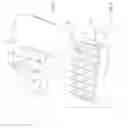
FIG. 1 shows an electronic card, electronic components, and a shielding cover;
FIG. 2 shows an electronic card, a shielding cover, and a heat dissipater mounted on the shielding cover;
FIGS. 3a and 3b comprise perspective views from above and below of a bridge and heat drains of a heat sink device in a first embodiment of the invention;
FIG. 4 is a view in section and in perspective showing the bridge and the drains, the bridge being mounted on an electronic card;
FIG. 5 is a view analogous to FIG. 4 also showing a shielding cover and a layer that is elastically deformable and thermally conductive;
FIG. 6 is a view analogous to FIG. 5 also showing a thermal dissipater on the shielding cover;
FIG. 7 shows temperature distribution on the electronic card in the situation shown in FIG. 2;
FIG. 8 shows temperature distribution on the electronic card in the situation shown in FIG. 6;
FIGS. 9a and 9b are figures analogous to FIGS. 3a and 3b for a heat sink device in a second embodiment of the invention;
FIG. 10 is a figure analogous to FIG. 6 for the heat sink device in the second embodiment of the invention.
DETAILED DESCRIPTION OF THE INVENTION
With reference to FIGS. 3 to 6, the heat sink device 10 in a first embodiment of the invention is intended in this example for removing the heat produced by three radiofrequency power amplifiers 11 mounted in alignment on an electronic card 12 of a piece of electronic equipment, and covered by a shielding cover 13. The shielding cover 13 isolates the three amplifiers 11 electromagnetically, i.e. it serves firstly to prevent the operation of the three amplifiers 11 being degraded by external electromagnetic disturbances, and secondly to prevent the operation of the three amplifiers 11 producing electromagnetic disturbances that might degrade the operation of other electronic components.
The shielding cover 13 has a top wall forming a plate 14 and side walls 15. The shielding cover 13 (and thus the plate 14) is fastened to the electronic card 12 by conventional fastener means that are not described herein.
The heat sink device 10 has a heat dissipater 16, a bridge 17, three rigid heat drains 18, and an elastically deformable and thermally conductive layer 19.
In this example, the heat dissipater 16 is a heat dissipater with fins, and it is mounted on the plate 14 (more precisely on a top face of the plate 14). The heat dissipater 16 thus extends above the amplifiers 11 and at a distance therefrom.
The bridge 17 extends between the amplifiers 11 and the plate 14.
The bridge 17 comprises a platform 20, legs 25 that raise the platform 20, and fastener means 21 for fastening the bridge 17 to the electronic card 12. The fastener means 21 may be means for fastening by staking/heading, snap-fastening, adhesive, or any other type of fastening.
In this example, the platform 20 extends parallel to the electronic card 12 and to the plate 14. Five cavities in alignment are made in the platform 20, comprising three sliding cavities 22 and two simple cavities 23. Each simple cavity 23 lies between two sliding cavities 22.
Each cavity 22, 23 opens out in a top opening in a top face of the platform 20 and in a bottom opening in a bottom face of the platform 20. The top opening of each slide cavity 22 is surrounded by an extra thickness of the platform 20 forming a collar 24.
Each drain 18 is in the form of a piston and has a first end and a second end. The first end is a head 27 of the piston, and the second end is an end 28 of a piston rod.
Each drain 18 is mounted on the platform 20 of the bridge 17 to slide perpendicularly to the electronic card 12 through a slide cavity 22 and the associated collar 24. The head 27 of the piston of the drain 18 extends beside a bottom face of the platform 20. The slide cavities 22 and the drains 18 are positioned in such a manner that when the heat sink device 10 is mounted on the electronic card 12 over the amplifiers 11, the head 27 of each drain 18 is positioned facing one of the amplifiers 11.
The elastically deformable layer 19 is fastened to the plate 14 (more precisely to a bottom face of the plate 14), and it extends over the platform 20 of the bridge 17 and the three drains 18.
When the heat sink device 10 is mounted on the electronic card 12 over the amplifiers 11, each drain 18 can move so as to slide in such a manner that the head 27 of the drain 18 comes into contact with the amplifier 11 that it is positioned to face. The elastically deformable layer 19 urges the drain 18 to bear resiliently against the amplifier 11, regardless of the thickness of the amplifier 11.
Thus, regardless of the thickness of the amplifier 11, and thus in particular regardless of any variations in thickness of the amplifier 11 due to manufacturing tolerances for the amplifier 11, the drain 18 is in contact both with the amplifier 11 and also with the elastically deformable layer 19, said elastically deformable layer 19 itself being in contact with the plate 14 on which the heat dissipater 16 is mounted. The heat produced by the amplifier 11 can thus be removed by conduction as far as the heat dissipater 16 and then dissipated by said heat dissipater 16.
The effectiveness of the heat sink device 10 in the first embodiment of the invention is illustrated by FIGS. 7 and 8.
The temperature distribution shown in FIG. 7, which was obtained by simulation, corresponds to the electronic card 12 on which the three amplifiers 11 are mounted, being covered by the shielding cover 13 and without the heat sink device 10 being used. Each amplifier 11 presents a square box-shape having a side of 3 millimeters (mm) and a thickness of 0.5 mm. The electronic card 12 is also of square box-shape having a side of 60 mm. The shielding cover 13 presents a rectangular box-shape having a length of 60 mm, a width of 20 mm, and a thickness of 5 mm. The heat dissipater 16 has ten fins, each having a height of 5 mm and a thickness of 3 mm at its base.
It should be observed that the mean temperature of each amplifier 11 is about 120° C. It should also be observed that the zone 30 situated around the amplifiers 11 presents a temperature of about 65° C.
The temperature distribution of FIG. 8 corresponds to a situation similar to that of FIG. 7, in which the heat sink device of the first embodiment 10 is used.
Each drain 18 in this example is made of thermal polyamide presenting vertical conductivity equal to 8 watts per meter per kelvin (W/m.K) and horizontal conductivity equal to 1 W/m.K. The elastically deformable layer 19 presents a thickness of 0.5 mm and conductivity of 2 W/m.K.
It should be observed that the mean temperature of each amplifier 11 is about 80° C., i.e. a drop of 40° C. It should also be observed that the zone 30 presents a temperature of about 55° C., i.e. a drop of about 10° C.
With reference to FIGS. 9 and 10, the heat sink device 40 in a second embodiment of the invention is similar to the heat sink device 10 in the first embodiment of the invention, except that in this embodiment the bridge 41 is fastened to the plate 14 (and more precisely to a bottom face of the plate 14) and not to the electronic card 12. The fastener means 42 of the bridge 41 are thus means for fastening the bridge 41 to the plate 14. It should also be observed that in this embodiment it is the bottom openings of the slide cavities that are surrounded by respective extra thicknesses of the platform to form collars 43.
Naturally, the invention is not limited to the embodiment described, but covers any variant coming within the ambit of the invention as defined by the claims.
Although it is stated that the heat sink devices described herein remove the heat produced by radiofrequency power amplifiers, the invention naturally applies to any type of electronic component.
Although heat sink devices described are suitable for removing the heat produced by three electronic components, a heat sink device of the invention can perfectly well be designed to remove the heat produced by some other number of electronic components (at least one component).
The plate, which is in this example is a top wall of a shielding cover, could perfectly well be a simple plate serving only to carry the heat dissipater.
Throughout the document, the term “electronic component” refers to any type of component suitable for mounting on an electronic card. By way of example, such a component may be a semiconductor-based electronic component such as an amplifier, a processor, a diode, a transistor, etc. Such a component could equally well be an active component or a passive or electrical component such as a resistor, a coil, a capacitor, a filter, etc.
Claims
1. A heat sink device for removing heat produced by at least one electronic component mounted on an electronic card, the heat sink device comprising:
a heat dissipater mounted on a plate provided with means for fastening it on the electronic card so that the heat dissipater extends over and at a distance from the electronic component;
a bridge extending between the electronic component and the plate, and fastener means for fastening the bridge to the plate or to the electronic card;
a rigid thermal drain that is mounted on the bridge to slide perpendicularly to the electronic card and that has a first end in contact with the electronic component and a second end pressing against an elastically deformable and thermally conductive layer fastened to the plate in order to urge the rigid thermal drain elastically to bear against the electronic component regardless of the thickness of the electronic component.
2. The heat sink device according to claim 1, wherein the rigid thermal drain is in the form of a piston having a rod and a head, the first end of the rigid thermal drain being a head of the piston and the second end being an end of the rod.
3. The heat sink device according to claim 1, wherein the rigid thermal drain is made of polyamide.
4. The heat sink device according to claim 1, wherein the plate is a top wall of a shielding cover.
5. The heat sink device according to claim 1, wherein the heat dissipater is a finned heat dissipater.
6. An electronic equipment including an electronic card, an electronic component, and a heat sink device according to claim 1.
7. The electronic equipment according to claim 6, wherein the electronic component is a radiofrequency power amplifier.
Images & Drawings included:



Sources:
- United States Patent and Trademark Office - verify current appl. status at the USPTO↗
Similar patent applications:
- » 20060140594
Heat-removing device and heat-removing method of vehicle interior part - » 20120275164
ILLUMINATING DEVICE AND HEAT REMOVAL DEVICE THEREOF - » 20200405086
Electric cooking appliance provided with a removable heating device - » 20080236794
Heat-removal device - » 10654781
Balance with a heat removing device - » 20140042148
Removeable heating device for a heating channel nozzle - » 20110001417
LED bulb with heat removal device - » 14733419
Pluggable module for heat removal device - » 20080002416
LED headlight for bicycle with heat removal device - » 20130345862
DEVICE FOR REMOVING HEAT FROM AN AUTOMATED HANDLING DEVICE, IN PARTICULAR A HANDLING ROBOT, AND USE OF THE DEVICE
Recent applications in this class:
- » 20220238416 2022-07-28
Distributing heatsink load across a processor module with separable input/output (I/O) connectors - » 20120241944 2012-09-27
Multichip electronic packages and methods of manufacture - » 20120218718 2012-08-30
Lower profile heat dissipating system embedded with springs - » 20120168123 2012-07-05
OVERHEAD-MOUNTED HEATSINK - » 20120039046 2012-02-16
Multichip electronic packages and methods of manufacture - » 20120000636 2012-01-05
Chip cooling device having wedge element - » 20110162828 2011-07-07
THERMAL PLUG FOR USE WITH A HEAT SINK AND METHOD OF ASSEMBLING SAME - » 20110079368 2011-04-07
FIXING MOUNT AND THERMAL MODULE THEREOF - » 20090244863 2009-10-01
Mounting device for mounting heat sink onto electronic component - » 20080239676 2008-10-02
THERMAL TRANSFER DEVICE
Recent applications for this Assignee:
- » 20240098421 2024-03-21
Heat sink vent - » 20240080222 2024-03-07
METHOD AND DEVICE FOR SELECTING A NODE IN A LOCAL AREA NETWORK - » 20240049158 2024-02-08
METHOD FOR MANAGING THE ASSOCIATION WITH A WIRELESS NETWORK OF STATIONS SUPPORTING VARIOUS INCREMENTAL VERSIONS OF A TECHNOLOGY - » 20240008105 2024-01-04
Managing method for managing the connection of a user equipment item to a distributed wireless communication network - » 20240007584 2024-01-04
METHOD FOR SELECTING PORTIONS OF IMAGES IN A VIDEO STREAM AND SYSTEM IMPLEMENTING THE METHOD - » 20230422203 2023-12-28
Construction of a UWB anchor repository - » 20230284268 2023-09-07
Method for selecting operation channels in a communication network and communication network implementing said method - » 20230199271 2023-06-22
Decoder box for reproducing an additional audio track - » 20230198829 2023-06-22
METHOD AND SYSTEM FOR DETECTING INCIDENTS IN AT LEAST ONE LOCAL AREA COMMUNICATION NETWORK - » 20230189014 2023-06-15
METHOD AND DEVICE FOR SELECTING A NODE IN A LOCAL AREA NETWORK