Chip adhesive
US20050110126A1
2005-05-26
10/720,524
2003-11-25
Abstract:
The claimed invention discloses a chip adhesive that is adhered to a stacked packaging structure between two adjacent chips. The chip adhesive includes a plurality of stuff particles to keep the chip adhesive with a predetermined thickness through suitably controlling type and quantity of the stuff particle. Two adjacent chips can be adhered together with a specific gap. The cost of dummy die can be saved and the space for wiring bonding can be retained. The chips of the stacked packaging structure, moreover, can be packaged with a faced-up type to reduce the cost of applying flip chip type or WBGA type.
Interested in similar patents?
Get notified when new applications in this technology area are published.
Classification:
H01L24/32 » CPC main
Arrangements for connecting or disconnecting semiconductor or solid-state bodies; Methods or apparatus related thereto; Means for bonding being attached to, or being formed on, the surface to be connected, e.g. chip-to-package, die-attach, "first-level" interconnects; Manufacturing methods related thereto; Layer connectors, e.g. plate connectors, solder or adhesive layers; Manufacturing methods related thereto; Structure, shape, material or disposition of the layer connectors after the connecting process of an individual layer connector
H01L24/83 » CPC further
Arrangements for connecting or disconnecting semiconductor or solid-state bodies; Methods or apparatus related thereto; Methods for connecting semiconductor or other solid state bodies using means for bonding being attached to, or being formed on, the surface to be connected using a layer connector
H01L25/0657 » CPC further
Assemblies consisting of a plurality of individual semiconductor or other solid state devices ; Multistep manufacturing processes thereof all the devices being of a type provided for in the same subgroup of groups - , e.g. assemblies of rectifier diodes the devices not having separate containers the devices being of a type provided for in group Stacked arrangements of devices
H01L23/3128 » CPC further
Details of semiconductor or other solid state devices; Encapsulations, e.g. encapsulating layers, coatings, e.g. for protection characterised by the arrangement or shape the device being completely enclosed a substrate forming part of the encapsulation the substrate having spherical bumps for external connection
H01L24/73 » CPC further
Arrangements for connecting or disconnecting semiconductor or solid-state bodies; Methods or apparatus related thereto Means for bonding being of different types provided for in two or more of groups , , , , , , ,
H01L2224/0401 » CPC further
Indexing scheme for arrangements for connecting or disconnecting semiconductor or solid-state bodies and methods related thereto as covered by; Means for bonding being attached to, or being formed on, the surface to be connected, e.g. chip-to-package, die-attach, "first-level" interconnects; Manufacturing methods related thereto; Bonding areas; Manufacturing methods related thereto; Structure, shape, material or disposition of the bonding areas prior to the connecting process Bonding areas specifically adapted for bump connectors, e.g. under bump metallisation [UBM]
H01L2224/2612 » CPC further
Indexing scheme for arrangements for connecting or disconnecting semiconductor or solid-state bodies and methods related thereto as covered by; Means for bonding being attached to, or being formed on, the surface to be connected, e.g. chip-to-package, die-attach, "first-level" interconnects; Manufacturing methods related thereto; Layer connectors, e.g. plate connectors, solder or adhesive layers; Manufacturing methods related thereto Auxiliary members for layer connectors, e.g. spacers
H01L2224/83136 » CPC further
Indexing scheme for arrangements for connecting or disconnecting semiconductor or solid-state bodies and methods related thereto as covered by; Methods for connecting semiconductor or other solid state bodies using means for bonding being attached to, or being formed on, the surface to be connected using a layer connector; Aligning involving guiding structures, e.g. spacers or supporting members
H01L2224/83194 » CPC further
Indexing scheme for arrangements for connecting or disconnecting semiconductor or solid-state bodies and methods related thereto as covered by; Methods for connecting semiconductor or other solid state bodies using means for bonding being attached to, or being formed on, the surface to be connected using a layer connector; Arrangement of the layer connectors prior to mounting Lateral distribution of the layer connectors
H01L2224/8385 » CPC further
Indexing scheme for arrangements for connecting or disconnecting semiconductor or solid-state bodies and methods related thereto as covered by; Methods for connecting semiconductor or other solid state bodies using means for bonding being attached to, or being formed on, the surface to be connected using a layer connector; Bonding techniques using a polymer adhesive, e.g. an adhesive based on silicone, epoxy, polyimide, polyester
H01L2225/0651 » CPC further
Details relating to assemblies covered by the group but not provided for in its subgroups; All the devices being of a type provided for in the same subgroup of groups - the devices not having separate containers the devices being of a type provided for in group; Stacked arrangements of devices Wire or wire-like electrical connections from device to substrate
H01L2225/06575 » CPC further
Details relating to assemblies covered by the group but not provided for in its subgroups; All the devices being of a type provided for in the same subgroup of groups - the devices not having separate containers the devices being of a type provided for in group; Stacked arrangements of devices Auxiliary carrier between devices, the carrier having no electrical connection structure
H01L2924/01033 » CPC further
Indexing scheme for arrangements or methods for connecting or disconnecting semiconductor or solid-state bodies as covered by; Chemical elements Arsenic [As]
H01L2924/01079 » CPC further
Indexing scheme for arrangements or methods for connecting or disconnecting semiconductor or solid-state bodies as covered by; Chemical elements Gold [Au]
H01L2924/07802 » CPC further
Indexing scheme for arrangements or methods for connecting or disconnecting semiconductor or solid-state bodies as covered by; Polymers; Adhesive characteristics other than chemical not being an ohmic electrical conductor
H01L2924/00014 » CPC further
Indexing scheme for arrangements or methods for connecting or disconnecting semiconductor or solid-state bodies as covered by; Technical content checked by a classifier the subject-matter covered by the group, the symbol of which is combined with the symbol of this group, being disclosed without further technical details
H01L2224/73215 » CPC further
Indexing scheme for arrangements for connecting or disconnecting semiconductor or solid-state bodies and methods related thereto as covered by; Means for bonding being of different types provided for in two or more of groups; Location after the connecting process on the same surface Layer and wire connectors
H01L2924/15311 » CPC further
Indexing scheme for arrangements or methods for connecting or disconnecting semiconductor or solid-state bodies as covered by; Details of package parts other than the semiconductor or other solid state devices to be connected; Die mounting substrate; Connection portion the connection portion being formed only on the surface of the substrate opposite to the die mounting surface being a ball array, e.g. BGA
H01L2224/73265 » CPC further
Indexing scheme for arrangements for connecting or disconnecting semiconductor or solid-state bodies and methods related thereto as covered by; Means for bonding being of different types provided for in two or more of groups; Location after the connecting process on different surfaces Layer and wire connectors
H01L2924/00 » CPC further
Indexing scheme for arrangements or methods for connecting or disconnecting semiconductor or solid-state bodies as covered by
H01L2924/181 » CPC further
Indexing scheme for arrangements or methods for connecting or disconnecting semiconductor or solid-state bodies as covered by; Details of package parts other than the semiconductor or other solid state devices to be connected Encapsulation
H01L2924/00012 » CPC further
Indexing scheme for arrangements or methods for connecting or disconnecting semiconductor or solid-state bodies as covered by; Technical content checked by a classifier Relevant to the scope of the group, the symbol of which is combined with the symbol of this group
Description
BACKGROUND OF INVENTION1. Field of the Invention
The present invention relates to a chip adhesive, and more particularly, to a chip adhesive applied to a stacked packaging structure.
2. Description of the Prior Art
The stacked packaging technology means stacking a plurality of chips, electrically connecting each chip, and packaging these chips to an IC. As shown in FIG. 1, when the size of the lower chip 10 is equal to or smaller than that of the upper chip 12, a gap between two chips 10, 12 is required to bond the lower wiring 14. A dummy die 16 is located between two chips 10, 12 and utilizing a adhesive 18 to adhere to the chips 10, 12 to keep the chips 10, 12 a enough distance for wiring.
Please refer to FIG. 2, which is a schematic diagram illustrating another packaging structure according to the prior art. The upper chip 12 retains facing up, and the lower chip 10 is packaged in a flip chip type. The adhesive 18 can adhere two chips 10, 12 without problem of insufficient space for wiring bonding. But the bonding processes of the lower chip 10 and the upper chip 12 are different and requiring different machines. This kind of packaging structure has complicated process and high cost.
Besides these two conventional packaging technologies, a window ball grid array (WBGA) technology is shown in FIG. 3. The upper chip 12 retains facing up, and the lower chip 10 is wire bonded through windows on the substrate 20. This technology does not need a dummy die to keep distance between two chips 10, 12, but the bonding processes of two chips are different and also requiring different machines. Thus, this kind of packaging structure also has complicated process and high cost.
SUMMARY OF INVENTIONIt is therefore a primary objective of the claimed invention to provide a chip adhesive, which can adhere to a stacked packaging structure between two adjacent chips and keep these two chips with a predetermined thickness to save the cost of dummy die.
It is therefore another objective of the claimed invention to provide a stacked packaging structure utilizing a chip adhesive, which can keep these two chips with a predetermined thickness to save the cost of dummy die.
According to the claimed invention, a chip adhesive is adhered to a stacked packaging structure between two adjacent chips. The chip adhesive includes a plurality of stuff particles to keep the chip adhesive with a predetermined thickness through suitably controlling type and quantity of the stuff particle. Two adjacent chips can be adhered together with a specific gap. The cost of dummy die can be saved and the space for wire bonding can be retained. In addition, the stacked packaging structure utilizing the chip adhesive is constructed on an packaging substrate, and the stacked packaging structure has a plurality of chips stacked from bottom to top. Two adjacent chips are adhered together with the claimed chip adhesive within a specific gap.
These and other objectives of the present invention will no doubt become obvious to those of ordinary skill in the art after reading the following detailed description of the preferred embodiment that is illustrated in the various figures and drawings.
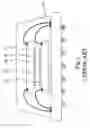
BRIEF DESCRIPTION OF DRAWINGSFIG. 1 to 3 are schematic diagrams showing stacked packaging structures according to the prior art.
FIG. 4 to 6 are schematic diagrams showing stacked packaging structures according to the present invention.
DETAILED DESCRIPTIONThe claimed invention discloses a chip adhesive and a stacked packaging structure applying it. The chip adhesive includes a plurality of stuff particles to keep the chip adhesive with a predetermined thickness and keep two adjacent chips with a specific gap. The thickness of the chip adhesive can be changed with stuffing different type or quantity of stuff particles to flexibly using the present invention.
Please refer to FIG. 4, which is a schematic diagram of an embodiment according to present invention. A stacked packaging structure is constructed on an packaging substrate 30, and the stacked packaging structure has a lower chip 32 and an upper chip 34 with same size. These two chips 32, 34 are adhered together with a chip adhesive 36, and the chip adhesive 36 includes a plurality of stuff particles 38 to keep the chip adhesive 36 with a predetermined thickness. The thickness of the chip adhesive 36 can be changed through suitably selecting types and quantities of the stuff particle 38. With the chip adhesive 36, two adjacent chips 32, 34 can be adhered together with a specific gap, and a sufficient bonding space for a lower wiring 40 can be retained to connect to a golden finger 42.
Please refer to FIG. 5, when the size of the lower chip 32 is smaller than that of the upper chip 34, the gap between two chips 32, 34 is absolutely required for the lower wiring 40. If a larger gap between two chips 32, 34 is needed for successfully bonding, the stuff particle 38 can be selected larger to enhance the thickness of the chip adhesive 36. The suitable gap can be retained with selecting the suitable size of the stuff particle 38.
In addition, as shown in FIG. 6, the claimed invention can be further applied to a stacked packaging structure with multi chips 44. The various stuff particles 46 can be selected for different needed gaps between each two chips 44, and keep the adjacent chips with different distances.
In contrast to the prior art, the present invention can adhere chips and retain a suitable gap simultaneously, so that the cost of dummy die can be saved and the various applied flexibilities of thickness between chips can be improved. Furthermore, the present invention can be applied to not only the situation that the size of the lower chip is equal to or smaller than that of the upper chip but also any requirements for retaining a specific distance between two adjacent chips.
Those skilled in the art will readily observe that numerous modifications and alterations of the device may be made while retaining the teachings of the invention. Accordingly, the above disclosure should be construed as limited only by the metes and bounds of the appended claims.
Claims
1. A chip adhesive adhered to a stacked packaging structure between two adjacent chips, and the chip adhesive includes a plurality of stuff particles to keep the chip adhesive with a predetermined thickness.
2. The chip adhesive of claim 1 can further control the thickness through suitably selecting a type of the stuff particle.
3. The chip adhesive of claim 1 can further control the thickness through suitably selecting a quantity of the stuff particle.
4. A stacked packaging structure utilizing a chip adhesive, comprising:
a stacked packaging structure constituted on an substrate, and the stacked packaging structure has a plurality of chips stacked from bottom to top; and
a chip adhesive adhered between these two adjacent chips, and the chip adhesive includes a plurality of stuff particles to keep the chips with a predetermined thickness.
5. The stacked packaging structure of claim 4 can further control the thickness through suitably selecting a type and a quantity of the stuff particle.
Images & Drawings included:



Sources:
- United States Patent and Trademark Office - verify current appl. status at the USPTO↗
Similar patent applications:
- » 20110130307
Microanalysis Chip Adhesive Sheet, Microanalysis Chip, And Manufacturing Method Thereof - » 20070215992
Chip package and wafer treating method for making adhesive chips - » 20120244347
METHOD FOR MANUFACTURING SEMICONDUCTOR CHIP, ADHESIVE FILM FOR SEMICONDUCTOR, AND COMPOSITE SHEET USING THE FILM - » 20100120229
Method for manufacturing semiconductor chip, adhesive film for semiconductor, and composite sheet using the film - » 20100207261
Chip attach adhesive to facilitate embedded chip build up and related systems and methods - » 20190319213
Display device including driving chip and adhesive member spaced apart from driving chip and method of fabricating display device - » 20100133703
Semiconductor chip laminate and adhesive composition for semiconductor chip lamination - » 20070082463
Semiconductor device with semiconductor chip and adhesive film and method for producing the same - » 20070187816
Semiconductor component with semiconductor chip and adhesive film, and method for its production - » 20070134846
Electronic member fabricating method and ic chip with adhesive material
Recent applications in this class:
- » 20250174593 2025-05-29
SEMICONDUCTOR DEVICE - » 20250167163 2025-05-22
SEMICONDUCTOR DEVICE - » 20250167162 2025-05-22
ELECTRONIC PACKAGE AND SUBSTRATE STRUCTURE THEREOF - » 20250167161 2025-05-22
INTEGRATED CIRCUIT PACKAGE AND METHOD - » 20250149495 2025-05-08
SEMICONDUCTOR PACKAGE AND METHODS - » 20250140733 2025-05-01
DIE BONDING STRUCTURE AND METHOD OF MANUFACTURING THE SAME - » 20250125300 2025-04-17
ENHANCED THERMAL CONTROL OF A HYBRID CHIP ASSEMBLY - » 20250125299 2025-04-17
SEMICONDUCTOR PACKAGE - » 20250112196 2025-04-03
SELECTIVE TRANSFER OF THERMAL MANAGEMENT DIES - » 20250105197 2025-03-27
SEMICONDUCTOR DEVICE AND METHOD FOR MANUFACTURING SEMICONDUCTOR DEVICE